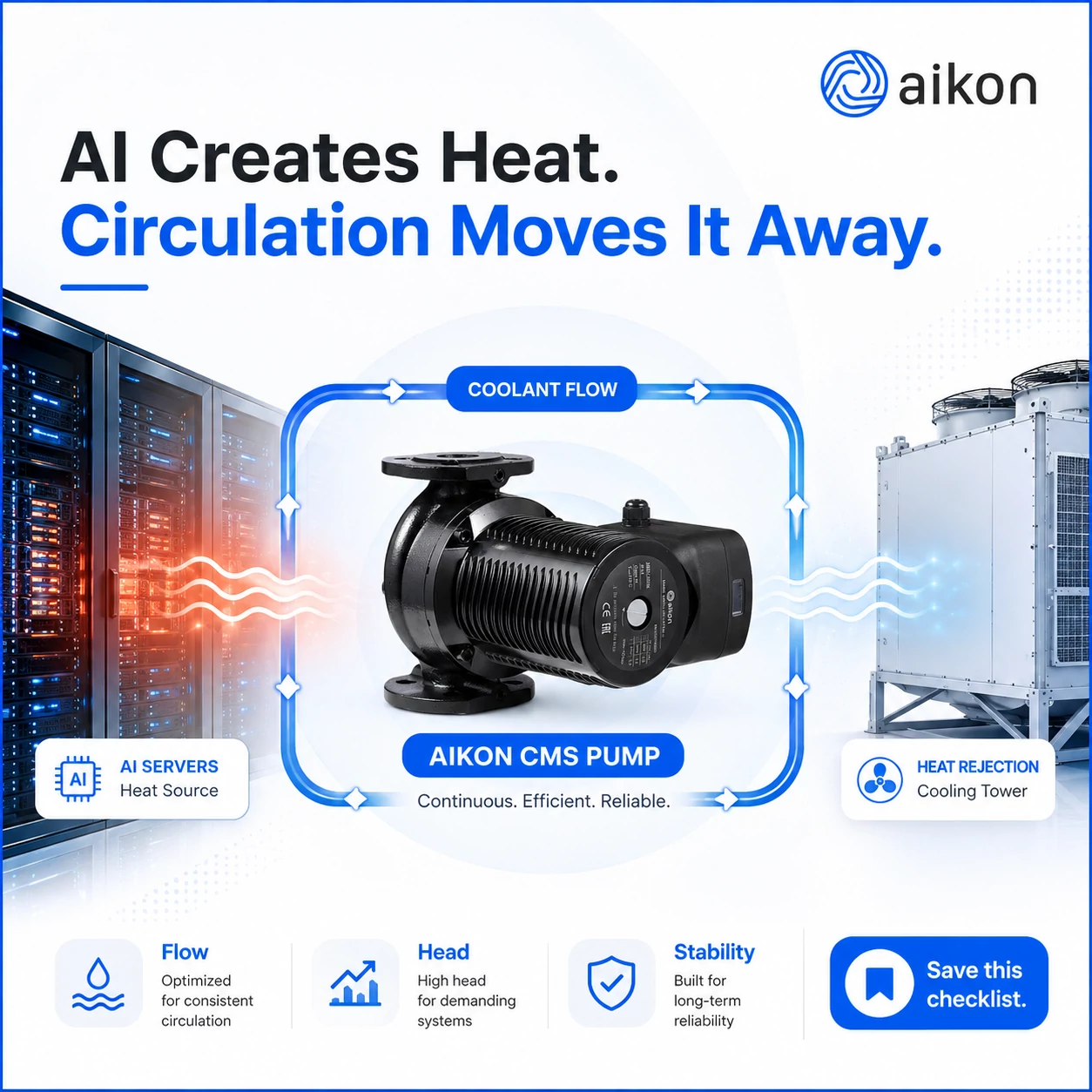
Learn why AI computing creates a heat-removal challenge, and how liquid-cooling circulation, flow, head, coolant type, pressure loss, leakage control, and pump selection affect thermal performance.
AI is usually discussed through chips, servers, models, and power.
But behind all of them is a very physical problem:
heat.
More computing power creates higher heat density. When heat becomes concentrated, cooling can no longer be treated as a background system. ASHRAE’s AI data center framework already places thermal efficiency at the center of AI data center planning, and recommends liquid-cooling technology systems for high-compute-density AI data centers.
The point is simple:
AI does not only need electricity.
It also needs a reliable way to move heat away.
Quick Answer
AI computing needs heat removal because high-density servers generate concentrated thermal loads. Liquid cooling helps move heat more efficiently, but liquid cooling still depends on one basic condition:
stable circulation.
If the pump, flow, head, pipe resistance, coolant condition, or leakage control is wrong, the cooling loop may not perform as expected.
Heat Does Not Disappear. It Has to Be Carried Away.

Cooling is not magic.
Heat must move from the equipment to another place.
In a liquid-cooling system, that usually means:
Heat source → cooling loop → circulation pump → pipe network → heat exchanger → heat rejection
If the circulation is unstable, the cooling capacity on paper may not become real heat-removal performance.
The result may be:
- unstable temperature control
- hot spots
- higher energy use
- pump noise or vibration
- leakage concerns
- more maintenance pressure
The International Energy Agency notes that cooling and environmental control can account for very different shares of data center electricity use, from about 7% in efficient hyperscale data centers to over 30% in less-efficient enterprise data centers.
So heat removal is not a side issue.
It is part of infrastructure performance.
Liquid Cooling Still Depends on Circulation

Liquid cooling is not only about cold plates, CDUs, heat exchangers, or cooling units.
The real question is:
Can the coolant keep moving steadily under real operating conditions?
Before choosing a pump for a liquid-cooling circulation system, engineers should check:

A cooling system is not finished when the cooling equipment is selected.
It is finished when the circulation loop can run steadily.
Where AIKON CMS Fits

AIKON CMS canned motor pumps can be applied in liquid-cooling circulation, HVAC cooling, equipment cooling, heating, hot water, and commercial circulation systems.
For liquid-cooling related projects, AIKON CMS focuses on practical circulation needs:
stable flow delivery
low-noise operation
compact installation
reduced leakage concern
flow and head matching
long-hour circulation support
The goal is not simply to make liquid move.
The goal is to keep circulation stable enough for the cooling system to remove heat continuously.
For AI-related cooling projects, pump selection should not be based only on connection size or price. It should be checked by flow, head, coolant type, temperature, system resistance, installation space, and operating hours.
Need a Quick Liquid-Cooling Circulation Check?
Before choosing a pump, send AIKON:
Application: liquid cooling / HVAC cooling / equipment cooling
Coolant or liquid type
Required flow and head
Liquid temperature
Pipe length or system layout
System resistance
Operating hours
Voltage and frequency
Installation space
Leakage and noise requirements
AIKON can help check whether the pump is too small, too large, mismatched with the duty point, or unsuitable for the liquid type and operating condition.
Suggested CTA:
DM us your flow and head—we’ll help check the liquid-cooling duty point.
FAQ
Why does AI computing need better heat removal?
Because higher computing density creates more concentrated heat. If heat cannot be moved away steadily, temperature control and equipment reliability may be affected.
Is liquid cooling only about cooling plates or CDUs?
No. Cooling plates, CDUs, and heat exchangers matter, but the circulation loop also matters. Flow, head, resistance, coolant type, and pump selection affect heat-removal performance.
Can AIKON CMS be used in liquid-cooling circulation?
Yes, AIKON CMS can be applied in liquid-cooling circulation projects, but the final model should be checked according to coolant type, temperature, flow, head, pressure loss, and operating conditions.
AI needs computing power.
Computing power creates heat.
Heat must be carried away by stable circulation.
Save this checklist for your next liquid-cooling or thermal management project.