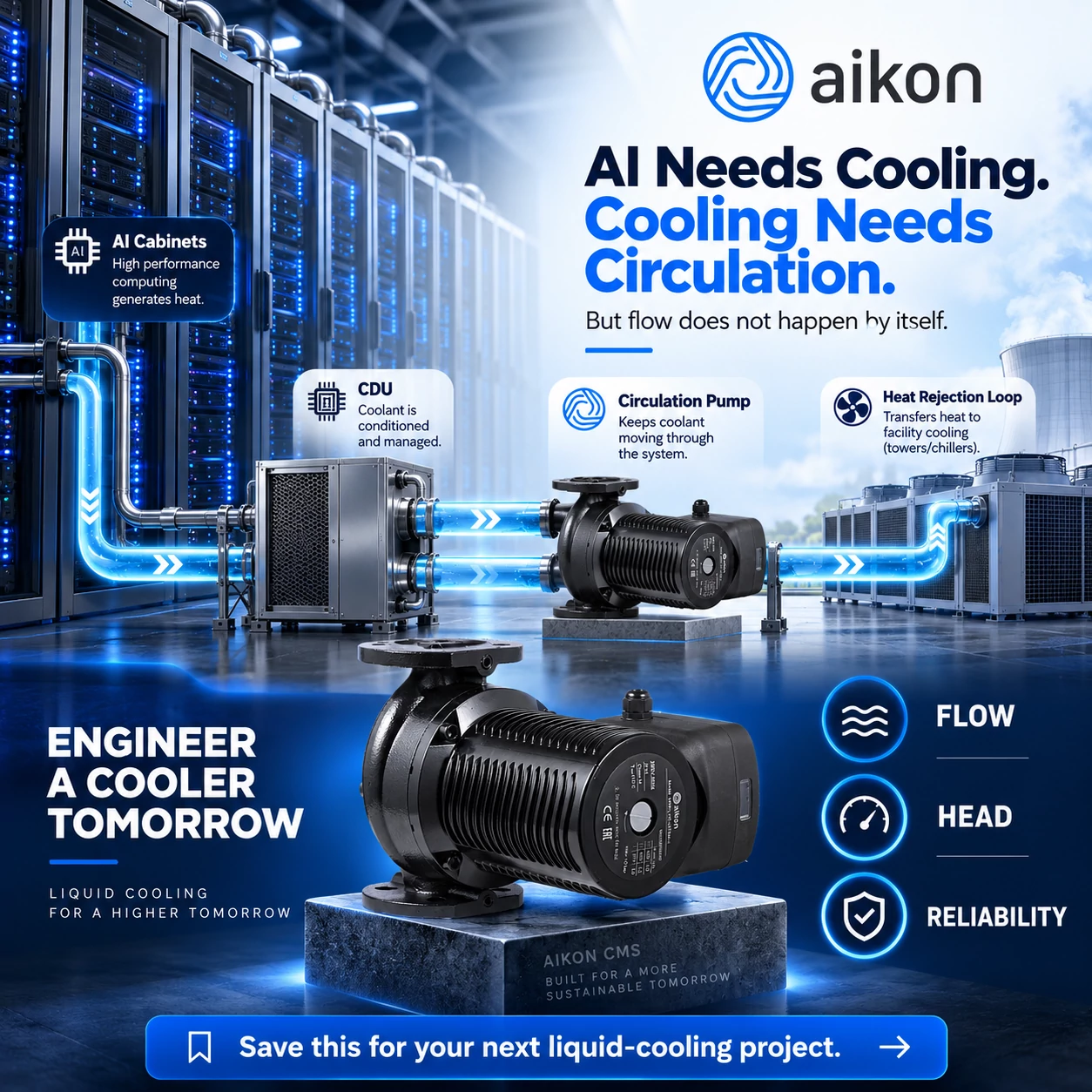
NVIDIA’s DSX Ready program puts CDUs among the first qualified AI-factory infrastructure categories. This article looks one layer deeper: what keeps coolant moving, and why pump duty point, coolant compatibility and leakage control matter.

On September 21, NVIDIA launched DSX Ready, a qualification program for infrastructure used in AI factories.
The first two categories were not chips or servers.
They were:
Battery Energy Storage Systems (BESS)
and
Cooling Distribution Units (CDUs).
NVIDIA says qualified CDUs are designed for high-density AI factories, and the first DSX Ready CDU solutions come from LG Electronics, LiquidStack and Vertiv.
That says something important about where AI infrastructure is heading:
Cooling is no longer a background utility. It is becoming part of the core AI-factory architecture.
And it raises a very practical question:
What keeps the coolant moving?
Quick Answer
A CDU does more than connect pipes.
NVIDIA describes CDUs as systems that circulate and manage coolant while maintaining the required temperature, pressure and flow.
But those conditions do not happen automatically.
Behind stable liquid cooling are basic hydraulic questions:
Is the flow sufficient?
Can the pump overcome system resistance?
Is the coolant compatible with the pump?
Can the circulation remain stable for long operating hours?
How tightly does the system need to control leakage risk?
Liquid cooling may be an AI-infrastructure topic.
But underneath it, the physics is still circulation.
A CDU Can Manage Flow. But Flow Still Has to Be Created.

The cooling loop can be simplified as:
Heat source → coolant → circulation pump → CDU / heat exchanger → heat rejection
If the coolant does not move at the required rate, heat cannot be carried away as designed.
Too little flow may reduce heat-transfer capability.
Too much flow can increase pressure loss, pump power, noise and system stress.
And if the pump cannot maintain the required head as resistance changes, the cooling system may have enough nominal capacity but still struggle to deliver it where needed.
This is why pump selection in a liquid-cooling loop should not start with connection size alone.
It should start with the duty point.
What Should Be Checked in a Liquid-Cooling Pump?
Before selecting the circulation pump, look at the complete loop:
What to CheckWhy It MattersRequired flowDetermines how much coolant moves through the loopRequired headMust overcome piping, valves and equipment resistanceCoolant typeAffects material and pump compatibilityLiquid temperatureAffects pump operating conditionsSystem resistanceDefines the real duty pointOperating hoursAI cooling can require long-duration circulationLeakage requirementTechnical spaces demand tighter risk control
NVIDIA also makes an important point about DSX Ready: qualification applies to a specific solution, and even a qualified CDU still has to be evaluated for its actual site, configuration and operating needs.
The same engineering logic applies inside the circulation loop.
Qualification does not replace system matching.
Where AIKON CMS Fits

AIKON CMS canned motor pumps can be applied in liquid-cooling and equipment-cooling circulation systems where the working conditions match the pump.
For these applications, the value is not simply:
“Can the pump move coolant?”
The more useful questions are:
Can it maintain the required flow and head?
Can it run steadily for long periods?
Is leakage risk a concern around technical equipment?
Is installation space limited?
This is where the CMS architecture becomes relevant.
AIKON CMS focuses on:
stable circulation
flow and head matching
reduced leakage concern
compact installation
low-noise operation
long-hour circulation support
The objective is not to label a pump as an “AI pump.”
It is to make sure the circulation component fits the real cooling loop.
Building a Liquid-Cooling Loop?
You do not need a complete data-center design package before starting a pump check.
Send AIKON:
coolant type
required flow
required head
liquid temperature
pipe length or system layout
estimated system resistance
operating hours
installation space
From there, the first question is simple:
Does the pump fit the cooling duty point?
DM us your coolant, flow and head—we’ll help check the circulation duty point.
FAQ
What is NVIDIA DSX Ready?
It is a qualification program for specific partner products and solutions that meet applicable NVIDIA DSX AI-factory requirements. The first categories are BESS and CDUs.
What does a CDU do?
NVIDIA describes a CDU as equipment that circulates and manages coolant for liquid-cooled computing systems while maintaining required temperature, pressure and flow.
Does DSX Ready mean every pump inside a qualified CDU is separately NVIDIA-qualified?
No. DSX Ready applies to the specific qualified product or solution. It should not be interpreted as a separate NVIDIA qualification of every component inside that system.
AI needs computing power.
Computing power needs cooling.
And liquid cooling needs stable circulation.
When cooling infrastructure becomes important enough to qualify, the components that keep coolant moving deserve just as much engineering attention.
Building a liquid-cooling loop?
DM us your coolant + flow + head. AIKON will help check whether the pump matches the real duty point before the system is built.