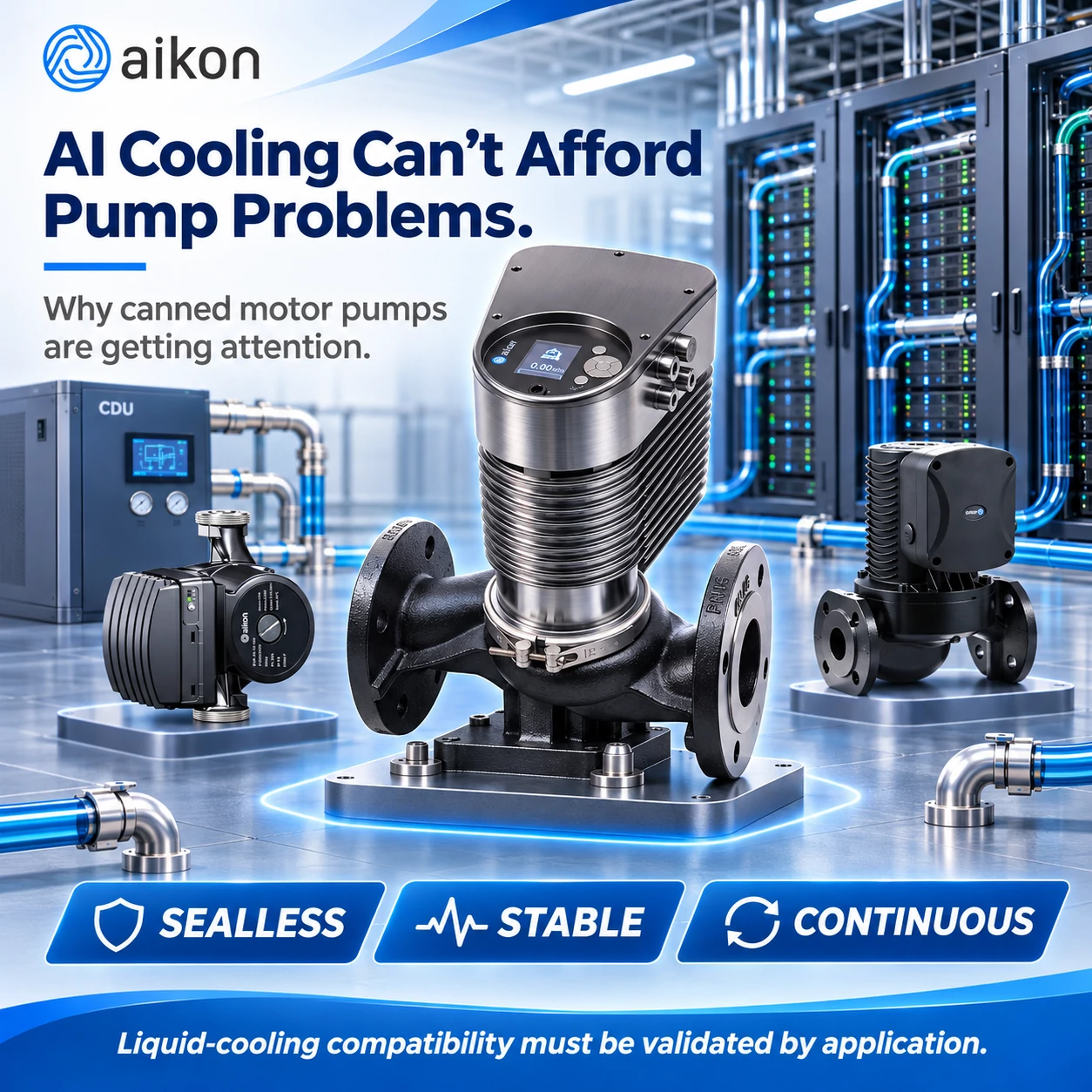
Canned motor pumps are beginning to move into direct liquid cooling, CDU and immersion-cooling applications. This article explains why sealless design, bearing conditions and hydraulic stability matter—and where AIKON CMS may fit after project-specific validation.
Canned motor pumps are no longer staying only in heating rooms and traditional circulation systems.
In October 2026, a Taiwan precision-pump manufacturer announced that its canned motor pump range for direct liquid cooling (DLC) and single-phase immersion cooling had moved into commercialization. Its immersion-cooling pump had entered mass production, while 1.0 kW and 3.0 kW canned motor pumps for In-Rack CDUs had completed development and entered sample validation.
That is an important signal.
At the same time, current Open Compute Project liquid-cooling designs already show N+1 sealless pump architectures in both large 2 MW CDUs and rack-level cooling units.
So the question is no longer:
Can canned motor / sealless pump technology enter AI liquid cooling?
A better question is:
Why is this pump architecture becoming relevant now?
Quick Answer
AI liquid cooling places strong demands on circulation:
continuous coolant flow
low leakage risk
stable pressure and head
long operating hours
coolant compatibility
high reliability
A canned motor pump removes the traditional dynamic shaft seal between motor and pump sections, which helps reduce one common leakage path.
But the value goes beyond sealing.
For long-hour liquid circulation, bearing conditions, hydraulic stability, internal wear and real duty-point matching also matter.
AI Cooling Makes Traditional Pump Problems Less Tolerable

Liquid cooling does not create completely new pump-engineering problems.
It makes familiar problems much harder to accept.
Leakage
In a heating plant room, a small leak is already a maintenance problem.
Around high-density AI equipment, leakage can trigger alarms, isolation and shutdown procedures. NVIDIA’s current liquid-cooling infrastructure includes automated leak detection and handling because coolant leakage can have serious rack-level consequences.
Loss of flow
Cooling depends on continuous circulation.
Open Compute Project guidance explicitly treats pump failure and loss of flow as reliability concerns, with redundancy expected to sustain operation.
Coolant compatibility
Modern liquid-cooling loops may use DI water, glycol mixtures or other application-specific fluids. OCP CDU specifications, for example, explicitly define coolant types such as DI water and PG25.
So pump selection cannot stop at:
“Does the flow and head look right?”
The actual coolant and operating environment matter too.
Why Canned Motor Pump Design Fits This Direction

A canned motor pump integrates the motor and pump structure without relying on a traditional dynamic mechanical shaft seal.
That immediately addresses one concern:
reducing a traditional leakage path.
But for AI cooling, long-term circulation also needs stable internal operation.
That is where several AIKON CMS-Ⅱ design features become relevant.
1. Medium-Lubricated Bearing Circulation
CMS-Ⅱ uses 4 × 1 mm internal circulation holes to guide working medium through the bearing region.
The design supports:
bearing lubrication
bearing cooling
air removal
axial-force balance
For continuous circulation, the value is not the holes themselves.
It is maintaining better operating conditions around the bearing system.
2. More Stable Rotor Support
CMS-Ⅱ uses enlarged radial-bearing support and an increased thrust-bearing working area.
Together with wear-resistant treatment at key shaft-bearing positions, this is intended to help control:
wear
rotor movement
vibration
long-term clearance change
Stable circulation requires a stable rotating assembly.
3. Internal Hydraulic Stability
CMS-Ⅱ uses a stainless-steel sealing ring seat and sealing wear ring to help control critical hydraulic clearances.
This helps reduce unwanted internal recirculation and supports more stable hydraulic performance over time.
For a cooling loop, that translates into a simple customer question:
How much of the pump’s work is becoming useful coolant circulation?
What CMS Can—and Cannot—Claim Today

AIKON CMS already has several structural characteristics that are relevant to liquid-cooling circulation:
canned motor architecture
medium-lubricated bearing design
controlled hydraulic clearances
long-hour circulation capability
compact pump structure
But application suitability still needs to be verified for the specific project.
Before using a CMS model in a liquid-cooling loop, AIKON should confirm:
coolant type and concentration
additives
temperature
pressure
required flow and head
material compatibility
operating hours
AIKON CMS should therefore be described as a platform that can be evaluated for liquid-cooling applications, not as universally certified for every DLC, CDU or immersion-cooling system.
That distinction matters.
Good engineering starts with compatibility, not marketing labels.
Designing a Liquid-Cooling Loop?
Send AIKON:
coolant type / concentration
required flow
required head
operating temperature and pressure
system layout or resistance
expected operating hours
We can help assess whether the current CMS platform is technically suitable for the next stage of application validation.
DM us your coolant + flow + head. Let’s check the pump before the validation starts.
FAQ
1.Why are canned motor pumps being considered for AI liquid cooling?
Because liquid cooling benefits from pump structures that support low leakage risk, continuous circulation and long-term reliability. Canned motor pumps remove the traditional dynamic shaft seal and can be engineered for stable long-hour circulation.
2.Are sealless pumps already used in AI cooling systems?
Yes. Current OCP liquid-cooling designs include N+1 sealless pump configurations in CDU architectures.
3.Is AIKON CMS already officially certified for AI liquid cooling?
AIKON CMS can be technically evaluated for suitable liquid-cooling applications, but application-specific coolant compatibility and operating-condition validation should be completed before making a formal qualification claim.