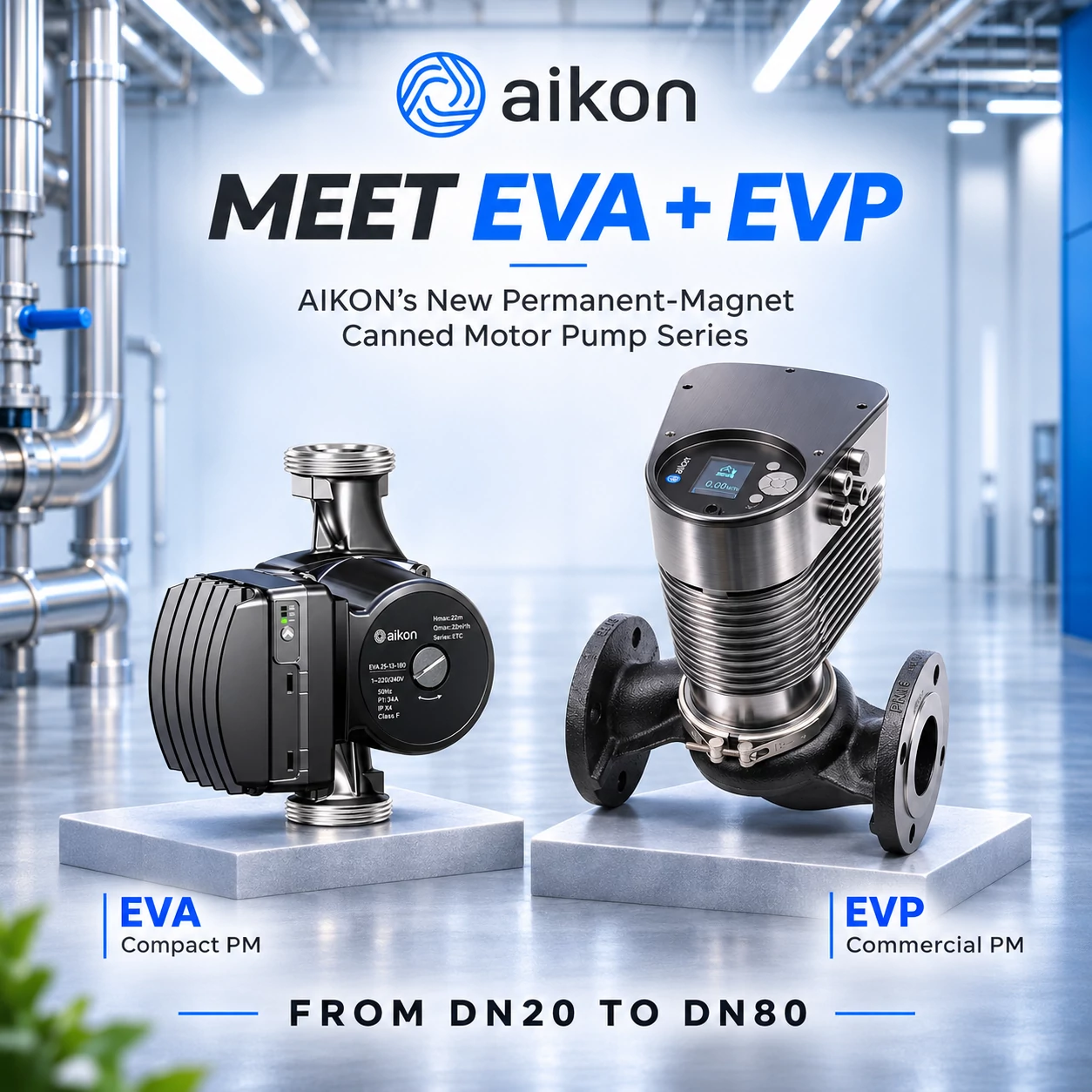
AIKON has launched the EVA and EVP permanent-magnet canned motor pump series. EVA focuses on compact heating, cooling and hot-water circulation, while EVP extends permanent-magnet technology into larger commercial systems—creating a clearer product path from small circulation duties to commercial HVAC applications.
Heating and cooling systems are changing.
Heat pumps, modern HVAC systems and long-hour circulation applications increasingly demand more than simply moving water from one point to another.
They need:
efficient motor technology
stable circulation
lower operating noise
flexible control
a product range that fits different system sizes
To respond to these needs, AIKON has now put two new permanent-magnet canned motor pump series into production:
EVA + EVP
EVA focuses on compact circulation.
EVP extends permanent-magnet technology into larger commercial systems.
Together, they expand the AIKON circulation-pump portfolio from smaller heating and hot-water applications to commercial HVAC and heat-pump systems.

EVA — Compact Permanent-Magnet Circulation
EVA is designed for smaller circulation requirements.
The current series covers DN20, DN25 and DN32 and uses a permanent-magnet synchronous motor with 230V / 50–60Hz power supply. The range reaches a maximum flow of 8.5 m³/h and maximum head of 14.5 m. Rated-point noise is specified at below 38 dB.
Its application range includes:
heating systems
heating and cooling
solar heating
district heating with heat exchangers
domestic hot-water production
domestic hot-water recirculation
That gives EVA a clear role:
Compact permanent-magnet circulation for modern residential and light-commercial systems.
It is not simply a smaller EVP.
It is a product line built around the needs of compact heating, cooling and hot-water circulation.
EVP — Permanent-Magnet Circulation for Commercial Systems
EVP takes the same permanent-magnet direction into larger circulation duties.
The current range covers DN40, DN50, DN65 and DN80, using permanent-magnet synchronous motors and 230V / 50–60Hz power supply. The documented models specify EEI ≤0.19, with liquid temperatures up to 110°C under defined operating conditions.
The series includes configurations with maximum head up to 18 m, while the EVP80-120F has a rated flow of 37.41 m³/h.
Applications include:
heating
cooling
solar thermal systems
ground-source heat-pump systems
Its role is therefore different from EVA:
Permanent-magnet circulation for larger commercial systems.

One Technology Direction. Two Application Levels.
The real value of launching EVA and EVP together is not simply adding more models.
It creates a clearer product structure.
EVA
DN20–DN32
Compact circulation
Heating / cooling / DHW
Permanent-magnet motor
EVP
DN40–DN80
Commercial circulation
Heating / cooling / heat pump
Permanent-magnet motor
So customers can start with the application and system duty rather than trying to select from a long list of unrelated models.
Small circulation → EVA
Commercial circulation → EVP
This also gives distributors a clearer way to expand their product range without mixing different technology directions into one confusing catalogue.
Where Do EVA and EVP Fit Alongside CMS?
EVA and EVP are not intended to make CMS irrelevant.
They add another technology path.
CMS
Broad circulation coverage + Replacement
Different hydraulic levels, threaded and flanged configurations, and a wide size range make CMS useful for traditional circulation and replacement applications.
EVA
Compact permanent-magnet circulation
For smaller heating, cooling and hot-water applications.
EVP
Commercial permanent-magnet circulation
For larger HVAC, heating, cooling and heat-pump systems.
Together, AIKON can now offer:
Broad Coverage + Compact PM + Commercial PM

Built for More Than Nameplate Performance
Both EVA and EVP specifications include electrical, sealing and reliability testing requirements.
EVA documentation lists tests including electrical insulation, withstand voltage, sealing, high-temperature/high-water-temperature testing, temperature-rise testing, start-stop testing and life testing.
EVP documentation similarly specifies electrical inspections, sealing tests, high-temperature testing, pressure testing, temperature-rise testing, start-stop testing and life testing.
That matters because a new product should not only introduce:
new efficiency technology
but also provide:
confidence for long-hour circulation.
Which One Fits Your Application?
The answer should start with the system—not the product name.
Choose based on:
application
flow
head
connection size
medium temperature
operating conditions
If the requirement is smaller permanent-magnet circulation, EVA may be the right direction.
For larger commercial duties, EVP may be more appropriate.
And where traditional circulation or replacement coverage is the priority, CMS remains an important part of the range.
Looking for a Permanent-Magnet Circulation Pump?
Send AIKON:
Application
Required flow
Required head
Connection size
Operating temperature
We can help review whether EVA, EVP or another AIKON circulation-pump range is the better fit.
EVA + EVP are now in production.
From compact circulation to commercial systems, AIKON’s permanent-magnet range is ready for the next application.
FAQ
1.What is the main difference between EVA and EVP?
EVA covers DN20–DN32 compact permanent-magnet circulation, while EVP extends the permanent-magnet range into DN40–DN80 commercial circulation applications.
2.What applications is EVA designed for?
The EVA specification includes heating, heating and cooling, solar heating, district heating, domestic-hot-water production and DHW recirculation.
3.What applications is EVP designed for?
The EVP specification includes heating, cooling, solar thermal and ground-source heat-pump systems.
4.Does EVA or EVP replace CMS?
Not necessarily. CMS continues to provide broad traditional circulation and replacement coverage, while EVA and EVP add permanent-magnet options for different application sizes.