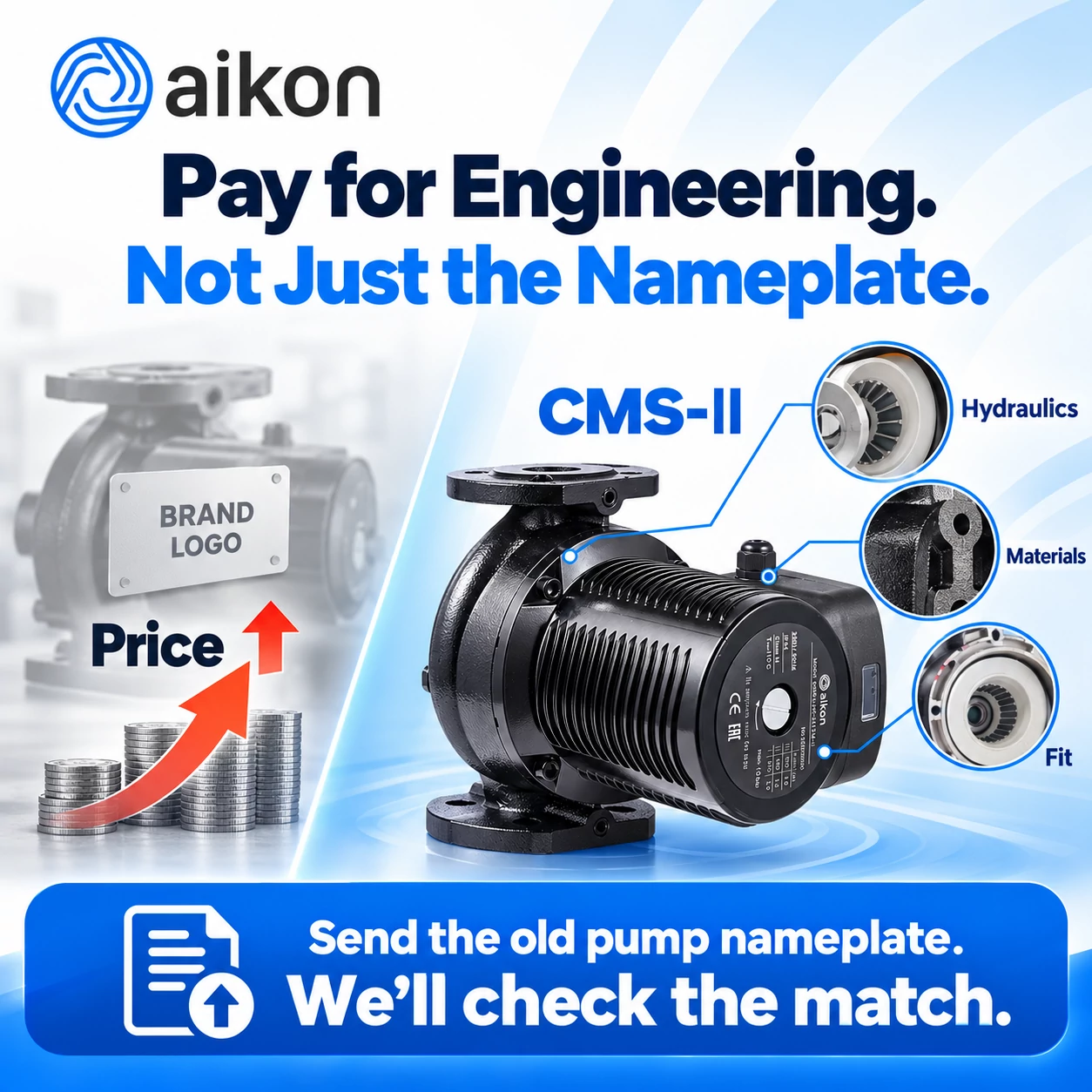
Learn how to evaluate a lower-cost canned motor pump replacement without compromising project requirements, and why performance matching, installation compatibility and internal engineering all matter.
A circulation pump needs replacing.
The original model is expensive—or no longer available.
So the buyer faces a familiar choice:
Buy the same brand again?
Or find a compatible alternative?
For many project buyers, distributors and maintenance teams, the real question is no longer:
“Can another pump run?”
It is:
“Can another pump match the system without adding risk?”
That means matching more than flow and head.
A real replacement should also match the connection, installation dimensions and operating conditions—while offering a cost that makes sense for the project.
This is where AIKON CMS is positioned.
Quick Answer
For confirmed compatible models, AIKON CMS can provide a cross-brand replacement option for common canned motor pump applications, while helping customers match:
Flow & head
Connection size
Installation length
Voltage and frequency
Application conditions
The objective is simple:
keep the system, replace the pump, control the procurement cost.
And instead of competing only on price, CMS uses specific internal design choices intended to support long-term hydraulic and mechanical stability.
A Lower Price Should Not Mean Removing the Engineering

There is a common assumption in industrial purchasing:
Lower price = lower specification.
That does not have to be true.
The better question is:
Where is the money being spent inside the pump?
AIKON CMS-Ⅱ focuses on areas that matter during real circulation duty.
Stainless-Steel Sealing Ring Seat + Wear Ring
CMS-Ⅱ uses a stainless-steel sealing ring seat and sealing wear ring to help control critical hydraulic clearances.
That helps:
reduce internal recirculation
protect the pump body and impeller
support stable hydraulic performance over time
The customer is not paying for “a stainless-steel ring.”
The value is:
less wasted internal circulation and more useful hydraulic output.
PES + GF30% Impeller for Smaller Sizes
CMS-Ⅱ models below DN65 use a PES + 30% glass-fibre-reinforced impeller.
The material is selected for:
rigidity
dimensional stability
heat resistance
hydrolysis resistance
Larger models use stainless-steel impellers to support higher mechanical loads.
Why does that matter?
Because the impeller geometry directly affects hydraulic performance.
A more dimensionally stable impeller helps the pump maintain its intended hydraulic behaviour during long-term operation.
Bearing Lubrication and Cooling Built Into the Flow Path
CMS-Ⅱ uses four 1 mm circulation holes in the pump-cover area to guide working medium through the bearing cavity.
This supports:
lubrication
cooling
air removal
axial-force balance
Combined with enlarged radial-bearing support, the design helps maintain a stable rotating assembly.
Because long-term hydraulic stability depends on more than the impeller.
It also depends on whether the rotor and shaft continue running smoothly after thousands of operating hours.
Replacement Should Match Both Performance and Installation

A cheaper pump is not a good replacement if the installer has to rebuild the pipework.
That is why AIKON looks at two types of compatibility.
Performance Match
Flow + Head + Application
The replacement must meet the real duty point.
Physical Match
Connection + Installation Length + Connection Type
For confirmed compatible models, AIKON CMS can match common installation dimensions, helping reduce unnecessary pipework modification.
Change the pump. Not the pipework.
That can mean:
less site modification
shorter installation time
fewer adapters
lower labour cost
less downtime
This is where the real price comparison should happen.
Not only:
Pump A costs X. Pump B costs Y.
But:
What is the total cost of putting the replacement into service?
Lower Procurement Cost. Not Lower Project Expectations.

AIKON CMS is positioned as a cost-competitive replacement option for customers who do not want to pay a large brand premium but still expect engineering details that support real project performance.
The value proposition is not:
“the cheapest pump.”
It is:
Pay for the pump—not for unnecessary replacement complexity or brand premium.
For distributors and project buyers, that means looking at:
purchase price
installation compatibility
internal engineering
batch consistency
long-term operating requirements
together.
Already Have a Pump You Want to Replace?
You do not need to prepare a full technical specification.
Send AIKON:
a photo of the current pump nameplate
brand + model
application
flow and head, if available
We can help check:
1. Performance match
2. Connection size
3. Installation length
4. Suitable CMS replacement
Send us the old pump nameplate. We’ll help check whether there is a more cost-effective replacement that still fits the system.
FAQ
1.Can AIKON CMS replace pumps from other brands?
For confirmed compatible models, yes. Flow, head, connection dimensions and operating conditions should be checked before ordering.
2.Does a lower price mean lower quality?
Not necessarily. Price and engineering quality are not the same thing. Buyers should compare materials, internal structure, testing, hydraulic matching and installation compatibility rather than judging only by brand or quotation.
3.Can every CMS model replace another brand without changing pipework?
No. Direct replacement depends on the specific original model. Connection size and installation length must be confirmed model by model.