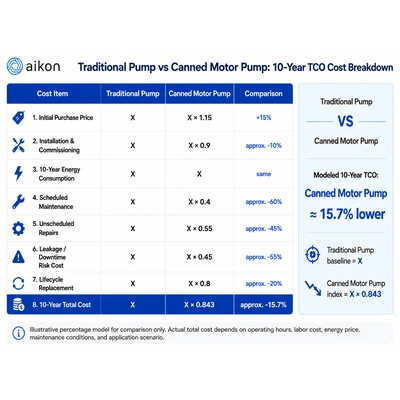
This article compares canned motor pumps and conventional mechanical pumps using a 10-year Total Cost of Ownership (TCO) model for HVAC systems. The analysis covers purchase cost, installation, maintenance, repairs, leakage risks, downtime, and lifecycle expenses to explain why long-term operating cost is more important than initial pump price.
For HVAC contractors, system integrators, and procurement professionals, pump selection is often driven by the initial purchase price. However, the real cost of a circulation pump does not end after installation.
During a 10-year operating period, energy consumption, maintenance, spare parts, emergency repairs, leakage management, and system downtime can significantly influence the actual ownership cost.
This is why Total Cost of Ownership (TCO) provides a more practical method to compare a canned motor pump with a conventional mechanical pump.
This article uses a standardized 10-year lifecycle cost model to demonstrate how different cost factors influence the long-term economic value of HVAC circulation pumps.
Important Notice:
The figures below are illustrative model values for comparison purposes only, not measured field test data. Actual costs depend on pump design, operating hours, electricity prices, labor rates, maintenance frequency, installation conditions, and application requirements.
What Is Total Cost of Ownership (TCO) for HVAC Pumps?
The total cost of ownership includes much more than the initial pump price.
For this comparison:
TCO = Purchase Cost + Installation Cost + Energy Cost + Planned Maintenance + Unplanned Repairs + Leakage/Downtime Cost + Replacement Cost
To simplify the comparison, the 10-year TCO index of a conventional mechanical pump is defined as X, and the canned motor pump is evaluated against this baseline.

Under this base-case model, the estimated lifecycle cost difference between a canned motor pump and a conventional mechanical pump is approximately 15.7%.
The difference does not come from assuming significant energy savings. In this model, energy consumption is intentionally set as equal for both pump types.
The main cost difference comes from maintenance, repair requirements, leakage risks, and lifecycle-related expenses.
1. Initial Purchase Cost: Lower Price Does Not Always Mean Lower Cost
The model assumes:
· Conventional pump purchase index: X
· Canned motor pump purchase index: X × 1.15
A canned motor pump may require a higher initial investment, making conventional pumps appear more attractive when only the quotation price is considered.
However, the purchase price represents only one part of the 10-year lifecycle cost.
For long-term HVAC systems, maintenance, reliability, and downtime costs often have a greater impact on total ownership cost.
2. Installation and Commissioning
A canned motor pump integrates the pump and motor into a compact structure.
Because it does not require a traditional external coupling between pump and motor, certain alignment-related installation procedures may be reduced depending on the pump design.
The model assumes:
· Conventional pump installation index: X
· Canned motor pump installation index: X × 0.9
The difference is intentionally conservative because installation costs vary between projects.
For HVAC contractors, the main advantage is often simplified commissioning and fewer mechanical connection points.
3. Energy Consumption: A Conservative Comparison
Energy consumption is usually one of the largest lifecycle cost factors for HVAC circulation pumps, especially in systems operating thousands of hours per year.
However, it is not accurate to assume that every canned motor pump automatically consumes less electricity than every conventional pump.
Actual energy performance depends on:
· Pump efficiency
· Motor efficiency
· Operating point
· Control method
· System resistance
· Operating hours
Therefore, this TCO model assumes:
· Conventional pump energy index: X
· Canned motor pump energy index: X
This creates a conservative comparison without relying on unverified efficiency claims.
4. Maintenance Cost: The Structural Advantage of Canned Motor Pumps
One of the main differences between canned motor pumps and conventional mechanical pumps is maintenance structure.
Traditional mechanical pumps may include:
· Mechanical seals
· External couplings
· Alignment points
These components may require inspection, adjustment, or replacement during operation.
A canned motor pump eliminates the traditional shaft seal structure between the pump and motor.
The model assumes:
· Conventional maintenance index: X
· Canned motor pump maintenance index: X × 0.4
This does not mean canned motor pumps require no maintenance.
Operators still need to monitor:
· Water quality
· Operating conditions
· Noise
· Electrical performance
· Hydraulic conditions
The difference is that some traditional mechanical maintenance points are eliminated.
For contractors managing multiple buildings, reduced maintenance frequency can lower long-term labor costs.
5. Unplanned Repairs and Downtime Risk
Unexpected pump failures can create additional costs, including:
· Emergency service
· Spare parts
· Troubleshooting
· System shutdown
· Heating or cooling interruption
The model assumes:
· Conventional repair index: X
· Canned motor pump repair index: X × 0.55
This is an illustrative assumption, not actual failure-rate data.
The purpose is to show how lifecycle costs change when seal-related, coupling-related, or alignment-related repair requirements are reduced.
6. Leakage Risk and Mechanical Seal Maintenance
The absence of a conventional mechanical seal is one of the most important structural advantages of canned motor pumps.
Mechanical seals are wear components, and their service life depends on:
· Temperature
· Water quality
· Pressure
· Installation conditions
· Operating environment
When leakage occurs, costs may include:
· Repair labor
· System drainage and refill
· Site cleaning
· Equipment corrosion
· HVAC downtime
The model assumes:
· Conventional leakage/downtime index: X
· Canned motor pump leakage/downtime index: X × 0.45
This does not mean every conventional pump will leak. It means a mechanical seal creates a potential leakage maintenance point, while a canned motor pump eliminates this specific structure.
7. Different HVAC Applications Create Different TCO Results
The TCO difference varies depending on application conditions.
For residential systems operating intermittently, maintenance and downtime costs are usually lower.
For commercial HVAC systems, hotels, hospitals, and industrial facilities, reliability and continuous operation become more important.
Assuming the conventional pump TCO index is 100, the scenario model is:

These percentages are scenario-based model results only and should not be considered guaranteed savings.
They demonstrate an important purchasing principle:
The higher the maintenance labor cost, repair cost, leakage risk, and downtime impact, the more important lifecycle cost becomes compared with initial purchase price.
Where Does a Canned Motor Pump Provide the Greatest Value?
Canned motor pumps are especially suitable for applications requiring:
· Quiet operation
· Reduced seal-related maintenance
· Compact design
· Long operating hours
· Lower service frequency
Typical applications include:
· Hydronic heating systems
· Underfloor heating
· Heat pump circulation
· Hot water circulation
· Commercial HVAC systems
· Hotels
· Office buildings
· Residential developments
· Closed-loop water circulation systems
For procurement teams, the key question should not only be:
“How much does the pump cost?”
A better question is:
“What will this pump cost to own, operate, maintain, and replace over the next 10 years?”
Conclusion
The initial purchase price is only one part of pump economics.
In this 10-year TCO model, the conventional mechanical pump is used as the baseline X.
Under the commercial HVAC base-case scenario:
Canned Motor Pump TCO Index = X × 0.843
The modeled difference of approximately 15.7% mainly comes from lower maintenance, repair, leakage management, and downtime-related costs. It does not come from assuming additional energy-saving advantages.
For HVAC contractors and procurement professionals, pump selection should consider the complete lifecycle cost rather than only the initial quotation price.
Actual TCO should be calculated based on:
· Electricity price
· Operating hours
· Labor cost
· Maintenance history
· System importance
· Pump performance data
A complete lifecycle evaluation helps HVAC professionals select circulation pumps with better long-term reliability, lower maintenance requirements, and improved overall value.
Q1: Are canned motor pumps more expensive than conventional pumps?
Canned motor pumps may have a higher initial purchase cost, but their lifecycle cost can be lower due to reduced maintenance requirements and fewer leakage-related risks.
Q2: What is included in HVAC pump TCO analysis?
HVAC pump TCO includes purchase cost, installation, energy consumption, maintenance, repairs, downtime risks, and replacement costs.
Q3: Which HVAC applications benefit most from canned motor pumps?
Hydronic heating, heat pump circulation, underfloor heating, commercial HVAC systems, hotels, and continuous circulation applications can benefit from canned motor pump technology.