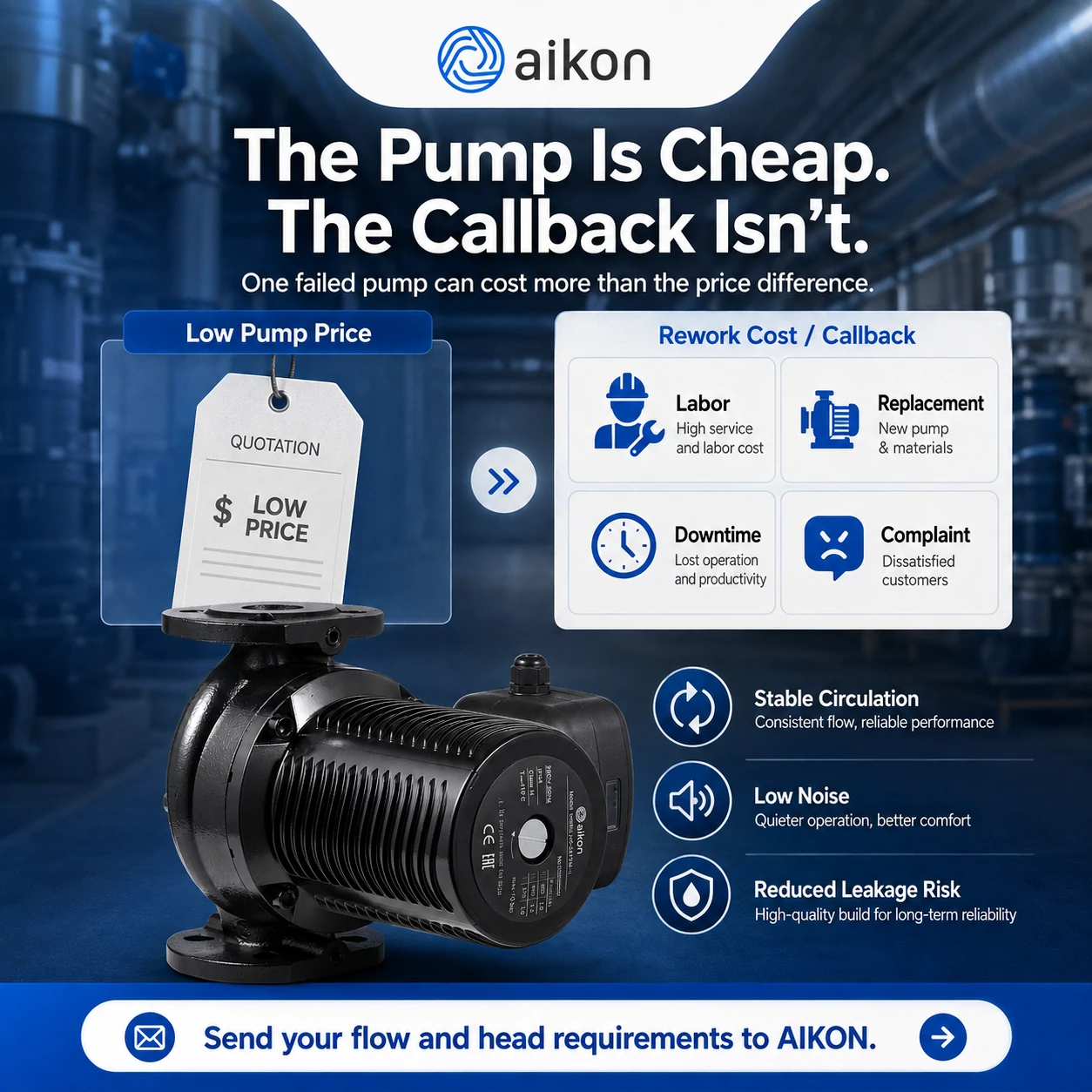
Learn why a cheap circulation pump can become expensive after installation. This article explains callback cost, labor, replacement, downtime, customer complaints, and how AIKON CMS supports lower project risk.
A circulation pump may be a small part of the project.
But when it fails, it does not feel small anymore.
Someone has to answer the customer’s call.
Someone has to go back to the site.
Someone has to drain the system, replace the pump, test it again, and explain why the problem happened.
The pump may be cheap.
But the callback is not.
A lower pump price can make the quotation look better today. But if it creates one extra service visit after installation, the saving may disappear very quickly.
The cost difference is visible today. The quality difference appears later.
And when it appears, it usually becomes someone’s problem on site.
Quick Answer
A cheap circulation pump can become expensive when it causes a callback after installation. The real cost is not only the pump itself. It may include technician labor, replacement handling, system downtime, customer complaints, and lost trust. Buyers should compare callback risk, not only the first pump price.
Who This Article Is For
This article is written for installers, contractors, distributors, OEM customers, and project buyers who work with heating, HVAC, hot water, floor heating, and commercial circulation systems.
It is especially useful when a customer says:
“This pump is cheaper.”
That may be true.
But the next question should be:
“What happens if this pump brings us back to the site?”
The Real Cost Starts After the Pump Fails
A supplier may offer a lower price.
That is easy to compare.
But after installation, the cost is no longer only about the pump. It becomes a service issue, a time issue, and sometimes a trust issue.


A free replacement pump does not make the callback free.
The real question is not only:
“Will the supplier replace the pump?”
The real question is:
“Who pays for the time, labor, and customer explanation?”
Why a Low Price Can Become a High Risk
A low-priced pump is not always a bad choice.
It may be suitable for temporary systems, low-risk applications, or places where replacement is simple.
But in long-hour circulation systems, the risk becomes higher when the low price comes from:
weaker materials
limited bearing support
reduced testing
unstable batch consistency
poor model selection support
These issues may not show up on the first day.
They often appear later as:
noise after operation
weak circulation
leakage complaints
motor overheating
shorter service life
unstable bulk quality
For B2B customers, the real damage is often not the failed pump itself.
It is the phone call after installation:
“The pump is noisy.”
“The system is not circulating.”
“Can you come back and check it?”
That is where the real cost begins.
Before You Approve a Low Pump Quotation
Before choosing the lowest price, check whether the pump can safely handle the project.


A low price is only safe when the basic engineering questions are answered.
If they are not answered, the low price may only be the beginning of a later service cost.
How AIKON CMS Helps Reduce Callback Risk Before Installation

For AIKON, the question is not only:
Can this pump run?
The better question is:
Can this pump keep running quietly and steadily after it is installed in a real project?
AIKON CMS canned motor pumps are designed for heating, HVAC, hot water, floor heating, and commercial circulation systems where stable operation matters after installation.
AIKON helps customers look at the working conditions before choosing the pump, instead of selecting only by pipe size or quotation price.

In a project, these problems do not stay inside the pump.
They become customer complaints.
That is why reducing callback risk should happen before the pump is installed, not after the customer calls.
Want to Know Whether Your Pump Selection Is Safe?
Before confirming a low quotation, send AIKON the basic working conditions.
You do not need a perfect technical file.
Start with these:
What is the application?
Heating, HVAC, hot water, or floor heating?
What flow and head do you need?
Even an estimated value is better than choosing only by pipe size.
Where will the pump be installed?
A residential system, hotel, commercial building, equipment room, or OEM package?
How long will it run each day?
Short operation and long-hour circulation are not the same selection logic.
Please send:
- required flow and head
- liquid temperature
- pipe length or system layout
- voltage and frequency
- operating hours
- quantity and target market
- OEM or private label requirements
AIKON can help check:
✓ whether the pump is undersized or oversized
✓ whether the model matches the application
✓ whether the project has callback risk
✓ whether CMS is suitable for your system
✓ whether OEM or bulk supply is available
Suggested CTA button:
Check My Pump Selection
or
Send Flow & Head Requirements
FAQ
Why can a cheap circulation pump cost more later?
Because a failed pump can create labor cost, replacement handling, downtime, customer complaints, and reputation loss.
Is a cheap pump always a bad choice?
No. It may work for low-risk or temporary systems. But for long-hour HVAC, heating, and hot water systems, buyers should compare callback risk.
What is a circulation pump callback cost?
It is the cost of returning to the project site after installation to inspect, remove, replace, retest, or explain a pump-related problem.
How can buyers reduce callback risk?
Check flow, head, operating conditions, noise requirements, leakage risk, batch consistency, and supplier selection support before ordering.
Strong CTA
The pump may be cheap.
But the callback is not.
If your project needs stable circulation, low noise, reduced leakage risk, and fewer after-sales problems, do not choose by price alone.
Send your flow, head, water temperature, voltage, quantity, and application conditions to AIKON. AIKON helps buyers check pump selection before installation and reduce callback risk.