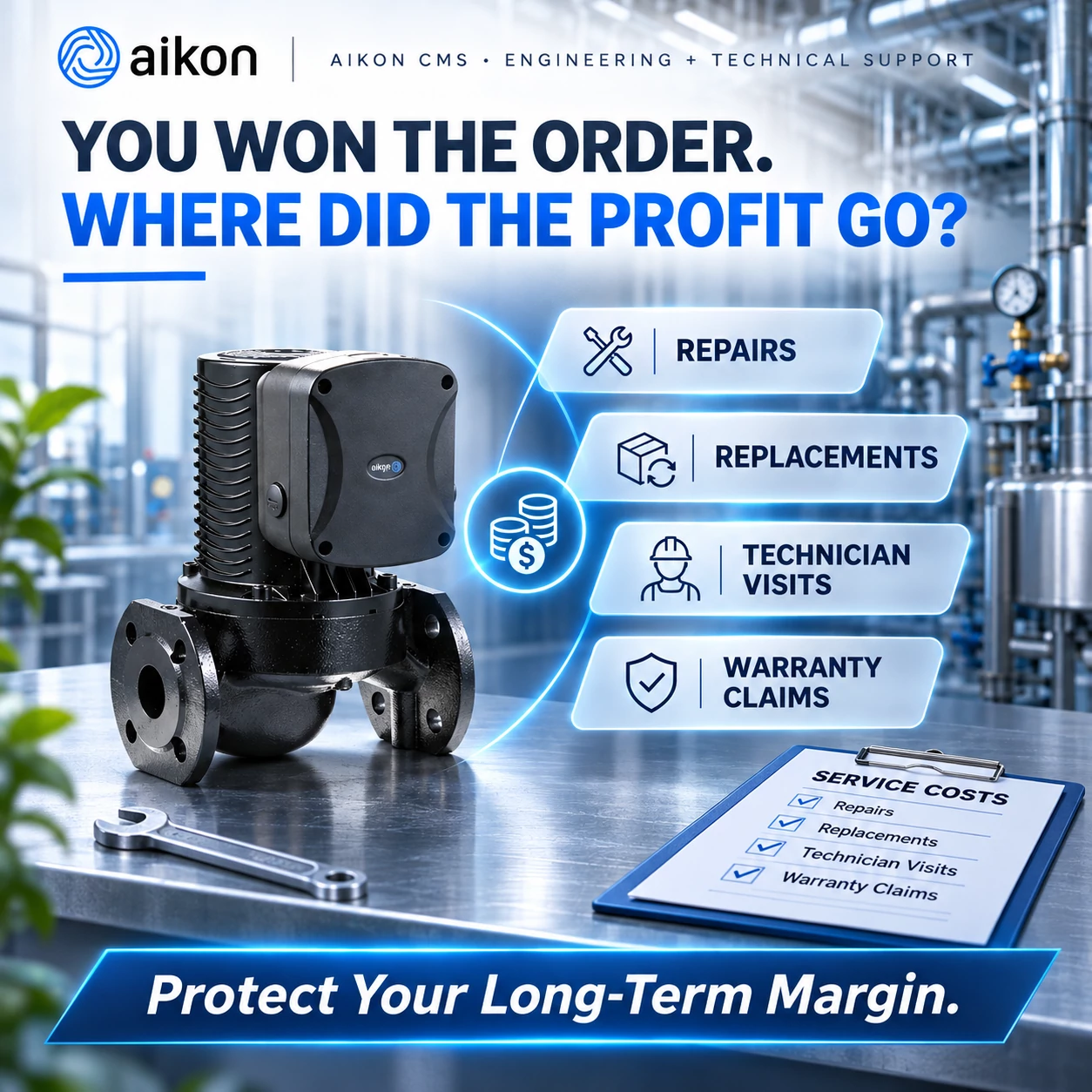
A low pump purchase price can help distributors win orders, but after-sales costs may reduce the final margin. Learn how product engineering, correct selection, batch quality control and supplier support contribute to more predictable pump distribution and OEM business.
You offered a competitive price.
You won the order.
The margin looked good.
But a few months after installation, the calls started coming in.
Noise complaints.
Replacement requests.
Technician visits.
Warranty claims.
Each problem takes time and money to resolve.
And suddenly, the profit you made on the original order starts disappearing.
Winning the order is one thing. Keeping the profit is another.
Quick Answer
A pump's real cost to a distributor is not just its purchase price.
It also includes potential repair costs, replacement shipments, technician visits, troubleshooting time and the cost of losing customer trust.
That is why choosing a pump supplier should involve more than comparing quotations.
Good product engineering helps reduce the risk. Good supplier support helps manage problems when they happen.
Where Does Your Margin Go?

Consider four common situations:

The problem is not always a defective pump.
Sometimes the model is wrong for the application. Sometimes installation conditions are unsuitable. Sometimes a small internal design weakness only becomes noticeable after months of operation.
A low purchase price cannot compensate for every problem that happens afterward.
What Does AIKON CMS-II Do Differently?

Product quality should be supported by actual engineering—not just claims on a catalogue.
AIKON CMS-II incorporates several design features intended to address common long-term operating risks.
1. Enlarged Bearing Support
Larger radial-bearing support and an increased thrust-bearing working area help support rotor stability and manage local loading.
2. 4 × 1 mm Bearing Circulation Holes
These internal passages guide the working medium through the bearing area, supporting lubrication, cooling, air removal and axial-force balance.
3. Stainless-Steel Sealing Ring Structure
The stainless-steel sealing ring seat and wear ring help control critical hydraulic clearances, reduce internal recirculation and support stable hydraulic performance.
4. Impeller Material Selection
Smaller CMS-II sizes use PES + GF30% impellers, while larger sizes use stainless-steel impellers. These material choices support rigidity and dimensional stability under applicable operating conditions.
These are not simply component specifications.
They are engineering measures intended to help reduce wear-related, mechanical and hydraulic risks during long-term circulation.
Good Support Should Not End at Shipment

Even a well-designed pump needs correct selection, quality control and support after installation.
That is why a good OEM or distribution partnership should cover two stages.
Before shipment:
- Application-based model selection
- Product quality checks
- Agreed batch quality requirements
- Technical documentation and product information
After installation:
- Technical troubleshooting
- Operating-condition review
- Model and application verification
- Replacement coordination
- Warranty and after-sales handling under agreed terms
If a customer reports a problem, the response should not simply be: "The pump passed our factory test."
The important question is:
What happened on site, and how can we solve it together?
Look Beyond the Purchase Price
For a distributor, the real business calculation is:
Sales Margin − After-Sales Costs = Realized Profit
A competitively priced pump matters.
But so do product consistency, long-term operating performance and the support behind it.
The value of a reliable supplier is not just helping you win the next order.
It is helping you protect the profit after that order is delivered.
Building Your Pump Distribution or OEM Business?
Tell AIKON:
- Your target market
- Main applications
- Required flow and head ranges
- Expected product range
- OEM or private-label requirements
We can help review suitable CMS configurations, product selection and the technical support needed behind your sales.
DM us "PARTNER" + your target market. Let's build a pump business that makes sense beyond the purchase price.
FAQ
1.Does a lower pump purchase price always mean better profitability?
No. Repair costs, replacement shipments, labor and customer complaints can reduce the margin earned from the original order.
2.How can pump design help reduce after-sales risks?
Bearing support, lubrication and cooling, hydraulic-clearance control and suitable impeller materials can help address specific long-term operating risks. Correct selection and installation remain essential.
3.What after-sales support can AIKON provide?
AIKON can assist with technical troubleshooting, application review, model verification and replacement handling according to agreed cooperation and warranty terms.