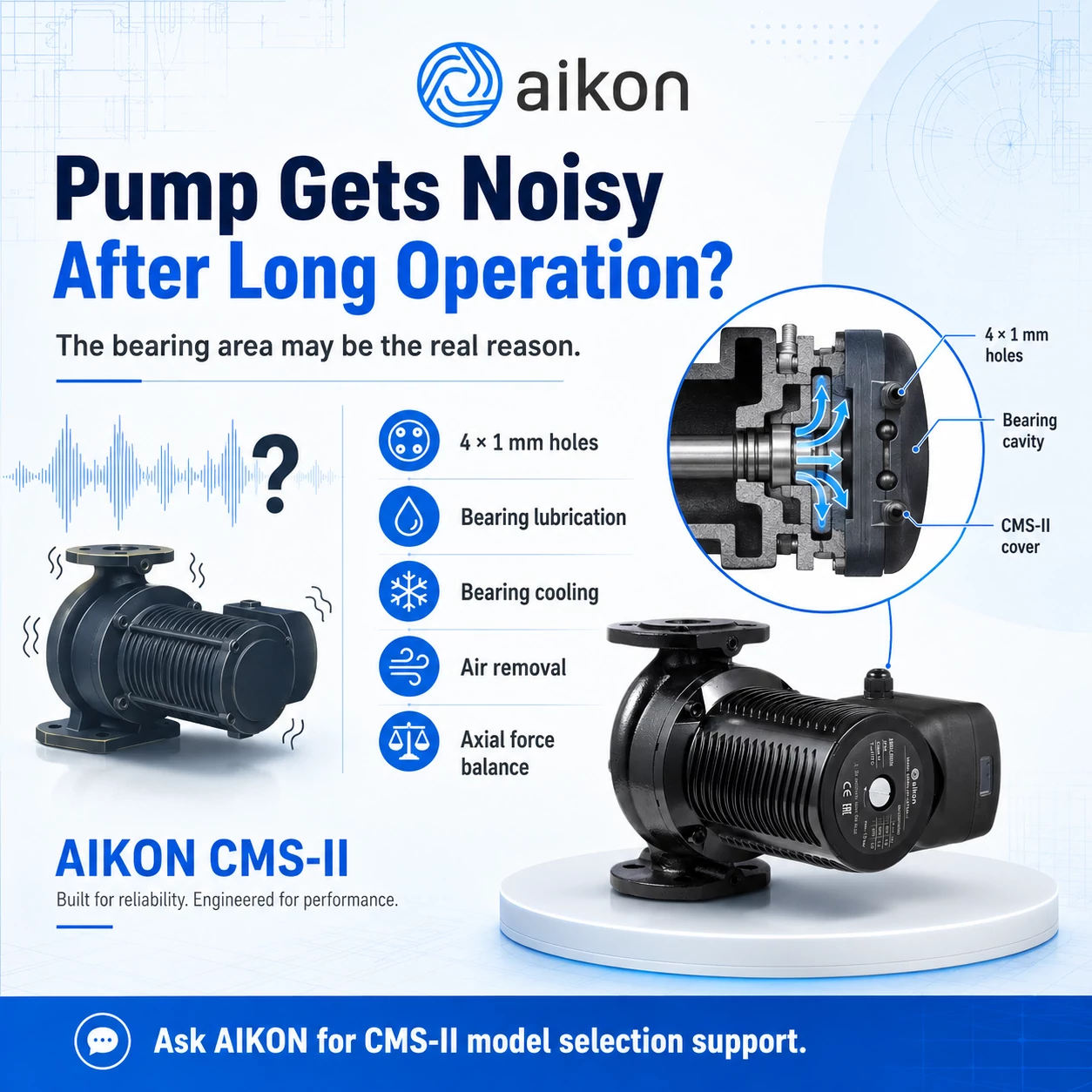
AIKON CMS-Ⅱ improves this area through four evenly distributed 1 mm circulation holes on the pump cover and larger front and rear radial bearings, helping support bearing lubrication, cooling, axial force balance, air removal, and long-term stable operation.
A circulation pump may work well at the beginning.
The flow looks normal.
The head looks enough.
The system starts without obvious problems.
But after long operation, some pumps begin to show problems:
noise becomes louder
vibration increases
the bearing area gets hot
the pump starts less smoothly
service life becomes shorter than expected
When this happens, users often think the pump quality is poor.
But the real reason may be more specific:
the bearing area is not getting stable lubrication, cooling, air removal, and axial force control.
For canned motor pumps, the bearing working condition is one of the key factors that decides long-term stability.
Quick Answer

A circulation pump may become noisy after long operation because the bearing area faces friction heat, axial force, trapped air, and continuous load. AIKON CMS-Ⅱ improves this area through four evenly distributed 1 mm circulation holes on the pump cover and larger front and rear radial bearings, helping support bearing lubrication, cooling, axial force balance, air removal, and long-term stable operation.
Who This Article Is For
This article is useful for:
Installers dealing with noisy or unstable circulation pumps
Distributors who want fewer after-sales complaints
OEM customers who need stable batch performance
Project buyers selecting pumps for heating, hot water, or HVAC systems
Engineers who care about long-term bearing reliability
If your customer only compares flow, head, and price, this article helps explain why bearing structure also matters.
The Real Problem: The Pump Runs, But the Bearing Condition Gets Worse
In a canned motor pump, the rotor, shaft, and bearings work inside the pump structure.
During operation, the bearing area must handle:
shaft rotation
liquid temperature
friction heat
axial force from the impeller
air trapped during startup
continuous operation load
If the bearing area does not receive enough lubrication or cooling, friction can increase.
At first, the pump may still run. But over time, the user may hear more noise, feel more vibration, or notice unstable operation.
This is why bearing design is not a small detail.
It directly affects the pump’s long-term experience.
Why CMS-Ⅱ Uses Four 1 mm Circulation Holes

AIKON CMS-Ⅱ uses four evenly distributed 1 mm holes on the pump cover.
These small holes are designed to create an internal circulation path for the medium.
When the pump runs, the medium can enter the bearing cavity through these holes. This supports several important functions.
1. Better Bearing Lubrication
In the bearing area, the shaft and bearing surfaces need a stable liquid film.
If lubrication is not enough, dry friction may occur. Dry friction can increase wear, noise, heat, and vibration.
The four small circulation holes allow the medium to enter the bearing cavity and help form a lubricating film between the shaft and the ceramic / graphite bearing surfaces.
Because the holes are evenly distributed, lubrication can be more balanced around the bearing area.
For users, the benefit is clear:
less local friction, lower wear risk, and smoother long-term operation.
2. Better Bearing Cooling
A circulation pump does not only face hydraulic load. It also faces heat.
Heat may come from:
liquid temperature
bearing friction
motor heat transfer
long operating hours
If heat stays around the bearing area, local temperature may rise. This can accelerate wear and reduce reliability.
When the medium flows through the bearing cavity, it can carry away part of the friction heat and motor-transferred heat.
This helps keep the bearing area within a safer working condition under suitable applications.
For hot water, heating, and HVAC circulation systems, this cooling path is especially valuable.
3. Better Axial Force Balance
When the impeller works, it creates axial thrust.
If this axial force is not controlled well, the thrust bearing may carry more load. Over time, this can increase wear, noise, and instability.
The small holes allow part of the medium to move from the high-pressure side toward the low-pressure side. This can help offset part of the axial force and reduce thrust load on the bearing system.
This does not mean the holes “remove all axial force.”
But they help create a more balanced internal hydraulic condition.
That is important for long-term pump stability.
4. Better Air Removal During Startup and Shutdown
Air inside the bearing cavity can cause problems.
During startup or after system service, trapped air may affect lubrication and create unstable operation. In some cases, air can also increase noise or reduce bearing protection.
The circulation holes help discharge air from the bearing cavity during startup and shutdown.
This reduces the risk of air-related lubrication failure and makes the pump more suitable for real system conditions where startup, shutdown, and air pockets may occur.
Larger Radial Bearings Improve Support

CMS-Ⅱ also increases the size of the front and rear radial bearings.
This matters because a larger bearing support area can help the rotating system work more steadily.
If the radial bearing support is too small, the shaft may be more sensitive to load, vibration, and wear over long-term use.
By using larger radial bearings, CMS-Ⅱ supports:
better shaft stability
lower vibration risk
more stable rotor operation
better long-term bearing conditions
For users, this may be reflected in quieter operation and fewer stability complaints after long use.
What Buyers Should Check Before Choosing a Pump
When choosing a circulation pump, do not only check:
flow
head
power
price
Also ask:
How is the bearing lubricated?
How is friction heat removed?
How is trapped air released?
How is axial force managed?
How large is the radial bearing support?
Is the pump designed for long operating hours?
These questions help buyers judge long-term stability, not only first-day performance.
How AIKON CMS-Ⅱ Supports Real Project Stability
AIKON CMS-Ⅱ is designed for circulation systems that need stable operation, low noise, reduced wear, and long-term reliability.
The pump cover circulation holes and enlarged radial bearings are part of this design logic.
They are especially meaningful in applications such as:
heating circulation
hot water circulation
HVAC systems
floor heating systems
commercial building circulation
air-energy hot water circulation
solar hot water circulation
For distributors and OEM customers, these details can help reduce after-sales pressure.
For installers and project buyers, they help explain why two pumps with similar flow and head may perform differently after months or years of operation.
What to Send AIKON for Model Selection
To choose the right CMS-Ⅱ model, please send:
Application: heating / hot water / HVAC / floor heating / solar hot water
Required flow rate: m³/h or L/min
Required head: m
Liquid temperature: °C
Voltage and frequency
Pipe length or system layout
Connection type: threaded or flange
Installation position
Continuous operation or intermittent operation
OEM or bulk order needs
AIKON can help check whether the selected model matches the real working condition.
FAQ
Why does a circulation pump become noisy after long operation?
Noise may come from bearing wear, poor lubrication, trapped air, axial force, vibration, or system conditions. Bearing design plays an important role in long-term noise control.
What do the four 1 mm holes on CMS-Ⅱ pump cover do?
They help the medium enter the bearing cavity to support lubrication, cooling, axial force balance, and air removal.
Why are larger radial bearings important?
Larger radial bearings provide more stable shaft support, helping reduce vibration risk and improve long-term operating stability.
Does this mean the pump will never become noisy?
No pump can be guaranteed never to become noisy. Actual performance depends on model selection, system condition, liquid quality, installation, and operating environment.
Strong CTA
If your customer complains about pump noise, vibration, or short service life, do not only check the nameplate.
Check the internal bearing structure.