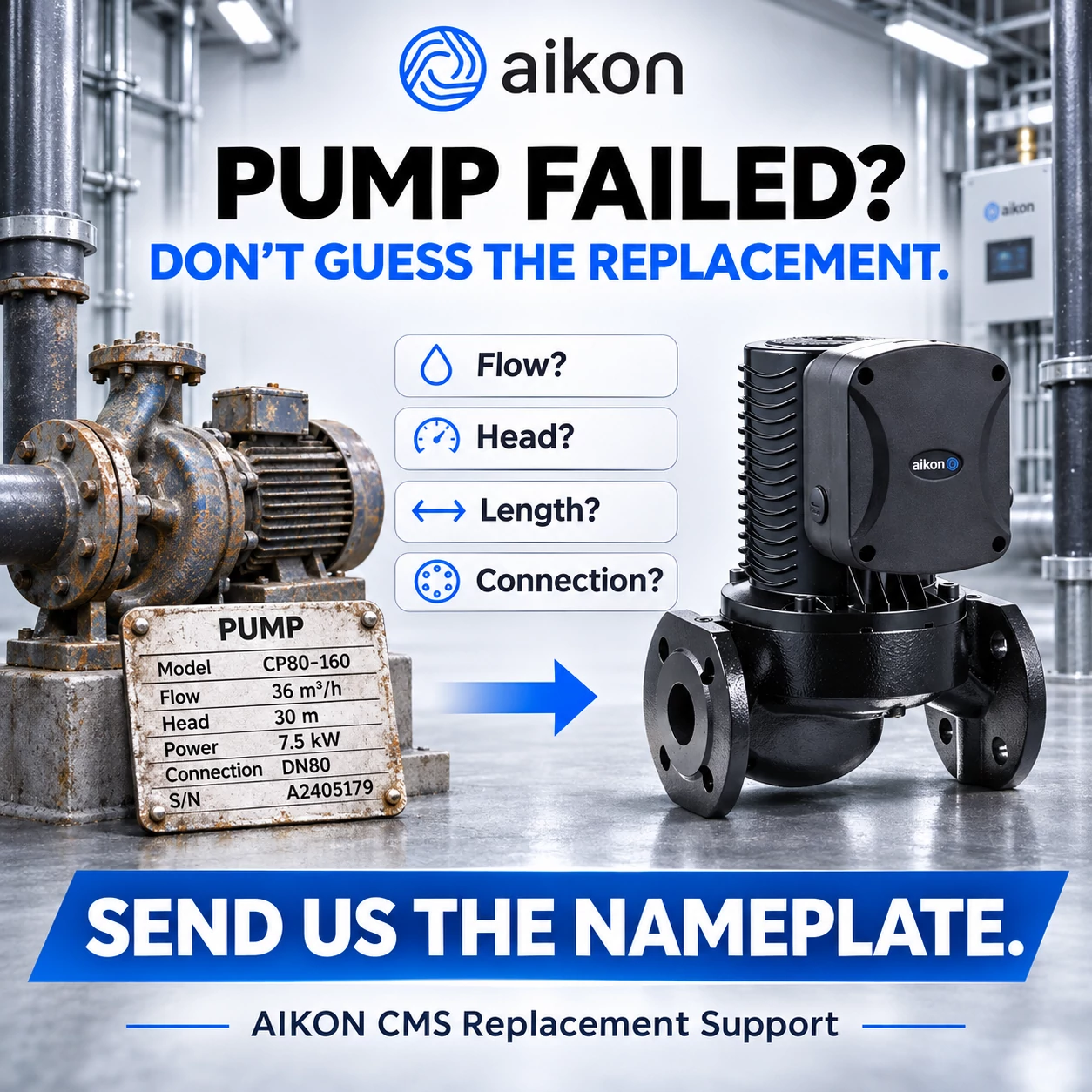
When a circulation pump fails, ordering the fastest replacement is tempting. But matching flow and head alone is not enough. Installation length, connections, electrical requirements and application also matter. Start with the old pump nameplate and check both performance and installation compatibility before ordering.
Your circulation pump has failed.
The system needs to get back online.
The quickest solution may seem obvious:
Find a pump with similar flow and head, order it, and replace the old one.
But a rushed replacement can create a second problem.
The new pump may deliver the right performance—but have the wrong connection, wrong installation length or wrong electrical requirements.
Then a simple replacement becomes:
Adapters. Pipe modification. Extra labor. More downtime.
So before ordering the next pump, check a few things first.

1. What Flow Does the System Need?
Start with the required flow.
Do not select a replacement only because its maximum flow looks similar to the old pump.
What matters is whether the new pump can deliver the required flow at the actual operating point.
2. What Head Is Required?
Flow and head work together.
Two pumps can have similar maximum head values but behave differently across their performance curves.
That is why the replacement should be checked against the actual system requirement—not just one number on the nameplate.
3. Does the Installation Length Match?
This is one of the easiest details to overlook.
A pump may be hydraulically suitable but physically longer or shorter than the existing unit.
If the installation length does not match, the job may require pipe cutting, repositioning or additional fittings.
A pump can match the duty point and still be a difficult replacement.

4. What Connection Does the Existing System Use?
Check:
Threaded or flanged?
What connection size?
What flange configuration?
A correct connection match can make the difference between a straightforward replacement and a pipework modification job.
5. Does the Voltage and Frequency Match?
Before ordering, confirm the electrical supply.
Depending on the market and application, the existing pump may use different voltage or frequency requirements.
This is especially important when replacing equipment sourced from another country or manufacturer.
6. What Is the Pump Actually Used For?
The same-looking pump may be used in very different systems:
Radiator heating
Underfloor heating
Boiler circulation
Heat-pump systems
Hot-water circulation
Commercial HVAC
The application affects operating conditions, medium temperature and the duty point the replacement needs to meet.
Where AIKON CMS Helps
Once the basic information is clear, the next step is finding a pump that matches both:
Performance Match
Flow + Head + Operating Conditions
Installation Match
Length + Connection + Electrical Requirements
The AIKON CMS range offers different flow and head ranges, connection sizes, threaded and flanged configurations, giving more options for matching existing circulation systems.
But a replacement should not only fit.
It should also remain reliable after installation.
CMS-Ⅱ uses a canned motor structure without a traditional dynamic mechanical shaft seal.
Its internal design also includes:
4 × 1 mm circulation holes
→ support bearing lubrication and cooling
Enlarged bearing support
→ supports rotor stability during long-hour operation
Hydraulic-clearance control
→ helps reduce unwanted internal recirculation
So the goal is not simply:
Find a pump that looks similar.
It is:
Find a pump that fits the system and can do the job.

No Full Specification? Start With the Nameplate
Many customers do not know the exact system flow or head.
That is fine.
Start with:
A photo of the old pump nameplate
Installation length
Connection size / type
Application
AIKON can then help check the existing model and identify what additional information is needed for CMS matching.
Pump failed? Don’t guess the replacement. Send us the nameplate first.
FAQ
1.Is the old pump model number enough to find a replacement?
It is a useful starting point, but installation length, connection details, voltage and actual operating conditions may also need to be confirmed.
2.Can I replace a pump just because the flow and head are similar?
Not necessarily. Physical dimensions, connections and electrical requirements also matter.
3.Can AIKON CMS replace every circulation pump?
No. Replacement compatibility should be checked model by model according to the existing pump, system duty and installation conditions.