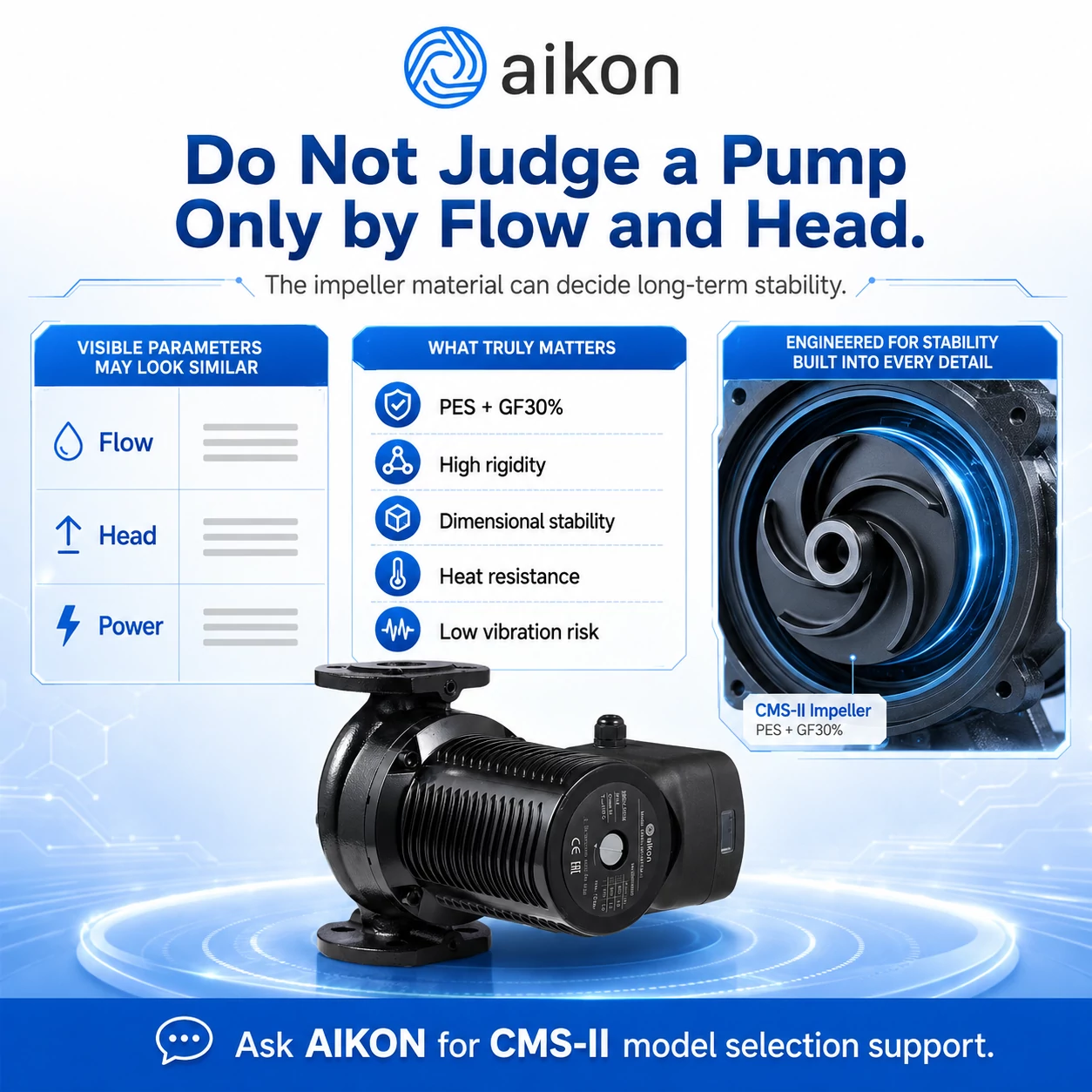
Impeller material matters because it affects heat resistance, dimensional stability, hydraulic efficiency, vibration control, corrosion resistance, and long-term reliability. AIKON CMS-Ⅱ uses PES + GF30% impellers for sizes below DN65, while larger sizes use stainless-steel impellers, so the material can better match the pump size and working conditions.
When buyers compare circulation pumps, they usually look at flow, head, power, connection size, and price.
These parameters are important. But they do not explain everything.
Inside the pump, the impeller is one of the parts that works the hardest. It keeps rotating, moves the liquid, faces water pressure, handles temperature changes, and directly affects hydraulic efficiency.
That is why two pumps with similar flow and head may perform differently after long-term use.
For AIKON CMS-Ⅱ, impeller material is not selected casually. It is part of the product’s long-term stability design.
Quick Answer
Impeller material matters because it affects heat resistance, dimensional stability, hydraulic efficiency, vibration control, corrosion resistance, and long-term reliability. AIKON CMS-Ⅱ uses PES + GF30% impellers for sizes below DN65, while larger sizes use stainless-steel impellers, so the material can better match the pump size and working conditions.
Who This Article Is For
This article is useful for:
Distributors comparing pump quality beyond price
Installers dealing with noise, vibration, or unstable operation
OEM customers who need stable batch quality
Project buyers choosing pumps for hot water, heating, or HVAC systems
Engineers who care about long-term hydraulic stability
If your customer only asks, “What is the flow and head?”, this article helps explain why internal material design also matters.
Why the Impeller Is So Important

The impeller is the part that transfers motor power into water movement.
If the impeller is stable, the pump can maintain smoother circulation.
If the impeller deforms, wears, or loses balance, the system may experience:
Lower hydraulic efficiency
More vibration
Higher noise
Unstable flow
More wear on nearby parts
For hot water and heating circulation systems, this becomes more important because the pump may run for long hours under warm or high-temperature conditions.
A good impeller is not only about shape. It is also about material stability.
Why AIKON CMS-Ⅱ Uses PES + GF30% for Smaller Sizes

For CMS-Ⅱ models below DN65, AIKON uses PES + GF30% impellers.
PES means polyethersulfone, a high-performance engineering plastic. GF30% means the material is reinforced with 30% glass fiber.
This material has several advantages for circulation pump applications:
High temperature resistance
It helps the impeller stay stable in hot-water operating conditions.
High rigidity
Glass-fiber reinforcement improves strength and reduces deformation risk.
Dimensional stability
The impeller can better maintain its shape during long-term rotation and temperature changes.
Hydrolysis and chemical resistance
It is suitable for hot water and weak corrosive circulation conditions within the proper application range.
Self-extinguishing flame-retardant property
This adds another level of material safety.
Lightweight structure
Compared with heavier materials, it helps reduce rotating mass while maintaining hydraulic performance.
According to the material logic shown in the CMS-Ⅱ structure reference, this PES+GF30% impeller is suitable for -25°C to 120°C hot water and weak corrosive circulation conditions, while the material itself has high-temperature resistance characteristics.
Why Larger Sizes Use Stainless-Steel Impellers

Not every pump size should use the same impeller material.
For larger diameters and higher-load applications, AIKON CMS-Ⅱ uses stainless-steel impellers.
This is a practical design choice.
Larger pumps may face higher hydraulic load, larger flow, and stronger mechanical stress. Stainless steel offers better mechanical strength for these applications.
So the design logic is not simply:
plastic impeller or metal impeller.
The real logic is:
choose the material that best matches the pump size, load, and working condition.
For CMS-Ⅱ:
Below DN65: PES + GF30% impeller
Larger sizes: stainless-steel impeller
This makes the product range more suitable for different applications instead of forcing one material solution across all sizes.
What This Means for Long-Term Pump Performance
For users, impeller material affects the real experience.
A stable impeller helps reduce internal imbalance and hydraulic disturbance. This can support:
More stable circulation
Lower vibration risk
Better hydraulic efficiency
Lower noise possibility
Longer component life
Better matching for hot water and heating systems
In many circulation systems, the pump does not fail suddenly. Instead, small issues appear over time: more noise, weaker circulation, vibration, or higher maintenance pressure.
A better impeller material helps reduce these risks from inside the pump.
AIKON CMS-Ⅱ Application Fit
AIKON CMS-Ⅱ is designed for circulation systems that require stable operation, low noise, long-term reliability, and reduced leakage risk.
The impeller material strategy supports applications such as:
Heating circulation
Hot water circulation
HVAC systems
Commercial building circulation
Floor heating systems
Air-energy hot water circulation
Solar hot water circulation
For B2B customers, this is especially important because one unstable pump can become an after-sales problem.
For distributors and OEM customers, stable material selection also supports batch consistency and long-term brand trust.
What to Send AIKON for Model Selection
To select the right CMS-Ⅱ model, do not only send pipe size.
Please send:
Application: heating / hot water / HVAC / floor heating / solar hot water
Required flow rate: m³/h or L/min
Required head: m
Liquid temperature: °C
Liquid type: clean water / hot water / weak corrosive liquid
Voltage and frequency
Connection size
Pipe length or system layout
Pump body material requirement
OEM or batch order needs
With this information, AIKON can help match the pump model and material configuration to the real working condition.
FAQ
Why does circulation pump impeller material matter?
Because the impeller affects hydraulic efficiency, vibration, noise, flow stability, and long-term wear. A stable material helps the pump maintain smoother operation.
What is PES + GF30%?
PES + GF30% is a glass-fiber reinforced engineering plastic. It offers high rigidity, heat resistance, dimensional stability, hydrolysis resistance, and chemical resistance.
Why does CMS-Ⅱ use PES impellers only below DN65?
Smaller sizes can benefit from the lightweight and stable properties of PES+GF30%. Larger sizes face higher mechanical load, so stainless-steel impellers are used.
Can one impeller material fit all pump sizes?
Not always. The right material should match pump size, hydraulic load, temperature, liquid condition, and application requirements.
Strong CTA
Do not compare circulation pumps only by flow and head.
The impeller material can decide whether the pump stays stable, quiet, and efficient after long-term operation.
Send your flow, head, liquid temperature, liquid type, and application conditions to AIKON for CMS-Ⅱ model selection support.