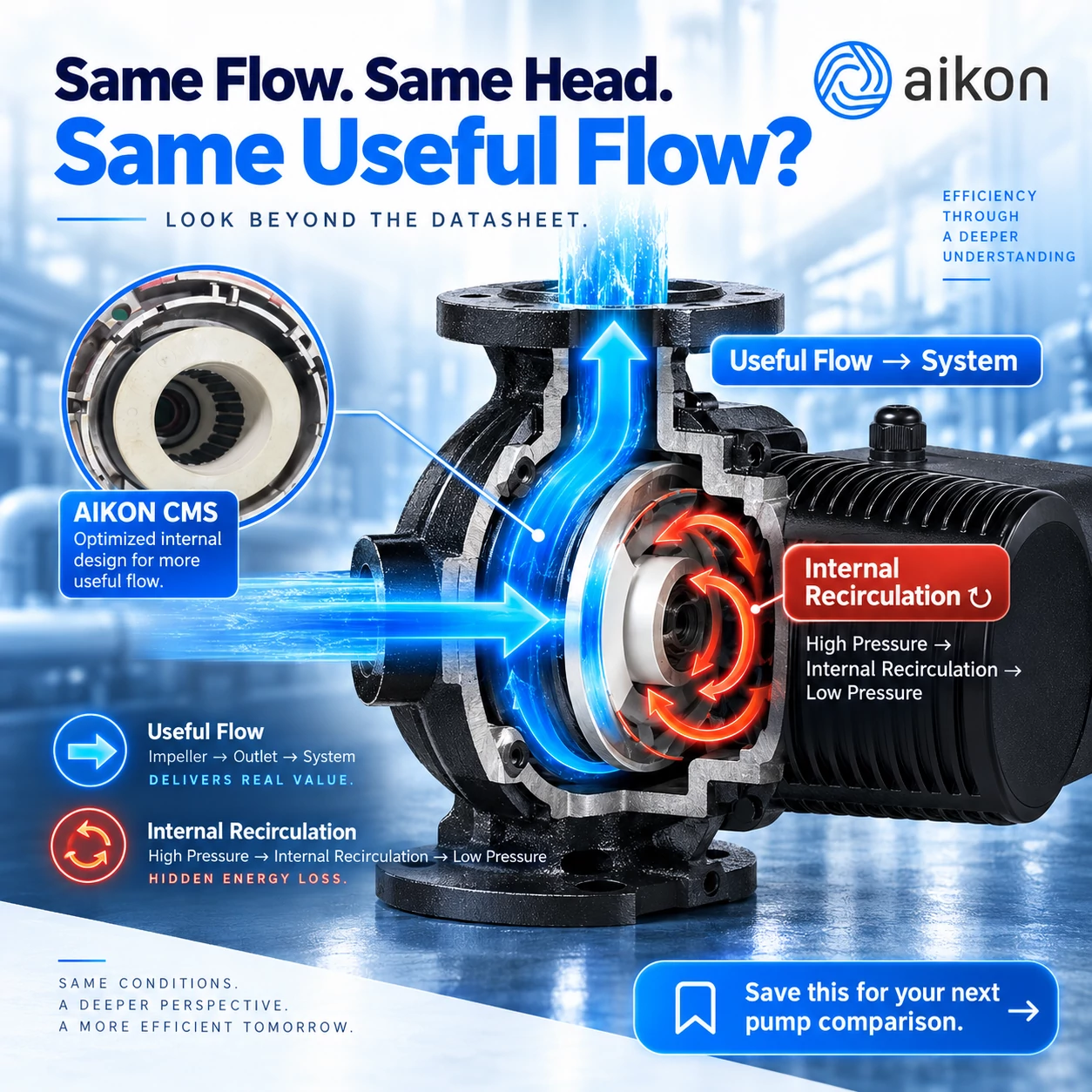
Learn why two circulation pumps with similar flow and head may deliver different real-world performance, and how internal recirculation, hydraulic clearances and wear-ring design affect useful flow, efficiency and long-term stability.
Two circulation pumps can look almost identical on a datasheet.
Similar maximum flow.
Similar maximum head.
Similar input power.
Yet after installation, one pump may deliver stable circulation for years while another gradually becomes noisier, less efficient or less consistent.
Why?
Because not all the energy entering a pump necessarily becomes useful flow delivered to the system.
Some of it can be lost inside the pump itself.
One often-overlooked source is internal recirculation.
Quick Answer
When the impeller creates pressure, the liquid should move toward the outlet and into the system.
But if critical clearances between rotating and stationary hydraulic components are not well controlled, part of the higher-pressure liquid can flow back toward the lower-pressure side.
That liquid has not leaked onto the floor.
It is still inside the pump.
But instead of helping the building, heating loop or cooling system, it is circulating where it should not.
That is internal hydraulic loss.
The Leak You Cannot See
Think of the pump as trying to push 100 units of useful flow into the system.
If part of the liquid repeatedly moves from the high-pressure side back toward the low-pressure side, the pump has to move that liquid again.
Energy has already been used to pressurize it.
But the system has not received the full benefit.
This internal recirculation can contribute to four practical problems:
1. Less effective flow
A greater share of the pump's hydraulic work is spent moving liquid internally instead of delivering it to the system.
2. Lower hydraulic efficiency
The motor may still consume energy, but more of that energy is being lost inside the hydraulic path.
3. Less stable internal flow
Unwanted recirculation can create more disturbed flow conditions, contributing to vibration and noise.
4. Greater performance deterioration as parts wear
As hydraulic clearances increase with wear, internal recirculation can increase further, creating a cycle of declining hydraulic performance.
This is why maximum flow and maximum head do not tell the whole story.
The real question is not only how much pressure the impeller can create. It is how much of that hydraulic energy becomes useful system flow.
Europe Is Looking More Closely at Real Circulator Efficiency

This question is becoming increasingly relevant in Europe.
The EU's current Ecodesign rules for glandless circulators already set minimum energy-efficiency requirements and require product information such as the Energy Efficiency Index, or EEI. The European Commission is now reviewing Regulation (EC) No 641/2009 in light of technological progress.
Importantly, the review process has considered stronger information requirements around parameters that influence circulator efficiency—including head, flow, hydraulic power and electrical power at full and part load. It has also considered broader circular-economy requirements.
That does not mean Europe is requiring canned motor pumps.
It does mean the regulatory conversation is increasingly about more than a headline maximum-flow or maximum-head number.
Real operating efficiency, performance transparency and what happens across the product's working life matter more.
How AIKON CMS-Ⅱ Addresses Internal Recirculation

This is where a small internal component can have a large hydraulic role.
AIKON CMS-Ⅱ uses a stainless-steel sealing ring seat and sealing wear ring around the hydraulic interface.
The purpose is not simply to add stainless steel.
The structure is designed to help:
control critical hydraulic clearances
reduce internal recirculation
support volumetric efficiency
protect the pump body and impeller from wear
support more stable hydraulic performance over time
It does not mean internal hydraulic loss is completely eliminated.
No real pump operates without hydraulic losses.
The engineering goal is to control the leakage path and keep the hydraulic clearance more stable, so a greater share of the pump's work can remain useful to the system.
For project customers, that matters much more than the component name.
You are not really buying a stainless-steel wear ring.
You are buying the engineering behind:
more useful circulation
less wasted hydraulic work
more stable long-term performance
lower risk of performance degradation as the pump ages
Look Beyond the Datasheet
When two pumps have similar flow and head, ask one more question:
How does the pump control what happens inside the hydraulic path?
Compare:
- internal clearance control
- wear-ring design
- impeller stability
- bearing and rotor stability
- operating point
- long-term hydraulic performance
Because two pumps can reach a similar duty point today.
The more important difference may be:
how efficiently and consistently they stay there.
FAQ
Is internal recirculation the same as an external leak?
No. Internal recirculation happens inside the pump when higher-pressure liquid moves back toward a lower-pressure region instead of being delivered to the system.
Does internal recirculation reduce actual pump efficiency?
Yes. It can reduce volumetric and hydraulic effectiveness because part of the pump's work is spent recirculating liquid internally rather than delivering useful flow.
Does CMS-Ⅱ completely eliminate internal leakage?
No. AIKON CMS-Ⅱ's sealing ring structure is designed to help control critical clearances and reduce internal recirculation. It should not be described as eliminating all hydraulic loss.