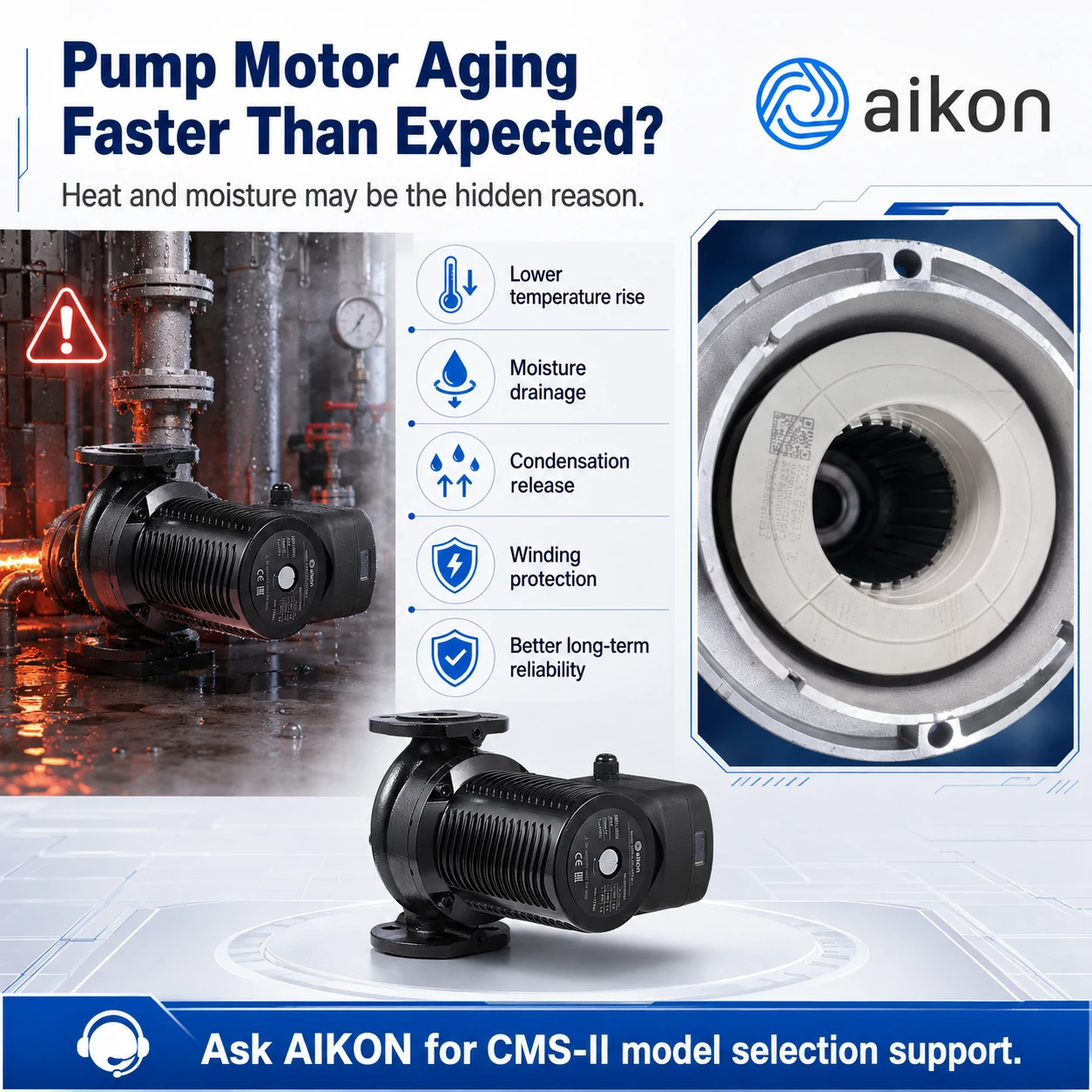
High motor temperature rise and trapped moisture can shorten circulation pump motor life. AIKON CMS-Ⅱ improves this area through a larger motor platform and better housing drainage design: 130 mm stator diameter, 75 mm rotor outer diameter, power margin up to 2.2 kW, temperature rise around 45–52 K, and multiple condensation drainage holes.
In real pump rooms, a circulation pump does not only face flow and head requirements.
It also faces heat, moisture, condensation, long operating hours, and cold-hot temperature changes.
This is common in hot water circulation, heating systems, HVAC systems, floor heating, air-source hot water, and solar hot water circulation. A pump may run normally at first, but after months or years, problems may appear: higher motor temperature, unstable operation, frequent tripping, insulation aging, or shorter motor life.
The key issue is simple: if heat cannot be controlled and moisture cannot leave the motor housing, long-term motor reliability will drop.
Quick Answer
High motor temperature rise and trapped moisture can shorten circulation pump motor life. AIKON CMS-Ⅱ improves this area through a larger motor platform and better housing drainage design: 130 mm stator diameter, 75 mm rotor outer diameter, power margin up to 2.2 kW, temperature rise around 45–52 K, and multiple condensation drainage holes.
Who This Article Is For
This article is useful for installers, distributors, OEM customers, project buyers, and engineers who deal with circulation pumps in humid pump rooms, hot-water systems, or long-hour operation.
If your customer only compares flow, head, power, and price, this article helps explain why motor temperature rise and moisture drainage also affect long-term reliability.
The Hidden Risk: Heat + Moisture

Motor temperature rise directly affects winding insulation. If the motor works under high temperature rise for a long time, insulation may age faster, electrical reliability may drop, and tripping risk may increase.
Moisture is another hidden risk. In humid pump rooms or cold-hot cycling environments, condensation may form inside the motor housing. If this moisture cannot drain out, it may increase the risk of insulation aging, electrical leakage, short circuit, corrosion, and unstable long-term operation.
So when buyers compare circulation pumps, they should not only ask:
What is the flow? What is the head? What is the price?
They should also ask:
How does the motor handle heat and condensation?
How CMS-Ⅱ Improves Motor Reliability

AIKON CMS-Ⅱ improves motor reliability through two main design directions: more thermal margin and better moisture drainage.
The CMS-Ⅱ stator diameter is increased to 130 mm, the rotor outer diameter is increased to 75 mm, and the platform power margin is expanded up to 2.2 kW. Under applicable conditions, the motor temperature rise is controlled around 45–52 K.
This gives the motor more thermal margin. In practical terms, it helps reduce heat stress on the winding, supports long-hour operation, and lowers the risk of early insulation aging.
CMS-Ⅱ also uses multiple condensation drainage holes / weep holes on the motor housing. These holes help release internal moisture, drain condensed water, balance internal and external pressure, and protect stator windings in humid or cold-hot environments.
This design is especially useful for:
humid mechanical rooms
hot water circulation systems
floor heating systems
solar hot water circulation
air-source hot water circulation
systems with frequent temperature changes


This is why two pumps with similar flow and head may perform differently after long-term use. The difference is often not on the nameplate. It is in the motor platform and housing design.
How AIKON CMS-Ⅱ Supports Real Projects
For projects involving heating, hot water, HVAC, floor heating, solar hot water, or air-source hot water circulation, AIKON can help check whether the selected CMS-Ⅱ model matches the real working condition.
Please send:
flow rate
head
liquid temperature
voltage and frequency
pump room condition
continuous or intermittent operation
connection type
OEM or bulk order needs
If your pump will operate in a humid pump room, hot-water system, or cold-hot cycling environment, do not compare only flow and head. Check how the motor handles heat and moisture.
FAQ
Why does motor temperature rise matter?
High temperature rise increases thermal stress on motor windings and may accelerate insulation aging during long-term operation.
Why are condensation drainage holes important?
They help release moisture and drain condensation from the motor housing, reducing electrical and insulation risks in humid environments.
Does a larger motor platform mean better reliability?
Not automatically, but a larger stator and rotor platform can provide more thermal margin when combined with correct design, proper selection, and suitable operating conditions.
What should buyers send before selecting a CMS-Ⅱ model?
Buyers should send flow, head, liquid temperature, voltage, pump room condition, installation position, and operation mode.
Strong CTA
If your pump works in a humid pump room, hot-water system, or cold-hot cycling environment, do not only compare flow and head.
Send your flow, head, liquid temperature, voltage, pump room condition, and application details to AIKON for CMS-Ⅱ model selection support.