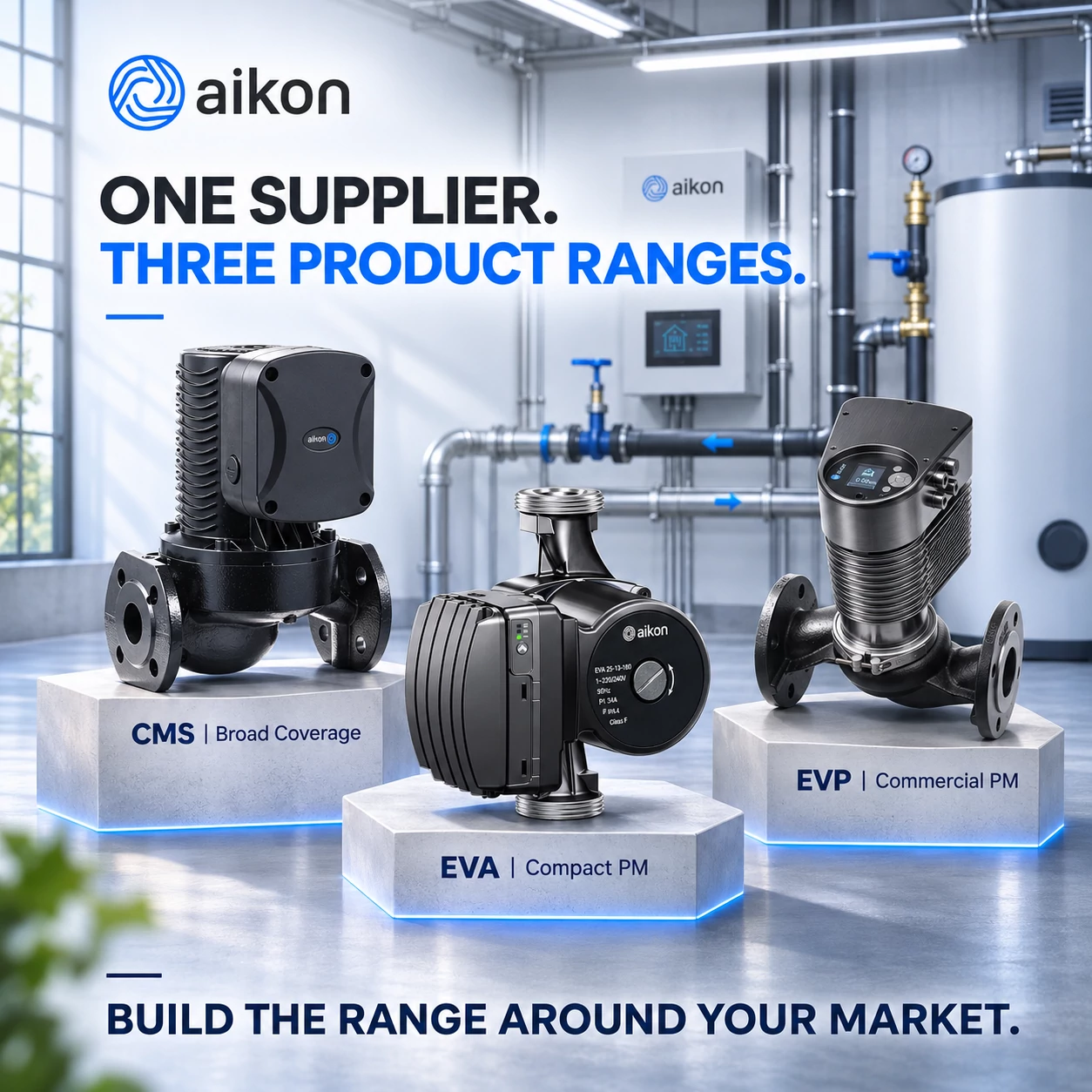
A strong circulation-pump range is not about stocking every available model. AIKON combines CMS, EVA and EVP to cover broad replacement demand, compact permanent-magnet circulation and larger commercial applications—giving distributors a clearer way to build a product portfolio around the customers they actually serve.
A distributor does not need another catalogue full of pump models.
The real question is:
What are your customers actually asking for?
One customer needs a replacement for an old heating pump.
Another wants a compact permanent-magnet circulator for a heat-pump system.
The next project requires a larger flanged pump for commercial HVAC.
If every requirement means introducing another unrelated product family, purchasing, stocking and selling quickly become complicated.
A better portfolio starts with customer demand—and gives each product family a clear role.
The goal is not more models. It is a clearer way to cover more customer needs.

Three Product Lines. Three Different Roles.
AIKON can now build the circulation-pump portfolio around three complementary ranges.
CMS — Broad Coverage and Replacement
CMS provides the broadest base.
The current range extends from DN20 through DN80 and includes different hydraulic levels, threaded and flanged configurations, plus single-phase and three-phase products.
That makes CMS particularly useful for:
traditional heating and circulation
different connection requirements
cross-reference and replacement enquiries
residential through commercial applications
Its role is simple:
Cover more of the existing market.
EVA — Compact Permanent-Magnet Circulation
EVA adds a different layer.
The current EVA range includes DN20, DN25 and DN32 permanent-magnet synchronous-motor pumps. The series operates on 230V / 50–60Hz, with maximum flow up to 8.5 m³/h and maximum head up to 14.5 m. Rated-point noise is specified below 38 dB.
Its application range includes heating, heating and cooling, solar heating, district heating with heat exchangers, domestic-hot-water production and DHW recirculation.
EVA therefore gives distributors an option for customers asking for:
compact permanent-magnet technology
lower-noise circulation
modern heating / cooling applications
heat-source and hot-water system upgrades
Its role is:
Add a modern permanent-magnet option to the smaller circulation range.
EVP — Permanent-Magnet Circulation for Larger Commercial Systems
EVP extends permanent-magnet technology into larger sizes.
The current range covers DN40, DN50, DN65 and DN80. It uses permanent-magnet synchronous motors, operates on 230V / 50–60Hz, and the documented models specify EEI ≤0.19. Liquid temperature can reach 110°C under specified conditions.
The portfolio includes models with maximum head up to 18 m, while the EVP80-120F has a rated flow of 37.41 m³/h. Applications include heating, cooling, solar thermal and ground-source heat-pump systems.
Its role is:
Extend the permanent-magnet range into commercial circulation.

Build the Range Around the Market
This creates a much clearer portfolio conversation.
Instead of asking:
“How many models should I stock?”
start with:
“What types of customers do I need to serve?”
A distributor could think about the range like this:

This does not mean every model needs to sit in stock.
The actual mix should reflect:
historical sales
local applications
fast-moving sizes
replacement enquiries
project demand
The manufacturer’s job is not to send the whole catalogue and say:
“Choose what you want.”
The better approach is to help turn the catalogue into a product mix that fits the distributor’s market.
One Supplier, Two Technology Paths
The combined range also gives distributors another useful choice.
Broad, Established Circulation Coverage
CMS
Different hydraulic duties, connection types and installation requirements.
Permanent-Magnet Circulation
EVA + EVP
EVA for smaller circulation requirements.
EVP for larger commercial circulation requirements.
That means a distributor can respond to both:
customers looking for practical replacement and conventional circulation solutions
and
customers moving toward permanent-magnet circulation technology
without building completely separate supplier relationships for each market direction.
From Your Best Sellers to an AIKON Product Mix
This is where AIKON can do more than provide product sheets.
Start with the distributor’s existing business:
current best-selling pump models
main applications
target market
common connection sizes
frequent replacement enquiries
demand for permanent-magnet products
Then map those needs against:
CMS + EVA + EVP
The result can be divided into:
Core Products
→ frequent everyday demand
Replacement Coverage
→ models selected around common old-pump enquiries
Permanent-Magnet Range
→ EVA / EVP for developing market demand
Project Models
→ lower-frequency commercial or application-specific requirements

Building or Expanding Your Circulation Pump Range?
You do not need to start with dozens of model numbers.
Start with what your customers already ask for.
Send AIKON:
your current best-selling models
main applications
target market
replacement demand
permanent-magnet product requirements
We can help map those needs across CMS, EVA and EVP.
Don’t build the range around the catalogue. Build it around your market.
Send us your current product list. We’ll help identify where CMS, EVA and EVP can fit.
FAQ
1.Do distributors need to stock CMS, EVA and EVP at the same time?
Not necessarily. The appropriate product mix depends on local applications, existing sales, customer demand and project frequency.
2.What is the main difference between CMS, EVA and EVP in the product portfolio?
CMS provides broad traditional circulation and replacement coverage. EVA adds a compact permanent-magnet range from DN20 to DN32, while EVP extends permanent-magnet circulation into DN40–DN80 commercial applications.
3.Can AIKON help decide which models should become core stock?
AIKON can map the product portfolio against the distributor's current sales and applications. Final stocking decisions should also reflect actual sales volume, lead time and local market demand.