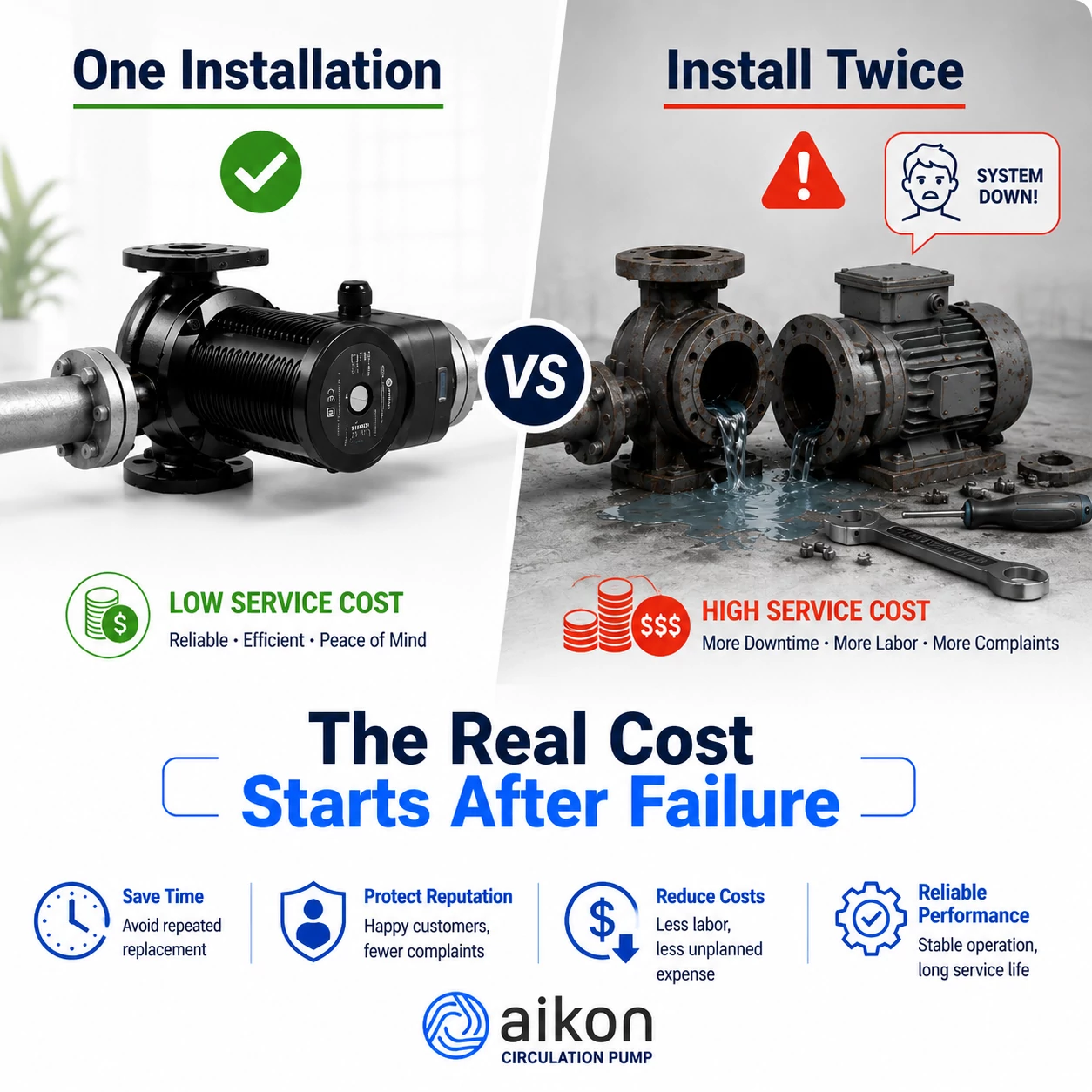
Circulation Pump Replacement Cost: Why Installing Twice Costs More

Category: ApplicationsPublished: 2026-07-24
Circulation Pump Replacement Cost: Why Installing Twice Costs More

Learn why a low-priced circulation pump can become expensive after installation. This article explains labor, draining, refilling, shipping, callbacks, and customer handling costs behind replacing a circulation pump.

The Most Expensive Circulation Pump Is the One You Install Twice

The price difference between two circulation pumps may look small at first.

One pump may cost less on the quotation. Another pump may cost more, but offer better stability, better testing, and better supplier support. For buyers, installers, and distributors, the real question is not only: Which pump is cheaper?

The better question is: What happens if the cheaper pump has to be installed twice?

A second installation may include another site visit, system isolation, draining, electrical disconnection, pump removal, new fittings, refilling, venting, testing, and customer complaint handling. That is why circulation pump replacement cost can be much higher than the pump price itself.

Quick Answer

The cheapest circulation pump can become the most expensive option when it has to be installed twice. The second installation may include technician labor, system isolation, draining, reconnection, replacement shipping, refilling, venting, testing, and customer complaint handling. Buyers should compare the cost per successful installation, not only the initial pump price.

Why Is Replacing a Circulation Pump More Expensive Than Buying One?

A circulation pump’s purchase price is only the first visible cost.

When a pump fails after installation, the buyer may face many extra costs. The installer may need to return to the site, stop the system, remove the old pump, install a new pump, and restart the system.

For HVAC, heating, and hot water circulation systems, this process is not always simple. The system may need to be isolated, drained, refilled, vented, and tested again before it can run normally.

So even if the supplier provides a replacement pump, the replacement is not truly free.

A free replacement pump does not make the replacement free.


This is why a low purchase price may not mean a low final cost.

Purchase Price vs Cost per Successful Installation

A more practical way to compare pumps is to calculate the cost per successful installation.

Cost per successful installation is a practical purchasing metric proposed in this article. It means:

Total purchasing, replacement, and service cost ÷ Number of pumps operating correctly after installation

For example, a distributor buys 100 pumps.


llustrative example only. Actual failure rates and service costs vary by supplier, application, and market.

The point is not that the higher-priced pump is always cheaper. The point is that two quotations are only truly comparable when quality risk, callback rate, and service cost are included.

When Does a Lower-Priced Pump Still Make Sense?

A lower-priced pump can still be reasonable in some situations.

It may fit temporary systems, non-critical applications, easy replacement locations, low labor-cost markets, or projects where the customer can handle repair locally.

But in other cases, stability should matter more than the lowest price. These include hotels, apartments, commercial buildings, heating-season operation, hard-to-access pump locations, OEM equipment, overseas replacement cycles, and private-label distribution.

In these applications, one pump failure can affect much more than the pump itself.

What Should Installers Check Before Choosing a Circulation Pump?

Before choosing a circulation pump, installers should check:

Duty point: flow and head

Voltage and frequency

Installation length

Thread or flange connection

Pump body material

Liquid temperature

Test records and batch consistency

A pump should match the real working conditions, not only the pipe size or the lowest quotation.

How AIKON Helps Reduce the Risk of a Second Installation

AIKON CMS Canned Motor Pumps are designed for circulation systems that require stable operation, low noise, compact installation, and reduced leakage risk.

To help customers reduce the risk of installing twice, AIKON supports the selection process before shipment.

First, AIKON can support duty-point verification. Customers can provide required flow, head, liquid temperature, pipe size, voltage, and frequency. This helps confirm a more suitable model before ordering.

Second, AIKON can support installation compatibility checks, including installation length, connection type, inlet and outlet size, pump body material, and electrical parameters.

Third, AIKON focuses on pre-shipment quality control. For B2B buyers, testing and inspection are important because they help reduce the chance of receiving a pump that creates noise, leakage, or early service problems.

Finally, AIKON can support a tested sample program for customers who want to evaluate performance before bulk orders. A tested sample helps buyers check installation, operation, and application fit before larger purchasing decisions.

FAQ

1.Is a warranty replacement really free?

A warranty may cover the replacement pump, but it may not cover technician labor, system draining, shipping, downtime, or customer handling. Buyers should confirm the warranty scope before purchasing.

2.Why is circulation pump replacement labor-intensive?

The system may need to be isolated or drained before removal. After installing the replacement pump, the system normally needs to be refilled, vented, and tested before operation resumes.

3.Should buyers always choose the more expensive pump?

No. Buyers should compare application risk, installation accessibility, supplier evidence, labor cost, and expected quality consistency. A higher price is justified only when the supplier can show additional value.

4What should installers compare besides pump price?

Installers should compare duty point, performance curve, installation length, connection type, voltage, materials, test records, warranty scope, and replacement support.

Conclusion

The most expensive circulation pump is not always the one with the highest quotation.

Sometimes, it is the one that must be removed, replaced, shipped again, installed again, and explained to the customer again.

For installers, distributors, and project buyers, the smarter comparison is not only pump price, but cost per successful installation.

Visit the AIKON CMS Canned Motor Pump product page to explore tested circulation pump solutions, request a CMS sample, or send your duty point for model selection support.

Products | AIKON Canned Motor Pumps | Canned Motor Pumps for HVAC & Liquid Cooling | AIKON