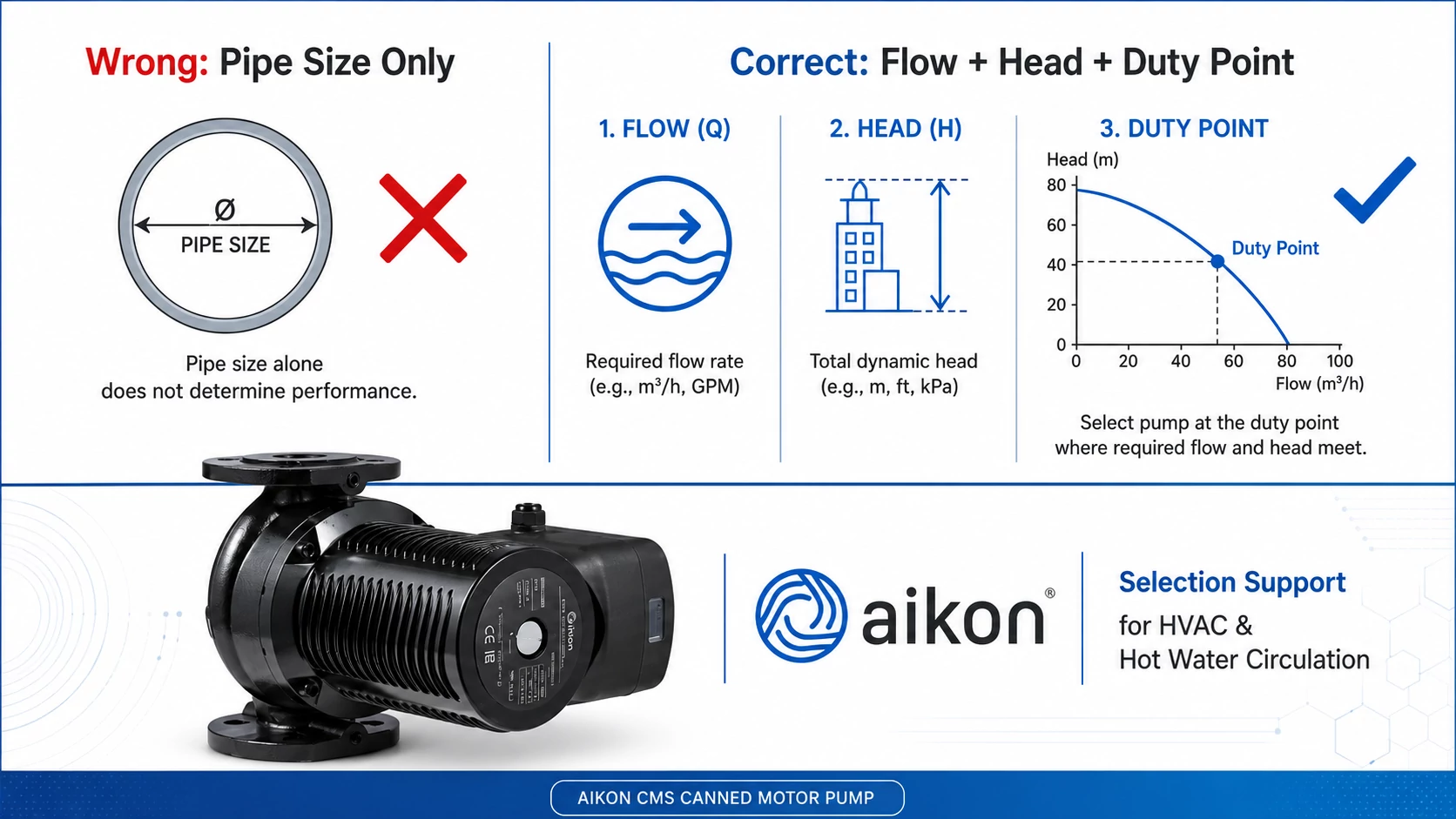
Circulation Pump Selection: Choose by Flow and Head, Not Pipe Size

Selection Jul 15, 2026 5 min read
Circulation Pump Selection: Choose by Flow and Head, Not Pipe Size

For many HVAC and hydronic projects, one common mistake is choosing a circulation pump only by pipe size.

For example, a buyer may say, “My pipe is DN25, so I need a DN25 pump.” This sounds simple, but it is not enough for correct circulation pump selection.

Pipe size only tells you the connection size. It does not tell you how much water the system needs, or how much resistance the pump must overcome.

A circulation pump should be selected by flow rate and head. Together, these two values create the pump’s duty point.

Why Pipe Size Is Not Enough

Two systems may use the same pipe size, but their pump requirements can be very different.

One system may have short pipes and only a few valves. Another system may have long pipelines, many elbows, heat exchangers, filters, and terminal units.

Even if both systems use the same pipe size, the required flow and head may not be the same.

If the pump is selected only by pipe size, it may be too small or too large. This can lead to poor circulation, noise, vibration, higher energy use, or customer complaints.

What Is Flow Rate?

Flow rate means how much liquid the pump needs to move in a certain time. It is usually shown as m³/h, L/min, or GPM.

In heating, cooling, or hot water systems, flow rate depends on the system demand.

A larger system usually needs more flow. A smaller system usually needs less flow.

For installers, the key point is simple: flow rate comes from the system requirement, not the pipe size.

What Is Head?

Head means the pressure the pump needs to move liquid through the system. It is usually shown in meters, feet, or kPa.

In a closed circulation system, head is mainly used to overcome resistance from:

Pipes

Elbows

Valves

Filters

Heat exchangers

Manifolds

Terminal units

A common misunderstanding is that pump head equals building height. In many closed hydronic systems, this is not correct. The pump mainly needs to overcome pipe and equipment resistance.

What Is a Duty Point?

The duty point is the working point of the pump. It includes both flow rate and head.

For example:

Flow rate: 3 m³/h

Head: 6 m

This means the pump should provide 3 m³/h of flow when working against 6 meters of head.

When engineers choose a pump, they should compare this duty point with the pump performance curve. A good selection means the pump can work near the required duty point in a stable and efficient way.

Simple Steps for Circulation Pump Selection

A simple pump selection process can follow these steps:

First, confirm the application. Is the pump used for HVAC, hot water circulation, floor heating, cooling, or another hydronic system?

Second, calculate or estimate the required flow rate.

Third, calculate the required head by checking the pipe length, fittings, valves, heat exchangers, and other resistance points.

Fourth, check the liquid temperature, power supply, installation direction, and working environment.

Finally, confirm the pump connection size. Pipe size is still important, but it should be checked after the flow and head are confirmed.

What If the Pump Is Too Small?

If the pump is too small, the system may not get enough flow.

This can cause weak heating, poor cooling, slow hot water return, or unstable circulation. In HVAC and floor heating systems, users may feel uneven indoor temperature.

What If the Pump Is Too Large?

A larger pump is not always better.

If the pump is too large, it may cause noise, vibration, energy waste, and system balancing problems.

The right pump should match the real flow and head requirement. This is why correct sizing is important for engineers and installers.

AIKON CMS Canned Motor Pumps for Circulation Systems

AIKON CMS Canned Motor Pumps are designed for circulation systems that require stable operation, low noise, compact structure, and reduced leakage risk.

They can be used in HVAC circulation, hot water circulation, heating systems, commercial building circulation, and other circulation applications.

For project selection, customers can share the required flow rate, head, liquid temperature, voltage, and installation conditions with AIKON for model selection support.

FAQ

1.Can I select a circulation pump by pipe size only?

No. Pipe size only helps confirm the connection. Correct circulation pump selection should be based on flow rate and head.

2.What is the most important point in pump selection?

The most important point is the duty point, which includes the required flow and head.

3.Is pump head the same as building height?

Not always. In many closed hydronic systems, pump head mainly overcomes pipe and equipment resistance.

Conclusion

Correct circulation pump selection should start with flow rate, head, and duty point, not pipe size.

Pipe size is important for installation, but it cannot replace proper pump sizing. For engineers and installers, choosing by flow and head helps reduce noise, avoid poor circulation, and improve system reliability.

Visit the AIKON CMS Canned Motor Pump product page to explore suitable circulation pump solutions and send your project parameters for selection support.

Product Page:

Request a Quote | Canned Motor Pumps for HVAC & Liquid Cooling | AIKON