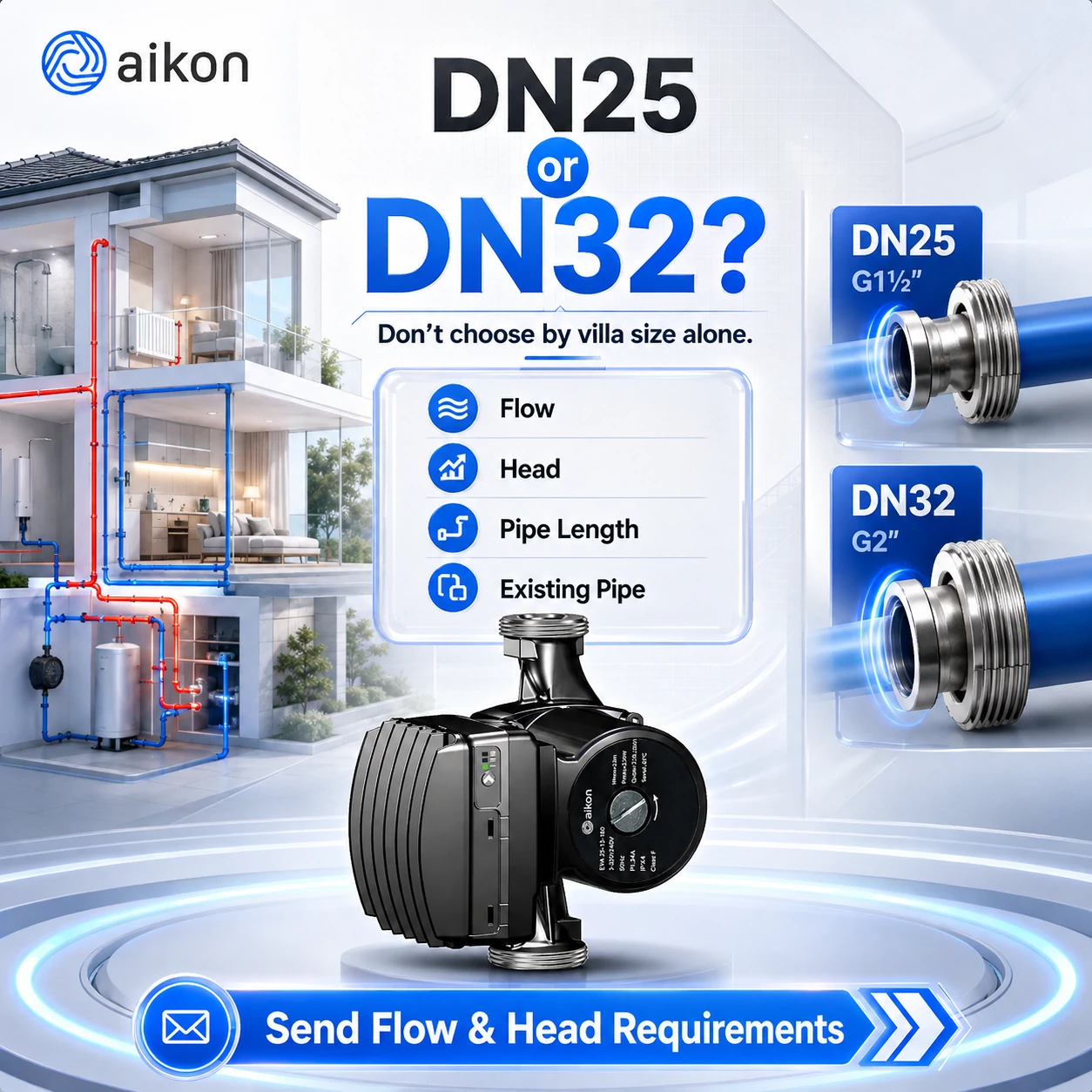
Learn how to choose DN25 or DN32 pump connection size for villa circulation systems based on flow, head, pipe length, pressure loss, and existing pipe size.
DN25 or DN32? How to Choose the Right Pump Connection Size
A buyer may ask a very simple question:
“For a villa circulation pump, should I choose DN25 or DN32?”
This sounds like a size question.
But in real projects, it is actually a system question.
Because the pump connection size does not decide everything. A DN25 pump can work well in the right system. A DN32 pump can still perform badly if the flow, head, or pipe layout is not matched.
So the answer is not:
“Villa means DN32.”
The better answer is:
Look at the water circuit first.
Quick Answer
Choose DN25 when the circulation demand is moderate, the pipe run is not too long, the existing main pipe is DN25, and the system pressure loss is acceptable.
Consider DN32 when the system needs higher flow, has longer pipes, more floors, more branches, higher pressure loss, or an existing DN32 main pipe.
The right size depends on flow, head, pipe velocity, pressure loss, and actual pipe size, not only the building type.
Why “Villa = DN32” Is Too Simple

Many buyers choose DN32 because it feels safer.
The thinking is easy to understand:
Bigger house. Bigger pipe. Bigger pump.
But this is not always correct.
If the system only needs moderate flow, and the existing pipe is DN25, using DN32 may only add cost and fittings. It may not improve circulation.
On the other hand, if the villa has long pipe runs, several bathrooms, multiple floors, or many branches, DN25 may create higher resistance or noise.
So DN25 or DN32 should not be decided by the word “villa.”
It should be decided by the actual system.
DN25 May Be Enough When the System Is Simple

DN25 is usually suitable when the project has:
- moderate circulation flow
- shorter pipe length
- fewer branches or loops
- existing DN25 main pipe
- limited installation space
- no high simultaneous water demand
For example, a small villa hot water return loop or a light heating circulation system may not need DN32.
In this case, DN25 can be a practical choice if the pump curve matches the required flow and head.
The key is not whether DN25 looks small.
The key is whether DN25 can deliver enough circulation without creating high pressure loss or noise.
DN32 Should Be Checked When the System Is Larger
DN32 becomes more reasonable when the project has:
- higher total flow demand
- longer circulation pipe length
- multiple floors
- multiple bathrooms or terminal branches
- higher pressure loss
- existing DN32 main pipe
- noise concern from high water velocity
- future expansion needs
For the same flow, a smaller pipe usually means higher water velocity. Higher velocity can bring more pressure loss and sometimes more noise.
So when the system needs more water movement, DN32 can help reduce resistance and make the circulation more stable.
But DN32 is not a magic answer.
If the pump flow and head are not matched, a larger connection size will not solve the problem.
Before Ordering, Check These Four Things
Before choosing DN25 or DN32, check:

A simple way to think about it:
DN25 may be enough when the system is moderate and the main pipe is DN25.
DN32 should be checked when the system needs higher flow, longer pipe runs, or already uses DN32 main pipe.
Do not choose by house size only.
Choose by the water system.
How AIKON Helps You Choose DN25 or DN32

For AIKON, the first question is not:
“Do you want DN25 or DN32?”
The better question is:
“What does your system need to circulate?”
AIKON CMS canned motor pumps are used in hot water circulation, heating, HVAC, floor heating, and commercial circulation systems.
Before recommending DN25 or DN32, AIKON checks the basic project conditions:
- application
- required flow
- required head
- pipe length
- existing pipe size
- number of floors or branches
- water temperature
- voltage and frequency
- installation space
This helps avoid two common mistakes:
choosing DN25 when the system needs DN32
or
choosing DN32 when DN25 is already enough
Not Sure Which Size to Choose?
Before ordering, send AIKON the basic project information.
You do not need a complete technical file.
Start with these:
Application: hot water / heating / HVAC / floor heating
Required flow and head
Pipe length or system layout
Existing main pipe size
Number of floors, branches, or loops
Water temperature
Voltage and frequency
Quantity and target market
OEM or private label requirements
AIKON can help check:
✓ whether DN25 is enough
✓ whether DN32 should be considered
✓ whether the pump is too small or too large
✓ whether pipe velocity may be too high
✓ which CMS model is more suitable
Suggested CTA:
Check My Pump Size
Send Flow & Head Requirements
FAQ
Is DN32 always better for a villa?
No. DN32 is useful for higher flow, longer pipes, or more branches. But for smaller villa circulation systems, DN25 may already be enough.
Can I choose pump size only by pipe diameter?
No. Pipe diameter matters, but pump selection should also consider flow, head, pipe length, pressure loss, and application.
What happens if DN25 is too small?
The system may have weak circulation, higher pressure loss, slower hot water return, or more noise.
What happens if DN32 is unnecessary?
It may increase cost and require extra fittings, without improving real circulation performance.
Strong CTA
Do not choose DN25 or DN32 only by building size.
A villa does not always need DN32.
DN25 is not always too small.
The right choice depends on flow, head, pipe length, pressure loss, and the existing main pipe size.
Send your project conditions to AIKON. AIKON can help check whether DN25 or DN32 is the better choice before ordering.