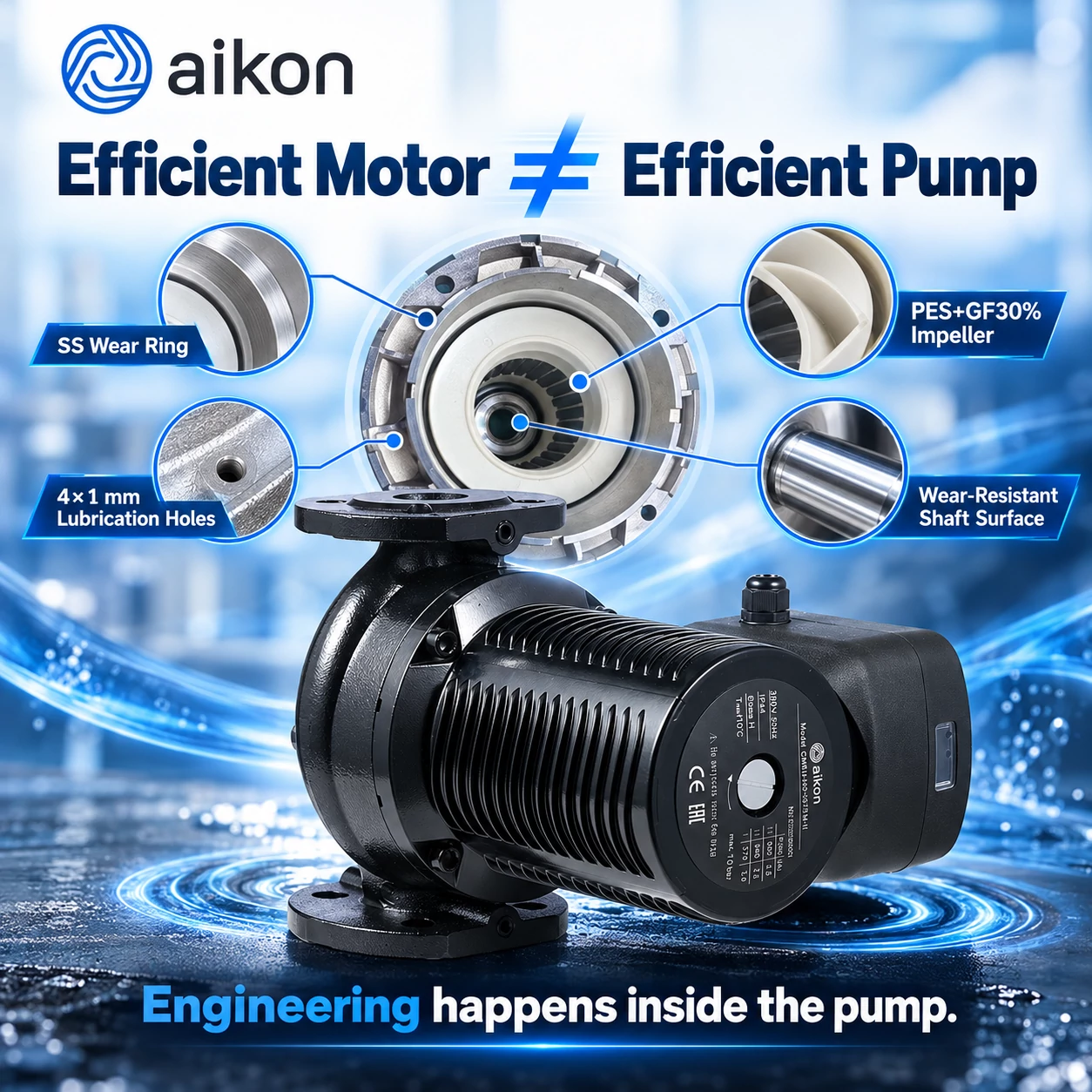
Learn why motor efficiency is only part of circulation-pump efficiency, and how CMS-Ⅱ uses specific hydraulic materials and internal structures to help control recirculation, wear and long-term performance loss.
A circulation pump can use an efficient motor.
But that does not automatically mean all that energy reaches the system.
The energy path is longer:
Electricity → Motor → Rotor → Impeller → Liquid → System
The motor may convert electrical power efficiently.
But after that, hydraulic losses can still occur inside the pump.
One of the easiest to overlook is internal recirculation.
If part of the pressurized liquid flows back through internal clearances instead of leaving the pump, the motor has already done the work—but the system does not receive the full benefit.
Motor efficiency is only the beginning.
Quick Answer
Pump efficiency depends on both motor performance and hydraulic design.
If critical clearances become too large, part of the high-pressure liquid can return toward the low-pressure side. This internal recirculation can reduce useful flow, increase hydraulic loss and contribute to less stable long-term performance.
That is why internal materials, wear-ring design, impeller stability and rotating-system support matter.
Where Does the Energy Go?
Internal recirculation is not an external leak.
The liquid stays inside the pump.
After the impeller raises the liquid pressure, most of the flow should move toward the outlet.
But some liquid can pass back through the clearance between high- and low-pressure regions.
That liquid then has to be accelerated and pressurized again.
The result is simple:
More internal work. Less useful hydraulic output.
Over time, this can contribute to:
- lower useful flow
- lower hydraulic efficiency
- more disturbed internal flow
- vibration and noise
- further performance loss as clearances wear
This is why the real question is not only:
“How efficient is the motor?”
It is:
“How much of that mechanical power becomes useful hydraulic power?”
How AIKON CMS-Ⅱ Controls the Hydraulic Side
AIKON CMS-Ⅱ does not rely on one single feature.
Several internal design choices work together to help maintain hydraulic stability.
1. Stainless-Steel Sealing Ring Seat + Wear Ring

CMS-Ⅱ uses a stainless-steel sealing ring seat and sealing wear ring at the hydraulic interface.
This structure is designed to help control the critical clearance between the high- and low-pressure regions of the pump.
Why does that matter?
Because better clearance control helps:
reduce unwanted internal recirculation
support volumetric efficiency
protect the pump body and impeller
reduce the risk of hydraulic performance degrading as wear develops
The value is not the stainless steel itself.
The value is what the structure helps protect:
useful hydraulic output.
2. Impeller Material Helps Preserve Hydraulic Geometry

Hydraulic efficiency also depends on the impeller keeping its intended shape.
For CMS-Ⅱ sizes below DN65, AIKON uses PES + GF30% — polyethersulfone reinforced with 30% glass fibre.
The material is selected for properties including:
high rigidity
dimensional stability
heat resistance
hydrolysis resistance
For larger sizes, CMS-Ⅱ uses stainless-steel impellers to support higher mechanical loading.
Why is this important?
Because even small changes in impeller geometry can affect how energy is transferred to the liquid.
A dimensionally stable impeller helps the hydraulic path remain closer to its intended design during long-term operation.
3. Four 1 mm Circulation Holes Support Bearing Lubrication and Cooling
Hydraulic stability also depends on the rotating assembly remaining stable.
CMS-Ⅱ uses four 1 mm circulation holes in the pump-cover area to guide the working medium through the bearing cavity.
This helps support:
bearing lubrication
bearing cooling
air removal
axial-force balance
At the same time, CMS-Ⅱ uses enlarged radial-bearing support.
Why does this matter hydraulically?
Because if the shaft and impeller begin to move less steadily, vibration increases and critical hydraulic clearances can become less stable.
So bearing design is not only a mechanical issue.
It also supports the hydraulic system.
4. Wear Resistance Matters After Thousands of Hours
CMS-Ⅱ also uses tungsten-carbide wear-resistant treatment at the shaft bearing position.
The purpose is to help control wear at a critical rotating interface.
Again, the customer value is not simply:
“tungsten carbide.”
It is:
better wear resistance → more stable rotating support → lower risk of long-term clearance change and vibration.
These are small internal details.
But together they influence two important questions:
How much hydraulic energy stays useful?
And how stable does that performance remain over time?
Don’t Compare Pump Efficiency by Motor Data Alone
When comparing two circulation pumps, buyers often look at:
Power
Flow
Head
Motor efficiency
Those numbers matter.
But they do not show everything happening inside the hydraulic path.
Also ask:
How are critical clearances controlled?
What material is the impeller made from?
How are the bearings lubricated and cooled?
How is long-term wear controlled?
Two pumps may look similar on a datasheet.
The real difference may be hidden inside.
What This Means for the Customer
AIKON CMS-Ⅱ is not selling a sealing ring, an impeller material or four small circulation holes as isolated features.
The customer value is:
more useful hydraulic output
less wasted internal circulation
more stable long-term hydraulic performance
lower risk of performance degradation as wear develops
That is the difference between selling parts and selling engineering value.
Comparing Two Pumps?
Send AIKON:
application
required flow
required head
liquid temperature
expected operating hours
We can help compare more than motor efficiency and headline data.
Send us your flow + head. Let’s look at what happens after the motor.
FAQ
1.Does an efficient motor guarantee an efficient pump?
No. Overall pump efficiency also depends on internal hydraulic losses, recirculation, impeller design and operating point.
2.What causes internal recirculation?
Internal recirculation occurs when part of the higher-pressure liquid flows back toward a lower-pressure region through internal clearances instead of leaving the pump as useful system flow.
3.Does CMS-Ⅱ eliminate hydraulic loss?
No. No real pump operates without hydraulic losses. CMS-Ⅱ uses specific hydraulic and mechanical design features intended to help control internal recirculation, wear and long-term hydraulic instability.