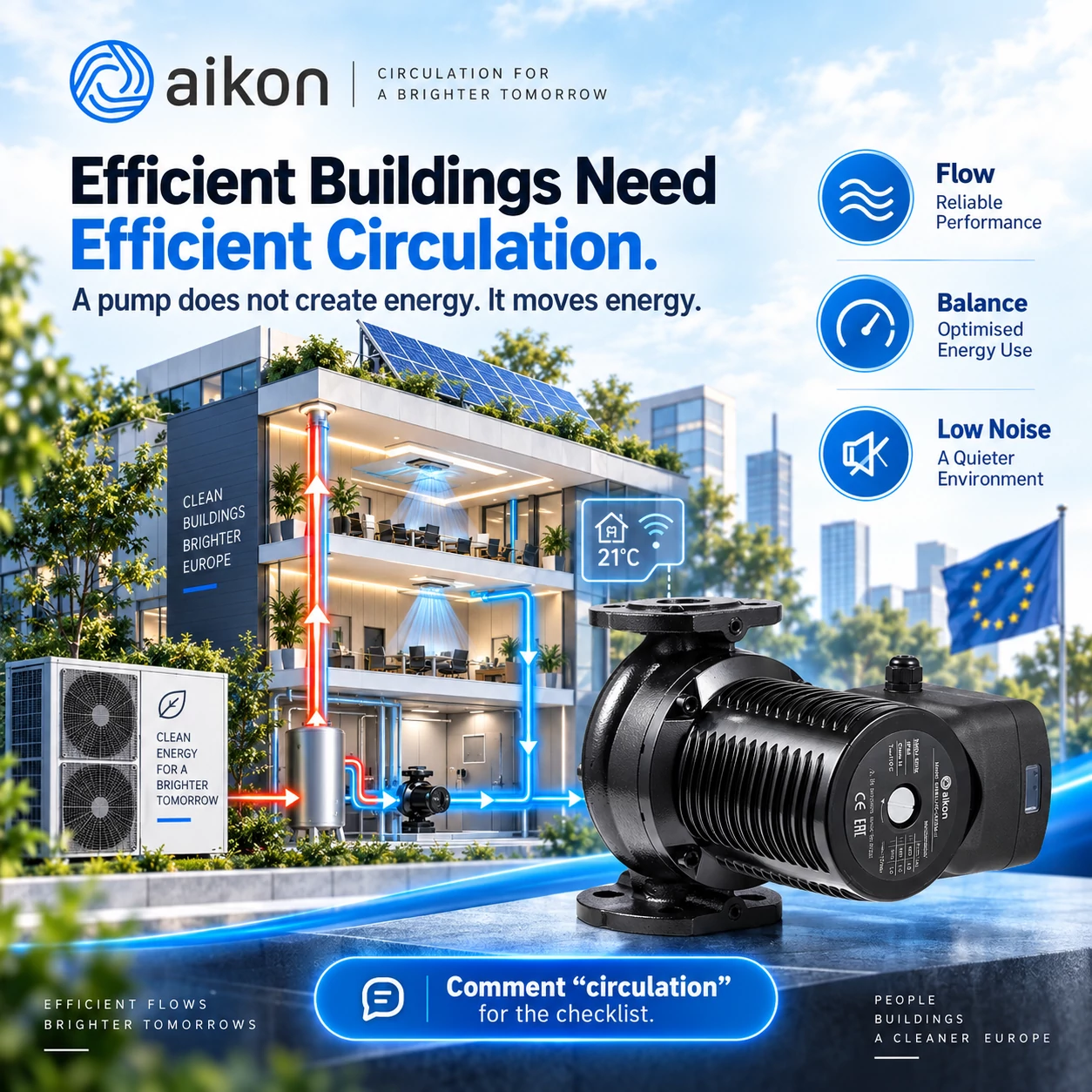
Learn why Europe’s building-efficiency push should not ignore circulation pumps, and how AIKON CMS supports stable circulation for heating, cooling, hot water, HVAC, liquid cooling, and commercial systems.
Europe is talking about more efficient buildings.
Most people immediately think of:
heat pumps, insulation, solar panels, smart controls, and high-efficiency chillers.
These are important.
But inside many heating, cooling, hot water, HVAC, and liquid-cooling systems, there is another component that is easy to overlook:
the circulation pump.
A pump does not create energy.
It moves energy.
If the heat, cooling, or working liquid cannot move through the system properly, the whole building may lose efficiency, comfort, and reliability.
Quick Answer
European building-efficiency policy does not directly say, “Use canned motor pumps.”
But it is raising expectations for building systems. The EU says buildings account for around 40% of EU energy consumption, and around 80% of energy used in EU homes is for heating, cooling, and hot water. The revised Energy Performance of Buildings Directive also entered into force on 28 May 2024.
So the real question is not only:
How do we produce energy efficiently?
It is also:
How do we circulate and deliver that energy efficiently?
Why Pumps Matter in Efficient Buildings

A heating or cooling system is a chain:
Energy source → circulation pump → pipe network → terminal units → comfort or cooling performance
If circulation is weak, unstable, noisy, or poorly balanced, better equipment may still underperform.
Common problems include:
- heat or cooling not reaching far-end zones
- slow hot water return
- unstable room comfort
- higher operating time
- pump noise complaints
- leakage or maintenance concerns
This is why pump selection should not be treated as a small detail.
In many projects, the pump is the part that decides whether the system can actually deliver what the main equipment produces.
What Europe’s Policy Direction Really Means

Europe’s policy direction is not pump-specific marketing.
It is system-efficiency pressure.
The revised EPBD focuses on improving the energy performance of buildings and moving toward a decarbonised building stock. It also covers building systems such as space heating, space cooling, ventilation, domestic hot water, automation and control, and energy storage.
At the product level, the EU already has ecodesign requirements for glandless standalone circulators and glandless circulators integrated in products under Regulation (EC) No 641/2009.
This does not mean every project must use a canned motor pump.
But it does show one thing clearly:
Circulation equipment is part of the efficiency conversation.
Why Canned Motor Pumps Deserve Attention
A conventional pump usually relies on a motor, shaft, and mechanical seal.
A canned motor pump uses an integrated motor-pump structure, helping reduce leakage concerns related to traditional shaft sealing.
For modern building systems, this structure becomes relevant when the project needs:
low-noise operation
reduced leakage concern
compact installation
long-hour circulation
lower maintenance pressure
These needs are common in:
residential heating upgrades, commercial HVAC, hot water circulation, equipment cooling, liquid cooling, hotels, hospitals, offices, and technical rooms.
A canned motor pump is not just another pump name.
It is a different structure for systems where circulation quality matters.
Where AIKON CMS Fits

AIKON CMS canned motor pumps can be applied in heating, cooling, hot water, HVAC, liquid cooling, equipment cooling, and commercial circulation systems.
AIKON CMS focuses on:
stable flow delivery
low-noise operation
compact installation
reduced leakage concern
flow and head matching
long-hour circulation support
For building efficiency projects, the pump should not be selected only by pipe size or price.
It should be checked by:
application, liquid type, flow, head, temperature, pipe length, system resistance, voltage, installation space, and operating time.
The goal is not simply to make liquid move.
The goal is to keep circulation stable enough for the whole system to perform.
Not Sure If the Pump Fits the System?
Before choosing a pump, start with a few simple questions:
What is the system used for?
Heating, cooling, hot water, HVAC, liquid cooling, or equipment cooling?
What liquid is circulating?
Clean water, glycol solution, coolant, or another working liquid?
What flow and head are required?
These decide whether the pump can match the real duty point.
What matters most in the project?
Noise, leakage concern, installation space, operating hours, or maintenance pressure?
With this information, AIKON can help check whether the pump is too small, too large, or not matched to the actual circulation loop.
Suggested CTA:
Comment “circulation” and we’ll send a pump selection checklist.
FAQ
Does European policy directly require canned motor pumps?
Usually no. European policy mainly pushes higher building and equipment efficiency. Canned motor pumps fit this direction when stable circulation, low noise, reduced leakage concern, and long-hour operation matter.
Why are pumps important in efficient buildings?
Because heating, cooling, hot water, and liquid-cooling systems depend on moving liquid through the system. Poor circulation can reduce real system performance.
Where can AIKON CMS be used?
AIKON CMS can be applied in heating, cooling, hot water, HVAC, liquid cooling, equipment cooling, and commercial circulation systems. Final selection should be based on flow, head, liquid type, temperature, system resistance, and operating conditions.
Europe wants more efficient buildings.
But efficiency is not only about the equipment that creates energy.
It is also about the components that move energy.
Save this checklist before your next HVAC, heating, hot water, or liquid-cooling project.