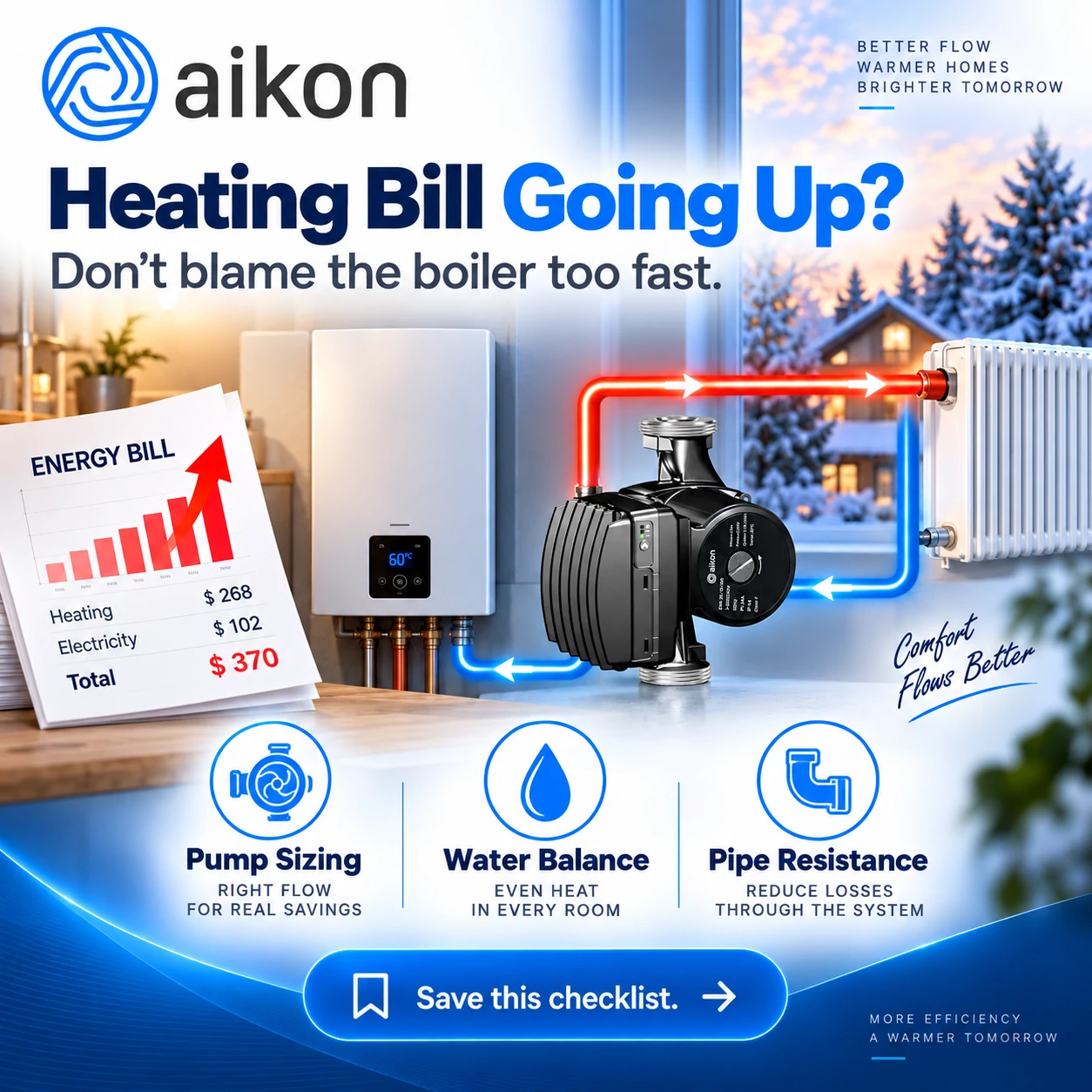
Learn why a rising heating bill may not be caused only by the boiler, and how circulation pump selection, water balance, filters, valves, and pipe resistance affect heating efficiency.
Your heating bill keeps going up.
The first suspect is usually the boiler.
That makes sense. The boiler creates heat. If heating costs rise, many people assume the boiler is old, inefficient, or not powerful enough.
But the boiler is only one part of the system.
A heating system also needs to move heat through pipes, radiators, floor heating loops, or terminal units. If circulation is poor, the system may run longer, feel less comfortable, and still waste energy.
So before replacing the boiler, it is worth asking:
Is the heat being circulated properly?
Quick Answer
A rising heating bill may be caused by the boiler, but it can also come from poor circulation.
Common circulation-side problems include old pumps, oversized or undersized pumps, poor water balance, blocked filters, air in the system, higher pipe resistance, or wrong pump operation mode.
The heat source creates heat.
The circulation system decides how well that heat is delivered.
Why Heating Cost Is Not Only About the Boiler

A good boiler cannot fix every heating problem.
If the pump is not matched to the system, heat may not reach every room evenly. Some areas stay cold, so users raise the thermostat. The system runs longer, but comfort still feels unstable.
In other cases, the pump may be too large. That can create noise, unnecessary flow, valve stress, and extra electricity use.
A heating system should not only produce heat.
It should deliver heat efficiently.
What to Check Before Replacing Major Equipment

Before assuming the boiler is the problem, check the circulation side first:

The problem is not always “not enough heat.”
Sometimes it is:
the heat is not moving efficiently.
How AIKON CMS Helps from the Circulation Side

AIKON CMS canned motor pumps are designed for heating, hot water, HVAC, floor heating, and commercial circulation systems.
For heating projects, AIKON focuses on practical system needs:
stable circulation
low-noise operation
compact installation
reduced leakage concern
flow and head matching
AIKON does not recommend choosing a pump only by pipe size or price.
The right pump should match the actual system: pipe length, required flow, required head, water temperature, operating hours, and installation conditions.
A suitable pump will not solve every heating bill problem. Insulation, energy price, outdoor temperature, controls, and user habits also matter.
But if circulation is wrong, the system may never operate efficiently.
Not Sure Where the Energy Loss Starts?
You do not need a complete technical file.
Start with these details:
Current pump model
Application: radiator heating / floor heating / hot water / HVAC
Required or estimated flow and head
Pipe length or system layout
Water temperature
Voltage and frequency
Problem description: high bill / uneven heating / pump noise / slow warm-up
AIKON can help check whether the pump may be too small, too large, inefficient, or not matched to the real duty point.
Suggested CTA:
DM us your pump model and system details—we’ll help check the circulation side first.
FAQ
Can a circulation pump affect heating bills?
Yes. If the pump is poorly selected, oversized, undersized, blocked by system resistance, or running inefficiently, it may contribute to higher operating cost.
Should I replace the boiler if my heating bill is rising?
Not immediately. First check insulation, controls, user habits, outdoor temperature, energy price, and the circulation system.
Is a bigger pump more energy efficient?
No. A bigger pump may increase noise, energy use, and balancing problems. The pump should match the real flow and head requirement.
A rising heating bill does not always mean the boiler is the only problem.
Before replacing major equipment, check whether heat is moving efficiently through the system.
Save this checklist for your next heating system inspection.