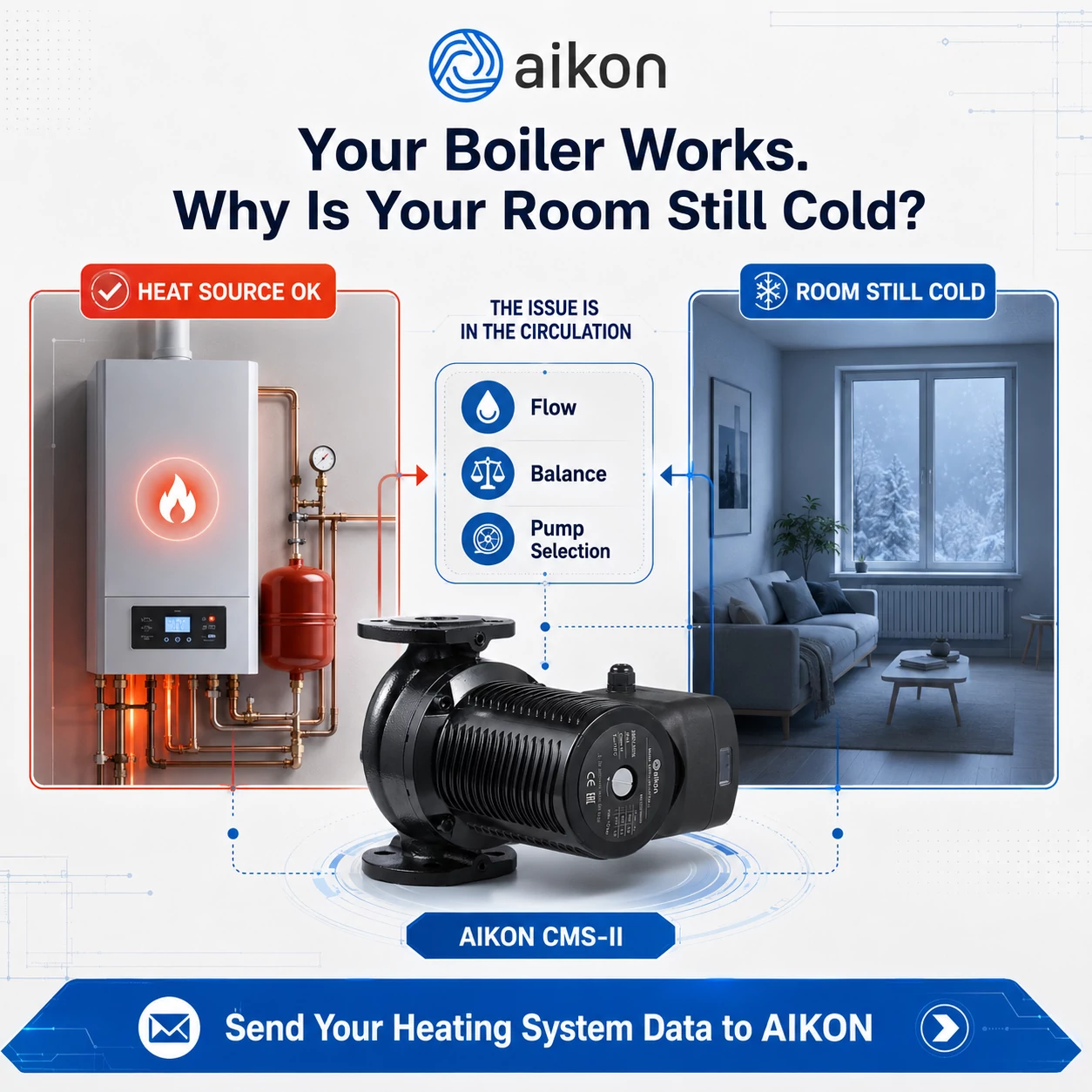
Learn why heating projects may fail even when the heat source works. This article explains how circulation, pump selection, flow balance, and system design affect real heating performance.
The boiler is running.
The heat pump is working.
The supply water temperature looks normal.
But the room is still cold.
This is one of the most common complaints in heating projects.
Many people immediately blame the heat source:
“The boiler is not powerful enough.”
But in many real projects, the heat source is not the problem.
The heat has already been created.
The real problem is:
Can the circulation system deliver that heat to every room efficiently?
A heating system is not only a heat production system.
It is a heat delivery system.
Quick Answer
A heating project can fail even when the heat source works because the circulation system cannot distribute heat effectively.
Common causes include:
- insufficient flow
- incorrect pump selection
- poor hydraulic balance
- air inside the system
- blocked filters
- unsuitable pipe design
The heat source creates heat.
The circulation system decides whether that heat reaches the room.
Who This Article Is For
This article is useful for:
Installers
Who face:
- cold room complaints
- uneven heating
- slow floor heating response
Distributors
Who help customers select:
- heating circulation pumps
- HVAC circulation solutions
- floor heating pumps
Project Buyers
Who care about:
- system reliability
- energy efficiency
- long-term operating cost
Engineers
Who need to match:
- flow
- head
- system resistance
- actual heating demand
The Real Problem: Heat Exists, But It Cannot Reach the Room

A heating system works through:
Heat Source → Pump → Pipe System → Heating Terminal → Room
The heat source creates energy.
The circulation system transports that energy.
When circulation is poor, customers may see:
- hot supply water but cold rooms
- warm areas near the heat source but cold remote areas
- slow floor heating response
- unstable room temperature
In these situations, increasing heat source power may not solve the problem.
Because the problem is not:
“Not enough heat.”
The problem is:
“The heat is not delivered correctly.”
Problem 1: Insufficient Flow
Water circulation is the method that transfers heat.
If flow is too low, the system cannot carry enough heat to the terminal side.
Typical symptoms:
- heating starts slowly
- far rooms stay cold
- floor heating takes too long to warm up
Possible causes:
- pump flow is insufficient
- pump head is not enough
- system resistance is too high
- pipe layout creates excessive pressure loss
The solution is not always a larger heat source.
The system may need a better circulation match.
Problem 2: Poor Hydraulic Balance

Many heating systems contain multiple loops.
For example:
- floor heating circuits
- different room zones
- multiple terminal units
If the system is not balanced:
Short loops may receive too much flow.
Long loops may receive too little flow.
The result:
- some rooms become too warm
- some rooms remain cold
- energy consumption increases
- comfort decreases
A good circulation system is not about pushing the most water.
It is about delivering the right amount of water to the right place.
Problem 3: Wrong Pump Selection
One common mistake is selecting a pump only by pipe size.
For example:
“The pipe is DN25, so choose a DN25 pump.”
But pipe size only describes the connection.
The pump should match:

The correct pump is not the strongest pump.
It is the pump that matches the real duty point.
What Installers Should Check Before Replacing Equipment
Before changing the heat source or replacing the pump, check:
System Side
- Is the system filled correctly?
- Is there air inside the pipes?
- Are filters clean?
- Are valves open?
- Is hydraulic balance correct?
Pump Side
- Is flow enough?
- Is head enough?
- Is the pump suitable for the system resistance?
- Is the pump running under the correct condition?
Many heating problems can be solved by correcting circulation instead of increasing heat source capacity.
AIKON CMS Solution for Heating Circulation

For heating, HVAC, floor heating, and hot water circulation systems, AIKON CMS circulation pumps are designed to support:
- stable circulation
- low noise operation
- compact installation
- long-term reliability
AIKON focuses on matching pump performance with the real application.
The correct pump selection depends on:
- required flow
- required head
- pipe length
- water temperature
- system resistance
- installation environment
This helps reduce common project problems:
- weak circulation
- uneven heating
- excessive noise
- unnecessary energy consumption
AIKON Application Value
For heating projects, the pump is not just a component.
It directly affects:
Heating Comfort
Better circulation helps deliver heat more evenly.
System Stability
Correct flow and head matching reduce operating problems.
Maintenance Cost
A suitable pump reduces unnecessary adjustment and replacement.
Customer Satisfaction
The end user does not care about the heat source specifications.
They care about one thing:
“Is my room warm enough?”
What to Send AIKON for Pump Selection
To recommend the suitable circulation pump, please provide:
Application
Heating / HVAC / Floor Heating / Hot Water Circulation
System Information
- Heating area
- Number of loops
- Pipe length
- Required flow
- Required head
- Water temperature
- Voltage and frequency
Installation Information
- Pump installation position
- Connection size
- Operating hours
- Environment condition
AIKON can help evaluate:
✓ Pump model selection
✓ Flow and head matching
✓ Application suitability
✓ Long-term operating requirements
FAQ
1.Why is my heating system cold even though the boiler works?
Because heat production and heat delivery are different. The heat source may work normally, but poor circulation can prevent heat from reaching the rooms.
2.Can a bigger pump solve heating problems?
Not always. An oversized pump may create noise, unstable balancing, and unnecessary energy use.
3.What is the most important factor when selecting a heating pump?
The pump should match the actual duty point:
Flow + Head + System Resistance
4.Is circulation as important as the heat source?
Yes. The heat source creates heat, but circulation determines whether the heat reaches the room.
Strong CTA
The heat source creates heat.
The circulation system delivers heat.
If your heating project has:
- cold rooms
- slow warm-up
- uneven temperature
- weak circulation
do not only check the heat source.
Send your flow, head, pipe length, water temperature, and application details to AIKON for circulation pump selection support.