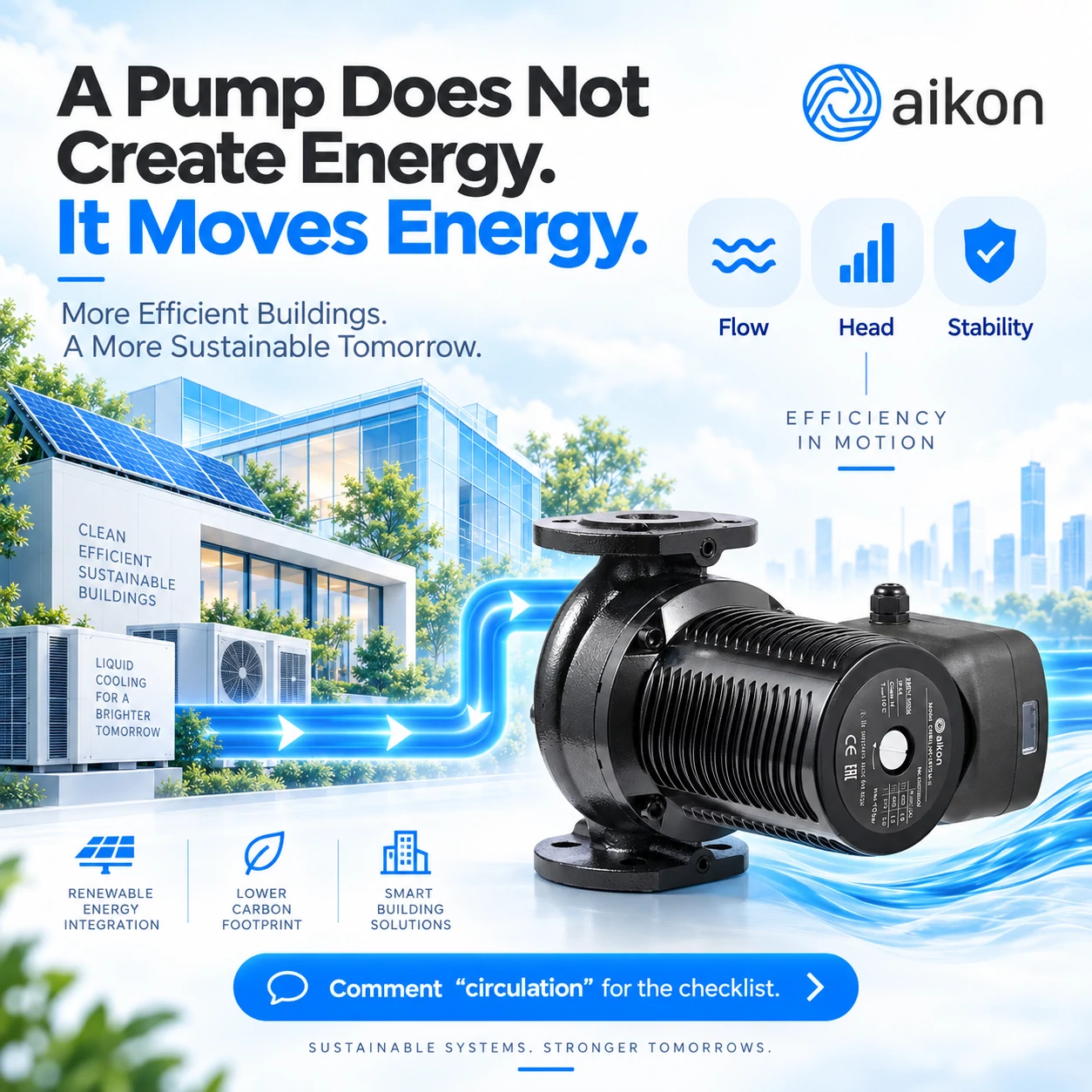
Learn why circulation pumps are becoming more important in energy-efficient buildings, and how AIKON CMS supports stable circulation for heating, cooling, hot water, HVAC, liquid cooling, and commercial systems.
When people talk about energy-efficient buildings, they usually mention solar panels, heat pumps, insulation, smart controls, or high-efficiency chillers.
But there is another component working quietly behind many of these systems every day:
the circulation pump.
A pump does not create energy.
It moves energy.
In heating, cooling, hot water, HVAC, liquid cooling, and commercial circulation systems, stable circulation decides whether energy can actually reach the place where it is needed.
Without stable circulation, even a good heat source or cooling unit may not deliver its full performance.
Quick Answer
Energy efficiency is not only about producing cleaner energy. It is also about moving energy efficiently.
A circulation pump helps move hot water, chilled water, coolant, or other working liquid through the system. If the pump is poorly selected, noisy, unstable, or difficult to maintain, the whole system may lose performance.
That is why canned motor pumps are becoming more relevant in modern circulation systems.
Why a Small Pump Matters in a Large System

In many projects, the pump is treated as a small accessory.
But once the system starts running, the pump affects:
- whether heat or cooling reaches the terminal side
- whether hot water returns quickly
- whether liquid cooling can carry heat away
- whether the system runs quietly
- whether leakage becomes a maintenance concern
- whether energy is wasted through poor circulation
A building does not only need energy generation.
It needs energy delivery.
That is where circulation becomes important.
What Is a Circulation Pump?
A circulation pump moves liquid through a closed or semi-closed loop.
It can be used in:
heating systems
cooling systems
hot water circulation
heat pump systems
commercial HVAC
liquid-cooling systems
industrial circulation loops
The real questions are simple:
Is the flow enough?
Is the head matched to system resistance?
Can the pump run quietly for long hours?
Can leakage and maintenance risk be reduced?
These questions are becoming more important because global energy policy is pushing buildings and equipment toward higher efficiency.
Why Global Policy Is Raising the Standard

Governments are not usually saying, “Use this exact pump.”
They are pushing a bigger direction:
higher building efficiency, better heating and cooling performance, lower energy use, and more efficient equipment.
In the EU, buildings account for around 40% of energy consumption, and the revised Energy Performance of Buildings Directive is designed to accelerate building efficiency and decarbonisation. The European Commission also highlights heating, cooling, and domestic hot water as key building-system areas.
The EU also has ecodesign requirements for glandless standalone circulators and glandless circulators integrated in products under Regulation (EC) No 641/2009.
In the United States, the Department of Energy has adopted energy conservation standards for circulator pumps, with compliance required from May 22, 2028.
China’s carbon policy direction includes peaking carbon dioxide emissions before 2030 and achieving carbon neutrality before 2060.
Japan is also tightening building-efficiency requirements, with energy-saving standards becoming mandatory in principle for all new residential and non-residential buildings from April 2025.
Brazil’s building-efficiency work includes PBE Edifica and Procel-related building labeling and efficiency evaluation frameworks.
The message is clear:
Future systems must not only produce energy efficiently.
They must circulate it efficiently.
Why Canned Motor Pumps Fit This Direction
A traditional pump usually depends on a motor, shaft, and mechanical seal.
A canned motor pump uses an integrated motor-pump structure, helping reduce leakage concerns related to traditional shaft sealing.
For modern circulation systems, this matters because customers increasingly care about:
low noise
reduced leakage risk
long-hour operation
compact installation
lower maintenance pressure
These needs are obvious in homes, hotels, hospitals, commercial buildings, equipment rooms, HVAC systems, and liquid-cooling applications.
AIKON CMS: Designed for Future Circulation Needs

AIKON CMS canned motor pumps can be applied in heating, cooling, hot water, HVAC, liquid cooling, equipment cooling, and commercial circulation systems.
For these applications, AIKON CMS focuses on practical circulation needs:
stable flow delivery
low-noise operation
compact installation
reduced leakage concern
flow and head matching
long-hour circulation support
The goal is not simply to make liquid move.
The goal is to keep circulation stable enough for the whole system to perform.
For heating, cooling, HVAC, or liquid-cooling projects, pump selection should not be based only on connection size or price. It should be checked by flow, head, liquid type, temperature, system resistance, installation space, and operating hours.
Not Sure If the Pump Fits the Circulation Loop?
Before choosing a pump, you do not need a complete technical file.
Start with a few simple questions:
What is the system used for?
Heating, cooling, hot water, HVAC, or liquid cooling?
What liquid is circulating?
Clean water, glycol solution, coolant, or another working liquid?
What flow and head do you need?
These two numbers decide whether the pump can move enough heat or cooling through the loop.
What does the system look like?
Pipe length, liquid temperature, system resistance, operating hours, voltage, and installation space all matter.
With this information, AIKON can help check whether the pump is likely to be too small, too large, or not matched to the real duty point before you order.
Suggested CTA:
DM us your flow and head—we’ll help check whether the pump fits your circulation loop.
FAQ
Why are circulation pumps important for energy-efficient buildings?
Because energy must be delivered through water or liquid circuits. Poor circulation can reduce heating, cooling, hot water, HVAC, or liquid-cooling performance.
Do policies directly require canned motor pumps?
Usually no. Policies mainly promote higher building and equipment efficiency. Canned motor pumps fit this direction because they support stable circulation, low noise, reduced leakage concern, and long-hour operation.
Where can AIKON CMS be used?
AIKON CMS can be applied in heating, cooling, hot water, HVAC, liquid cooling, equipment cooling, and commercial circulation systems. Final model selection should be checked according to flow, head, liquid type, temperature, pressure loss, and operating conditions.
The future of energy efficiency is not only about generating cleaner energy.
It is also about moving energy more efficiently.
Behind every efficient heating, cooling, hot water, HVAC, or liquid-cooling system, there must be a reliable circulation solution.
Save this checklist for your next building, HVAC, or liquid-cooling project.