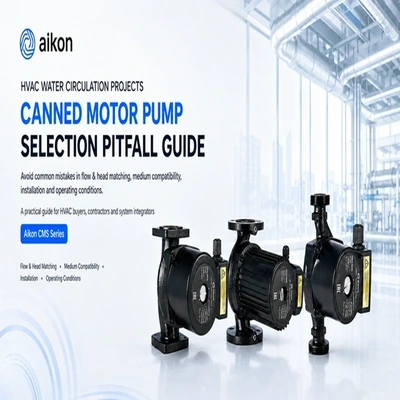
A practical guide for HVAC professionals to avoid common canned motor pump selection mistakes. Learn how to select the right pump based on flow, head, temperature, installation, electrical requirements, and system conditions for reliable heating and cooling circulation.
For HVAC contractors and purchasing managers, selecting the right canned motor circulation pump directly affects system stability, long-term energy consumption, and overall project returns. A seemingly small selection mistake can lead to cavitation, overheating, abnormal noise, seal failure, premature pump replacement, additional rework costs, and after-sales problems.
This guide summarizes the most common and critical mistakes in HVAC canned motor pump selection, covering five key areas: hydraulic parameter matching, medium compatibility, pump structure, operating conditions, and electrical or auxiliary configuration.
1. Hydraulic Selection Mistakes: Looking Only at Rated Parameters
1.1 Selecting Flow and Head Without Allowing for Actual Operating Conditions
Many pump selections are based directly on the rated flow and head shown on design drawings, without considering pipeline resistance, changes in medium temperature, aging of the pipe network, liquid-level fluctuations, and other operating losses. As a result, the pump may operate for long periods under a high-flow, low-head condition outside its efficient operating range. This can lead to excessive current, overheating, cavitation, and accelerated bearing wear.
However, higher head is not always better. An oversized pump may also operate far away from its best efficiency point. Running at a higher speed than the system requires wastes energy, creates additional noise, increases system pressure and flow, and may accelerate internal scaling.
How to avoid it: For normal operating conditions, allow approximately 10%–20% flow margin and 15%–25% head margin. High-temperature systems, long pipelines, and systems with multiple elbows may require greater allowance.
1.2 Confusing Rated Head with Actual System Head
A common mistake is to consider only the vertical lifting height while ignoring friction losses and local resistance from valves, elbows, filters, and heat exchangers.
This can result in insufficient pump head and system flow below the design requirement.
Canned motor pumps rely on the circulating medium for internal cooling and bearing lubrication. Insufficient circulation may therefore affect internal cooling performance and increase the risk of motor damage.
2. Medium Compatibility Mistakes: Ignoring Temperature, Cleanliness, and Viscosity
2.1 Ignoring the Effect of Medium Temperature
Using a standard pump under unsuitable high-temperature conditions can affect the containment sleeve, motor insulation, internal cooling circulation, and bearing lubrication.
For high-temperature applications, the pump configuration must match the actual medium temperature. If a system requires special cooling or an independent circulation design, relying only on internal self-cooling may lead to overheating and shutdown.
2.2 Ignoring Medium Cleanliness
A circulation pump suitable for one heating system may not be suitable for every circulating medium. The liquid used in HVAC circulation systems should be clean, free from solid particles and mineral oil, non-toxic, chemically neutral, and close to clean water in its properties.
Unlike a conventional centrifugal pump, a canned motor pump uses the pumped liquid to cool the motor and lubricate the sleeve bearings. The internal clearance between rotating and stationary components is also very small.
If welding slag, rust, sediment, or other particles remain in the system, they may block internal cooling passages and damage bearings, eventually causing motor failure. Many failures blamed on “poor pump quality” are actually caused by contaminated circulating water.
How to avoid it:
· Flush the complete pipeline system before installation.
· Install a filter or strainer at the pump inlet.
· Use clean, sediment-free water in closed HVAC systems.
2.3 Failing to Correct for Viscosity and Density
Pump catalogue performance data are generally based on clean water under standard conditions. When pumping higher-viscosity or higher-density liquids, pump head and efficiency may decrease while motor load increases.
If viscosity and density are ignored during selection, the pump may experience insufficient flow, overload trips, or repeated overheating.
3. Structural Selection Mistakes: Choosing the Wrong Pump Configuration
3.1 Ignoring Connection Type
Connection type directly affects installation compatibility.
For the Aikon CMS(L) Series:
· F indicates a flanged connection.
· T indicates a threaded connection.
For example, CMS(L)25-6T1M uses a threaded connection, while CMS(L)40-12F3M uses a flanged connection.
Before ordering, confirm whether the existing HVAC pipeline requires threaded or flanged connections. Selecting the correct connection type from the beginning can reduce unnecessary piping modifications on site.
3.2 Ignoring Installation Orientation
Even if the pump model is selected correctly, incorrect installation can still cause operating problems. The CMS(L) product requirements specify that the motor shaft must remain horizontal.
HVAC contractors should therefore consider installation orientation during the system design stage, especially where space is limited inside mechanical rooms, heat pump units, or circulation modules.
3.3 Ignoring Differences in the Containment Sleeve and Bearing Configuration
The containment sleeve and bearings are critical components in a canned motor pump.
Lower-grade configurations may use materials or structures with weaker resistance to corrosion, erosion, high temperature, or dry friction.
Under demanding operating conditions, selecting unsuitable internal components can become a major source of premature failure.
4. Operating Condition Mistakes: Failing to Consider Special Working Conditions
4.1 Ignoring NPSH and Cavitation Risk
One of the most serious selection mistakes is considering only flow and head while ignoring NPSH and inlet conditions.
Canned motor pumps have precise internal flow passages and can be sensitive to cavitation. Insufficient inlet pressure, excessive suction vacuum, low liquid level, or blocked pipelines may cause cavitation.
Possible consequences include:
· Impeller erosion
· Pump vibration
· Reduced flow
· Damage to internal components
How to avoid it: The available NPSH of the system should be greater than the pump's required NPSH, with an additional safety margin. High-temperature or easily vaporized liquids require particular attention.
4.2 Ignoring Frequent Start-Stop Conditions
Standard canned motor pumps are generally better suited to continuous operation.
Frequent starts and stops may affect bearing lubrication and expose components to repeated thermal expansion and contraction, accelerating wear.
For intermittent operating conditions, the pump and control configuration should be selected according to the actual start-stop frequency.
5. Electrical and Auxiliary Configuration Mistakes
5.1 Selecting the Wrong Electrical Configuration
Before purchasing an HVAC circulation pump, confirm:
· Voltage
· Frequency
· Phase
· Speed-control requirements
The Aikon CMS(L) Series offers different electrical configurations. Standard catalogue options include 220V/50Hz and 380V/50Hz, while voltage and frequency can also be customized according to customer requirements.
The model code also distinguishes between single-speed and three-speed versions.
For international HVAC projects, electrical specifications should always be confirmed according to the local power supply and system control requirements.
5.2 Operating Without Protection Devices
Canned motor pumps are sensitive to dry running, overheating, and overload. If a project uses only the pump without thermal protection, overload protection, dry-run protection, or pressure interlocking, air entering the pipeline or a loss of liquid may quickly damage the pump.
How to avoid it: Industrial applications should include overload, over-temperature, and dry-running protection. Critical systems can also use inlet and outlet pressure interlocks.
5.3 Using Variable Frequency Control Without Proper Matching
A standard fixed-frequency canned motor pump should not automatically be assumed suitable for variable-frequency operation.At low frequency, internal circulation flow may decrease, reducing motor cooling and bearing lubrication.
For variable-frequency applications, a VFD-compatible canned motor pump should be selected according to the actual operating range and cooling requirements.
Conclusion: Select the Pump Based on the Complete HVAC System
Most pump failures are not caused only by manufacturing defects. Incorrect selection, oversized models, improper installation, contaminated media, and unsuitable operating conditions can all shorten pump service life.
Proper HVAC canned motor pump selection allows the pump to deliver its intended advantages: low-noise operation, leak-free performance, reduced maintenance, and long-term stability.
The Aikon CMS(L) canned motor pump is designed for heating and cooling circulation applications, supporting three-speed adjustment, low-noise operation, a leak-free structure, and multiple pump configurations.
Before placing an order, HVAC contractors, distributors, and system integrators should carefully verify hydraulic parameters, medium conditions, connection type, installation orientation, electrical requirements, and protection configuration. Doing so can reduce selection errors and help the pump integrate more reliably into heating, cooling, heat pump, and underfloor heating systems.
FAQ 1: How do I choose the right HVAC canned motor pump?
The correct pump selection should consider flow rate, head, operating temperature, pipeline conditions, power supply, and application requirements. Aikon provides technical support to help customers select suitable models.
FAQ 2: What are the common mistakes in HVAC pump selection?
Common mistakes include selecting pumps only by pipe size, ignoring actual flow and head requirements, choosing unsuitable temperature ranges, and overlooking installation or electrical requirements.
FAQ 3: Why choose Aikon CMS(L) canned motor pumps for HVAC systems?
Aikon CMS(L) canned motor pumps feature a leak-free enclosed design, low-noise operation, three-speed adjustment, and reliable performance for heating, cooling, heat pump, and underfloor heating applications.