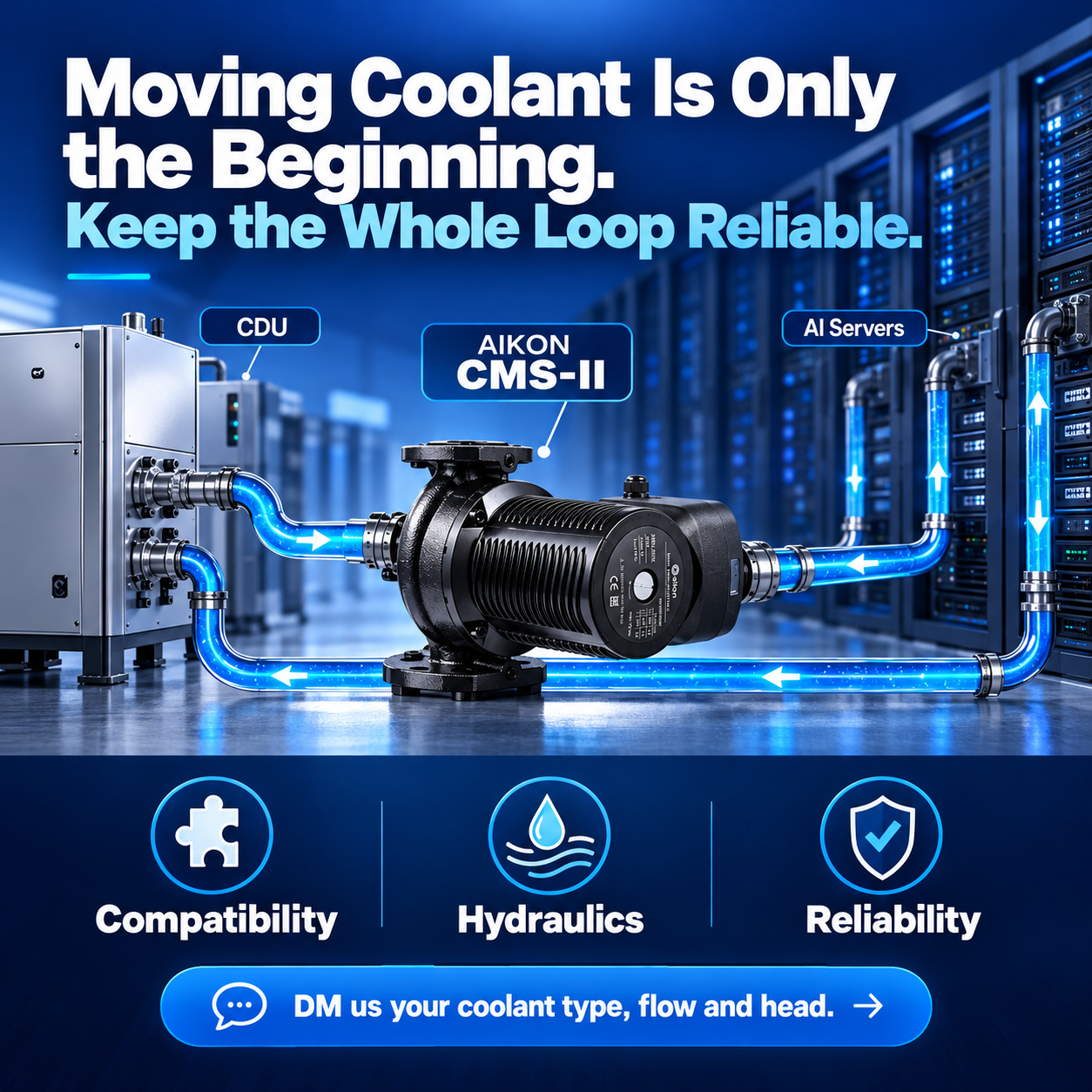
Discover why liquid-cooling reliability depends on more than coolant flow. Learn how fluid compatibility, pump design, hydraulic losses and operating conditions affect long-term circulation performance.
On October 14, 2026, DCX announced a new 8 MW Facility Distribution Unit (FDU) integrating continuous coolant monitoring and automatic chemical treatment into a large-scale liquid-cooling system.
The system is designed to monitor coolant conditions and automatically manage additives used for corrosion inhibition, pH control and biological control. It also supports different coolant-loop configurations, including propylene-glycol and deionized-water loops.
The message is clear: at large scale, liquid cooling is no longer just about moving coolant. It is also about maintaining the conditions that keep the entire loop operating reliably.
And that raises an important question for pump selection:
Is your circulation pump suited to the actual coolant, operating conditions and long-term demands of the system?
Quick Answer
A reliable liquid-cooling loop depends on more than flow and head.
The pump must also be compatible with the working fluid, operate within its specified temperature and pressure limits, and maintain suitable hydraulic performance under the actual system conditions.
Coolant management helps protect the fluid and the wider system. The circulation pump has a different but equally important role: moving the coolant reliably at the required duty point.
Why Coolant Quality and Pump Design Belong in the Same Conversation

Coolant condition can affect the materials and components throughout a liquid-cooling loop. Depending on the fluid and system design, unsuitable chemistry, contamination or corrosion can create maintenance problems and threaten long-term reliability.
But maintaining coolant quality is only one part of the picture.
The pump must also handle the fluid correctly. Material compatibility, bearing lubrication and cooling, internal clearances, operating temperature and hydraulic loading all deserve attention.
For example, a pump selected only by its maximum flow and head may not be suitable for a particular glycol mixture or deionized-water application. The fluid's properties and the manufacturer's operating limits still need to be checked.
A cooling system is only as dependable as the compatibility of its components and the conditions in which they operate.
What Should You Check Before Selecting a Liquid-Cooling Pump?

These checks are particularly important in systems expected to operate for extended periods, where maintenance access may be limited and unplanned downtime can be costly.
How AIKON CMS-II Approaches Circulation Reliability

AIKON CMS-II uses a stainless-steel sealing ring seat and wear ring designed to help control critical hydraulic clearances, reduce internal recirculation and protect the pump body and impeller.
Its bearing-area circulation design also supports lubrication and cooling of the rotating assembly.
These features address specific engineering concerns:
- Internal hydraulic losses: controlled clearances help reduce unwanted internal recirculation.
- Long-hour operation: bearing lubrication and cooling design support stable operation under suitable conditions.
- Hydraulic stability: the sealing ring structure helps protect critical hydraulic interfaces as the pump operates.
The objective is not to claim that hydraulic losses or wear can be eliminated. It is to control relevant risks and support more stable hydraulic performance over time.
For liquid-cooling projects, however, suitability must be confirmed for the specific CMS-II model and coolant. Fluid composition, additives, concentration, temperature, pressure and required flow/head must all fall within the applicable specifications.
CMS-II should not be assumed compatible with every data-center coolant simply because it uses a canned motor structure.
From Pump Design to Project Value
For project engineers and system integrators, these details translate into practical questions:
Will the pump work with the selected coolant?
Can it maintain the required flow and head?
Is its internal design suitable for the expected operating conditions?
Can the circulation requirements be met without creating unnecessary hydraulic losses or maintenance concerns?
These are more useful questions than comparing maximum flow and head alone.
The goal is not simply to move coolant. It is to select a pump that supports the actual cooling-loop requirements.
Planning a Liquid-Cooling Project?
Before selecting a pump, send AIKON:
- Coolant type, concentration and additives
- Required flow and head
- Operating temperature and pressure
- Basic system layout or estimated resistance
- Expected operating hours
- Installation and leakage requirements
AIKON can help assess whether a suitable CMS-II model fits the specified operating conditions. Final suitability should be confirmed against the model's technical specifications.
DM us your coolant type, flow and head. We’ll help assess the pump's suitability for your liquid-cooling application.
FAQ
Does coolant treatment replace the need for a suitable circulation pump?
No. Coolant treatment helps manage fluid condition, while the pump must deliver the required flow and head under the actual operating conditions. Both functions matter to overall system reliability.
Can AIKON CMS-II be used with any data-center coolant?
Not automatically. Compatibility depends on the specific fluid, concentration, additives, temperature, pressure and pump model. These conditions must be verified before selection.
Why does internal hydraulic design matter in liquid cooling?
Internal clearances and hydraulic passages influence recirculation and hydraulic losses. Their design can help support useful flow and stable performance, although it cannot eliminate all hydraulic losses.
Final Takeaway
Moving coolant is only the beginning. Keeping the whole loop reliable is the real engineering challenge.
Coolant quality, material compatibility, hydraulic performance and long-term operating conditions all deserve attention when selecting a circulation pump.
Planning a liquid-cooling loop? Send AIKON your coolant specification, flow and head. Let’s check the application before you choose the pump.