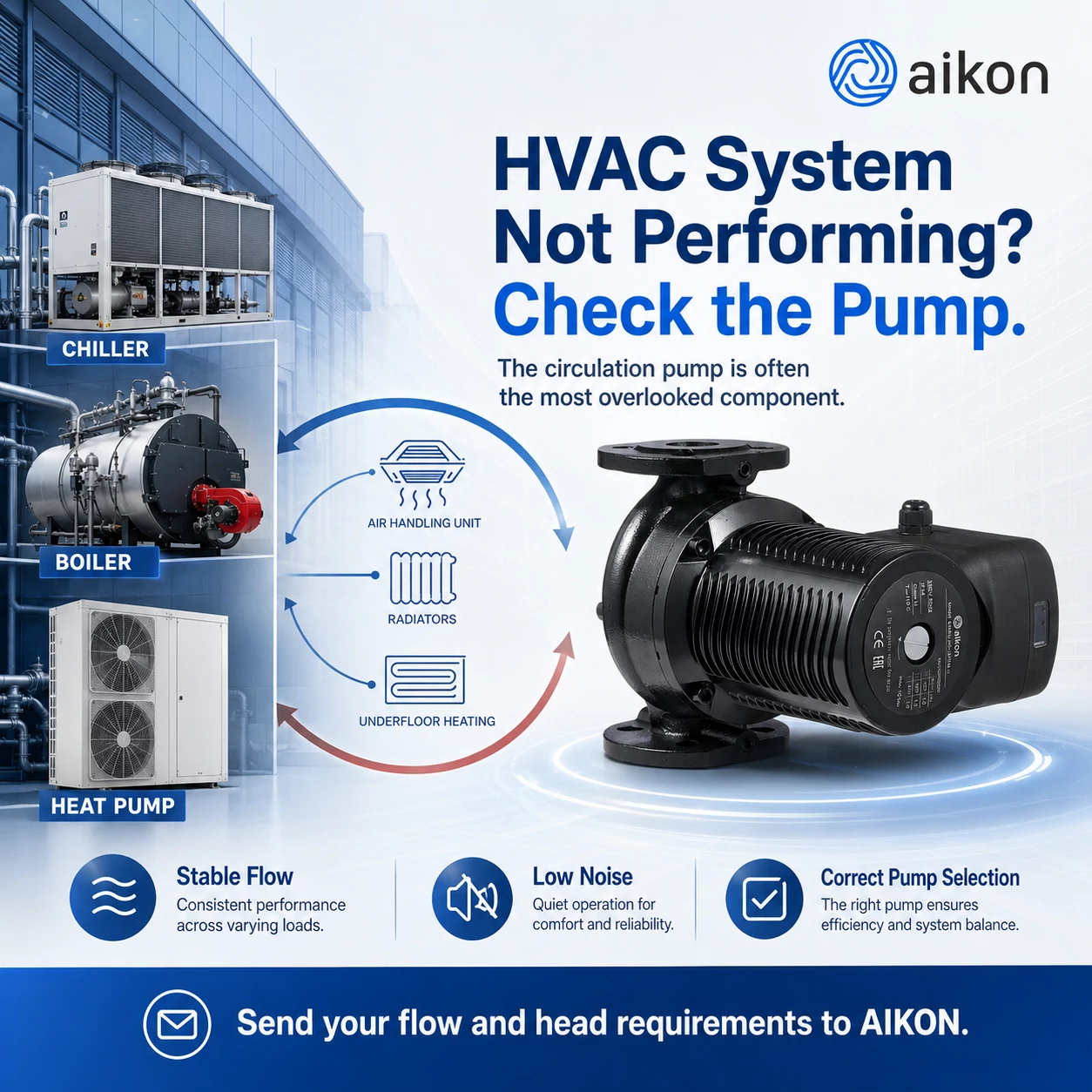
Learn why the circulation pump is one of the most overlooked components in HVAC systems, and how pump selection affects flow, comfort, noise, energy use, and long-term reliability.
In many HVAC projects, the main equipment gets the most attention.
The chiller.
The boiler.
The heat pump.
The control system.
The air handling unit.
But one component is often treated as a secondary detail:
the circulation pump.
This is a mistake.
In a hydronic HVAC system, the pump is not just an accessory. It is the component that moves heating or cooling energy through the system.
If the pump is wrongly selected, poorly matched, or unstable during long operation, the entire HVAC system may suffer.
The equipment may be working.
The water temperature may look normal.
But the building may still feel uncomfortable.
Why?
Because the problem may be in circulation.
Quick Answer
The circulation pump is one of the most overlooked components in HVAC systems because it does not produce heating or cooling directly, but it decides whether heating or cooling can be delivered effectively.
Wrong pump selection can cause insufficient flow, uneven temperature, high noise, energy waste, poor comfort, and higher maintenance cost.
Who This Article Is For
This article is useful for:
Procurement teams comparing HVAC pump quotations
Engineers selecting pumps for hydronic HVAC systems
Contractors trying to reduce callbacks after installation
Distributors selling HVAC circulation pump solutions
OEM customers integrating pumps into HVAC equipment packages
If your customer says:
“The main HVAC equipment works, but the building comfort is still poor.”
Then the circulation pump should be checked.
The Real Problem: HVAC Performance Depends on Flow

HVAC systems do not only need heating or cooling capacity.
They need proper flow delivery.
In a hydronic system, water carries energy from the equipment to the terminal side. If flow is too low, heat or cooling cannot reach the building properly. If flow is too high, the system may become noisy, unstable, and inefficient.
Common symptoms include:
- Some rooms are too hot while others are too cold
- Far-end zones cannot reach the set temperature
- The system takes too long to recover
- Pipes or valves become noisy
- Energy use increases without better comfort
- Service complaints increase after installation
These problems are often blamed on the chiller, boiler, heat pump, or control system.
But in many cases, the circulation pump is the hidden issue.
Why the Circulation Pump Is Often Ignored
The pump is often overlooked because it seems simple.
Buyers may think:
“As long as the pipe size matches, the pump should work.”
But pipe size is not enough.
A good HVAC pump selection should consider:

The right pump is not the biggest pump.
It is the pump that matches the actual HVAC system duty point.
What Happens When the Pump Is Wrong?
If the pump is too small, the system may suffer from:
weak circulation
slow heating or cooling response
poor far-end performance
customer complaints
If the pump is too large, the system may suffer from:
excessive flow speed
noise
valve stress
energy waste
unstable balancing
So the real goal is not “more pump power.”
The real goal is:
correct flow, correct head, stable operation.
AIKON CMS Solution for HVAC Circulation
For HVAC, heating, hot water, and commercial building circulation systems, AIKON CMS canned motor pumps are designed to support stable circulation with:
low-noise operation
compact installation
reduced leakage risk
stable long-term performance
For HVAC projects, these features matter because pumps may run for long hours, often close to occupied spaces or inside compact equipment rooms.
AIKON focuses on helping customers match the pump to the real system, instead of selecting only by pipe size or price.
Before choosing a pump, AIKON recommends checking:
required flow
required head
pipe length
water temperature
system resistance
voltage and frequency
installation space
noise requirement
This helps reduce common HVAC project problems such as weak circulation, uneven comfort, excessive noise, and unnecessary energy use.
Product / Structure Advantages
For B2B HVAC customers, AIKON CMS pumps are valuable because they address practical operating risks.
The pump is not just a component in the HVAC system.
It is the part that keeps energy moving.
What to Send AIKON
Need Help Checking Your HVAC Pump Selection?
Send AIKON your project information:
Application
HVAC / Heating / Cooling / Hot Water / Floor Heating
System Data
- Required flow rate
- Required head
- Pipe length
- Number of zones or loops
- Water temperature
- Voltage and frequency
- Installation space
- Noise requirement
Purchasing Requirement
- Quantity
- Target market
- OEM or private label needs
- Connection type
- Continuous or intermittent operation
AIKON can help evaluate:
✓ suitable CMS model
✓ flow and head matching
✓ HVAC application suitability
✓ OEM and bulk supply support
✓ whether the current pump selection may be undersized or oversized
FAQ
What is the most overlooked component in HVAC systems?
The circulation pump is often overlooked because it does not produce heating or cooling directly, but it decides whether energy can move through the system effectively.
Can the HVAC system work poorly even when the main equipment is normal?
Yes. The chiller, boiler, or heat pump may work normally, but poor circulation can still cause weak performance, uneven comfort, or slow response.
Should HVAC pumps be selected by pipe size?
No. Pipe size only shows the connection. Pump selection should be based on flow, head, pipe length, system resistance, temperature, and operating conditions.
Can a larger pump solve HVAC circulation problems?
Not always. An oversized pump may cause noise, energy waste, and unstable balancing. The correct pump should match the system duty point.
Do not let the circulation pump become the weakest part of your HVAC project.
If your system has:
uneven room temperature
slow heating or cooling response
far-end circulation problems
pump noise complaints
high service pressure
send your flow, head, pipe length, water temperature, voltage, and application details to AIKON.
AIKON helps HVAC customers select CMS circulation pump solutions based on real project conditions, not only pipe size or quotation price.