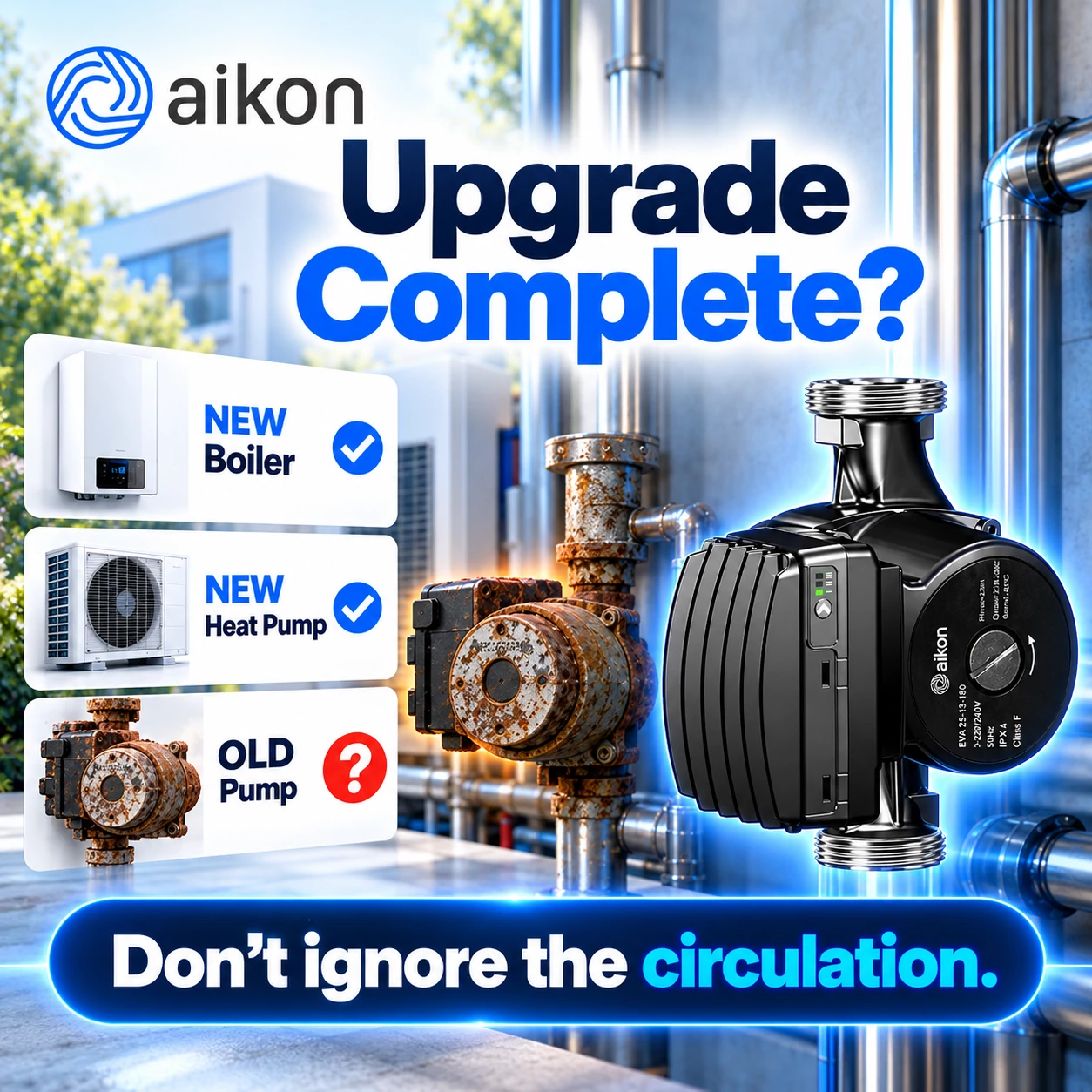
Replacing the boiler or heat pump does not automatically upgrade the entire heating system. This article explains why the circulation side should also be checked—and how AIKON CMS can support a more complete retrofit.
The boiler is new.
The heat pump is new.
The controls may be new too.
But hidden in the pipework is the same circulation pump that has been running for years.
So one question is worth asking:
Did you upgrade the heating system—or only the heat source?
A boiler or heat pump creates heat.
The circulation system has another job:
getting that heat to the rooms.
If the old circulation problems remain, the customer may still experience slow warm-up, uneven heating, pump noise or maintenance issues—even after investing in new heating equipment.
New heat source ≠ complete system upgrade.
Quick Answer
An old circulation pump does not automatically need replacing when a boiler or heat pump is upgraded.
But it should not be automatically ignored either.
The existing pump should be checked for:
flow and head suitability
noise and operating condition
long-hour running capability
age and maintenance condition
compatibility with the upgraded system
If it still fits, keep it.
If it does not, leaving it in place can allow an old weak point to remain inside a new system.
The Customer Feels the Whole System—not the New Equipment

Most homeowners do not judge an upgrade by the model number on the new heat source.
They judge it by questions like:
Does the house warm up properly?
Are the rooms more even?
Is the system quieter?
Do I still need service calls?
That is why heating-system upgrades should be viewed as a chain:
Heat Source → Circulation → Pipework → Heating Terminal → Comfort
Replacing the first component does not automatically improve every component after it.
A modern heat source connected to a poorly matched circulation system can still leave the installer with complaints.
When the Old Pump Deserves a Second Look

Before commissioning the upgraded system, ask:

The goal is not to replace equipment simply because it is old.
The goal is to avoid spending money on a major upgrade while leaving an obvious circulation bottleneck untouched.
Where AIKON CMS Can Complete the Upgrade

If the existing pump no longer suits the upgraded heating system, AIKON CMS canned motor pumps can be considered for heat-pump, heating, floor-heating, hot-water and HVAC circulation applications.
For retrofit projects, the most relevant value is practical:
flow & head matching
stable long-hour circulation
low-noise operation
reduced leakage concern
compact installation
And when a replacement is needed, the upgrade does not always have to become another pipework project.
For confirmed compatible models, AIKON CMS can also be checked against the existing:
connection size
installation length
duty point
Change the pump. Not the pipework.
The objective is not simply to install a newer pump.
It is to make sure the circulation side finally matches the upgraded heating system.
Upgrading the Heat Source?
Start with something simple.
Send AIKON:
a photo of the existing pump nameplate
new boiler / heat-pump information
radiator or floor-heating application
flow & head, if available
We can help check:
Does the old pump still fit the upgraded system?
And if replacement makes sense:
Does a compatible CMS model match both the duty point and installation dimensions?
FAQ
1.Does a new boiler mean I should replace the circulation pump too?
Not automatically. The old pump should first be checked against the upgraded system’s hydraulic and operating requirements.
2.Can an old circulation pump reduce the benefit of a new heat source?
It can if it is poorly matched, noisy, worn or unable to provide the circulation required by the upgraded system.
3.Can AIKON CMS replace an old pump without changing pipework?
For confirmed compatible models, connection size and installation length can be checked to simplify replacement without unnecessary pipework modification.