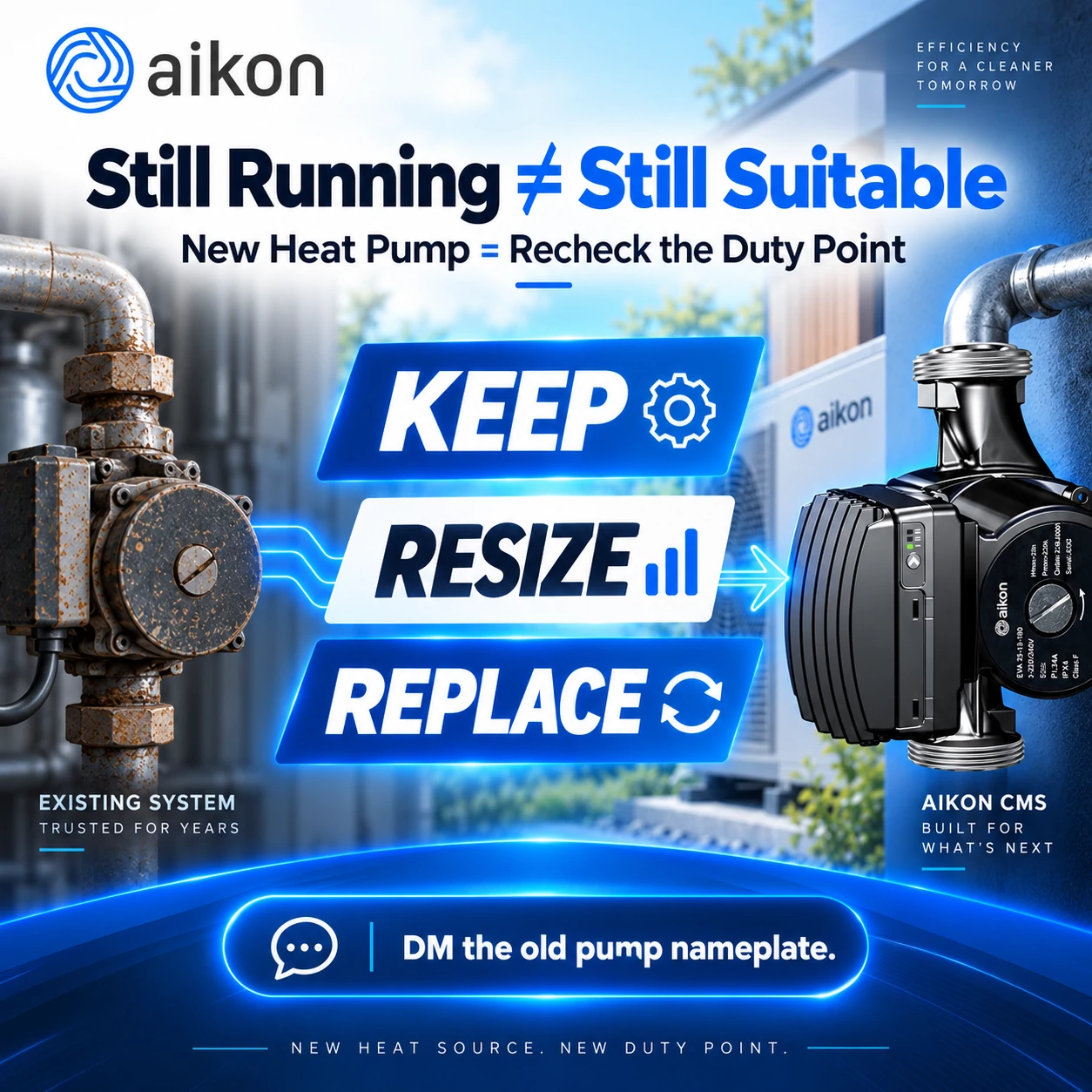
A new heat pump can change the hydraulic requirements of an existing heating system. Learn why an old circulation pump should be rechecked—and how to decide whether to keep, resize or replace it.
A new heat pump goes in.
The old circulation pump is still running.
So why change it?
Because:
Still running ≠ still suitable.

In July 2026 alone, 8,150 households applied for a heat pump under the Boiler Upgrade Scheme in England and Wales—a monthly record at the time and an 81% increase from June.
As more existing heating systems move from boilers to heat pumps, one question deserves more attention:
Does the old circulation pump still match the new heat source?
The answer may be yes.
But it should be checked—not assumed.
Quick Answer
You do not automatically need to replace the old circulation pump when installing a heat pump.
But you should recheck its duty point.
Heat pumps typically operate with lower heating-water temperatures than conventional fossil-fuel systems. Energy Saving Trust notes that radiator flow temperatures are often around 35–45°C, while MCS guidance explains that a smaller flow/return temperature difference can require a higher water flow rate to deliver the same heat output.
That leads to the first memory point:
New heat source. New duty point.
The Pump May Be Old. The Requirement May Be New.
A boiler system may have operated for years with a certain:
flow rate
head
water temperature
operating pattern
Then the heat pump arrives.
The radiators may stay.
The pipework may stay.
The pump may even stay in exactly the same place.
But the hydraulic requirement can change.
MCS specifically warns that too little flow can affect heat-pump operation, while excessive flow can increase noise and circulation-pump energy use.
So before deciding, check four things:

Energy Saving Trust also notes that existing pipework may need assessment because heat pumps can require higher flow rates than older boiler systems.
The fact that the pump turns on tells you only one thing:
the motor still turns.
It does not tell you whether the pump is still at the right operating point.
KEEP. RESIZE. REPLACE.

This is the simplest way to think about a heat-pump retrofit.
KEEP
Keep the existing pump if it still delivers the required flow and head efficiently, runs quietly and suits the new operating conditions.
RESIZE
Recheck the selection if the pump is working far from the new duty point, creating excessive flow, noise or weak circulation.
REPLACE
Replace it when the old unit cannot meet the hydraulic requirement—or when age, noise, leakage concern or installation condition makes replacement the more practical choice.
The goal is not:
“New heat pump = new pump.”
The goal is:
Right pump = right duty point.

Where AIKON CMS Fits
If the old pump no longer matches the new system, AIKON CMS can be considered for heat-pump, heating, floor-heating, hot-water and HVAC circulation applications.
For retrofit projects, the useful CMS advantages are:
flow & head matching
stable long-hour circulation
low-noise operation
compact installation
reduced leakage concern
And for confirmed compatible replacement models, connection and installation dimensions can also be checked to reduce unnecessary changes around the existing pipework.
The value is not simply replacing an old pump with a new one.
It is making sure the circulation system finally matches the new heat source.
Have a Heat-Pump Retrofit Project?
Send AIKON:
existing pump model or nameplate photo
heat-pump capacity
radiators or floor heating
flow and head, if available
pipe size / basic system layout
We can help check one simple question:
KEEP → RESIZE → REPLACE?
DM “retrofit” + your existing pump nameplate. We’ll help check the duty point.
FAQ
1.Does every heat-pump retrofit need a new circulation pump?
No. If the existing pump still matches the required flow, head and operating conditions, it may remain.
2.Why can the required flow change?
Heat pumps often operate at lower flow temperatures and smaller flow/return temperature differences. To carry the same heat output, the required water flow may therefore increase.
3.Is a bigger circulation pump safer?
No. Excessive flow can contribute to noise, unnecessary pumping energy and poor system operation.