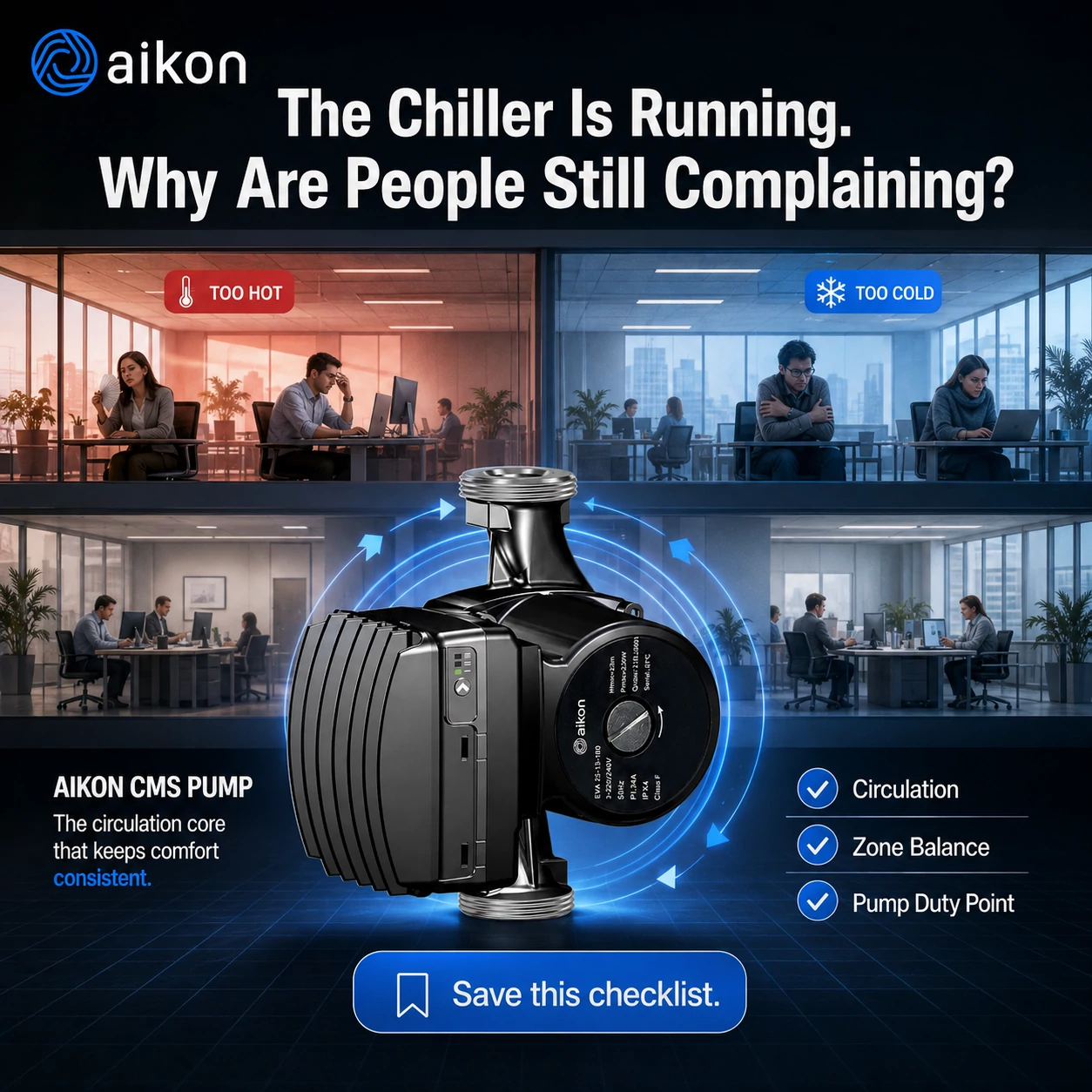
Learn why office comfort complaints may continue even when the HVAC unit is running, and how circulation, flow balance, valves, filters, and pump selection affect comfort.
The chiller is running.
The boiler is working.
The control panel looks normal.
But people in the office are still complaining.
One area is too cold.
Another area is too warm.
The far-end rooms never feel right.
The facility team keeps adjusting the system, but the complaints come back.
In many office buildings, comfort problems are not caused by one single component. They may come from controls, air distribution, building load, insulation, valves, balancing, or the water-side circulation system.
But one part is often checked too late:
the circulation pump.
Quick Answer
Office comfort complaints are not always a main-unit problem. In water-based HVAC systems, poor circulation can prevent heating or cooling from reaching different zones evenly.
Before blaming the chiller or boiler, check flow, head, pipe resistance, zone balance, valves, filters, and pump selection.
Why Office Comfort Problems Keep Coming Back

Office buildings are not simple spaces.
Different areas have different heat loads:
- meeting rooms fill up quickly
- glass-wall areas gain more heat
- corner rooms lose heat faster
- far-end zones may receive weaker flow
- some spaces run all day, others only part-time
If the HVAC system cannot move heating or cooling energy evenly, complaints become normal.
The issue may not be that the system has no capacity.
It may be that the capacity is not being delivered to the right place.
What to Check Before Replacing Major Equipment

Before assuming the main HVAC unit is the problem, check the basic circulation side:

A larger pump is not always the answer.
A smaller pump is not always the problem.
The right pump should match the actual duty point of the system.
Where AIKON CMS Fits

AIKON CMS canned motor pumps are used in HVAC, heating, hot water, and commercial building circulation systems.
For office projects, the key value is not simply “moving water.”
It is helping the system move water steadily, quietly, and with lower leakage concern.
AIKON helps buyers and HVAC contractors check pump selection based on:
flow, head, pipe length, system resistance, water temperature, voltage, installation space, and noise requirements.
This matters because office comfort complaints are visible.
People feel them every day.
And when the problem repeats, the property team or HVAC contractor usually takes the pressure.
Not Sure Where the Problem Is?
Before replacing equipment, send AIKON the basic system information:
Application: office HVAC / heating / cooling / hot water
Required flow and head
Pipe length or system layout
Number of zones or floors
Water temperature
Current pump model
Problem area: far-end zone / noisy pump / uneven temperature / slow response
AIKON can help check whether the issue may be related to pump sizing, water-side resistance, flow balance, or application mismatch.
Suggested CTA:
DM us your flow and head—we’ll help check the duty point.
FAQ
Why are some office areas too hot while others are too cold?
Possible causes include uneven heat load, poor air distribution, control settings, valve issues, hydraulic imbalance, or weak water-side circulation.
Does office comfort depend only on the chiller or boiler?
No. The main unit produces heating or cooling, but circulation and distribution decide whether that energy reaches each zone properly.
Can the circulation pump affect office comfort?
Yes. If the pump is undersized, oversized, noisy, or poorly matched, it can affect flow delivery, zone balance, comfort, and operating stability.
Strong CTA
Office comfort complaints are not always solved by adjusting the thermostat.
Sometimes the real question is:
Is the system delivering heating or cooling evenly?
Before your next office HVAC project, check the circulation side first.
Save this checklist for your next building comfort inspection.