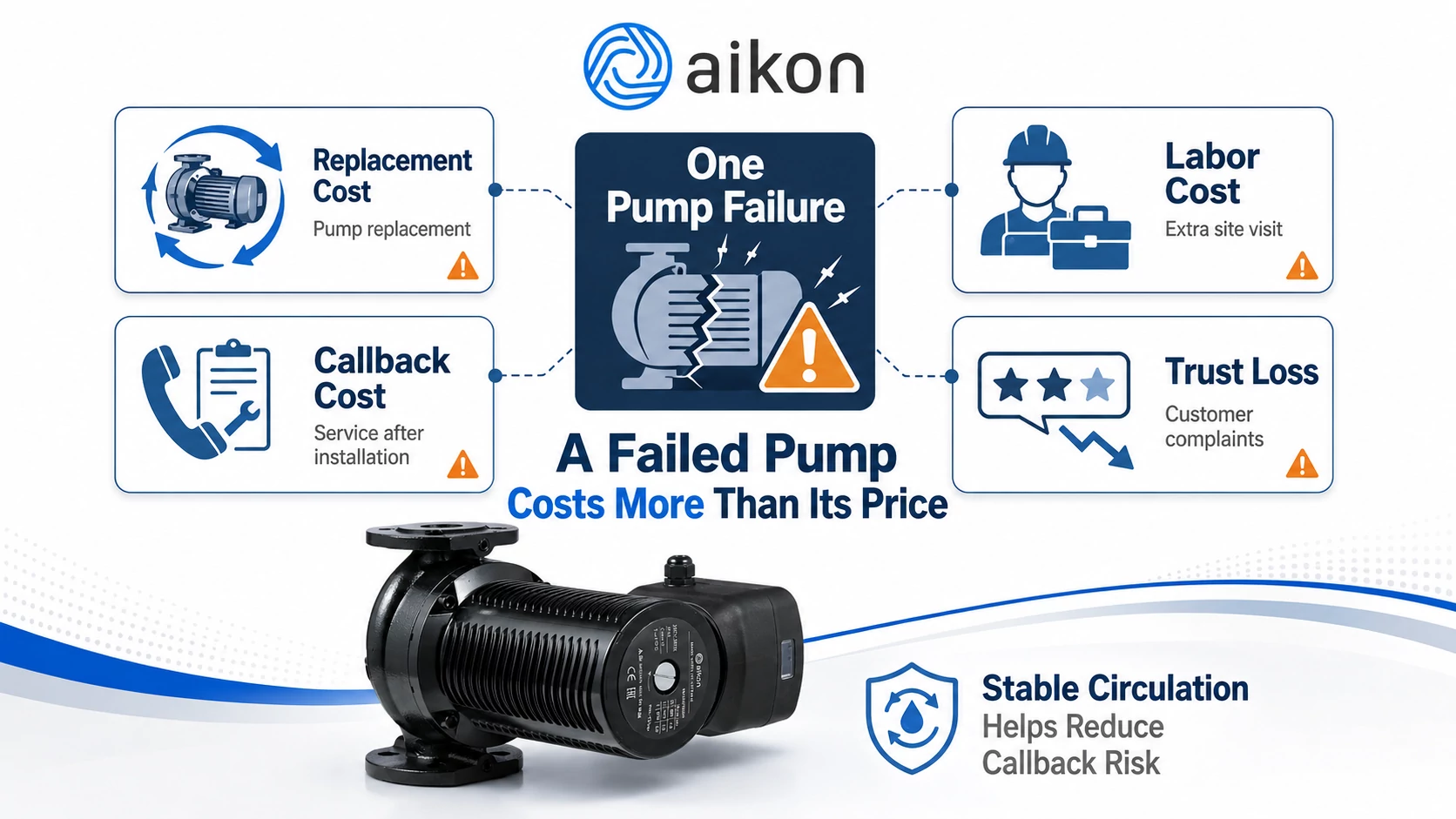
Learn how one circulation pump failure can create multiple costs for HVAC installers, including replacement pump cost, labor, callback visits, system downtime, customer complaints, and reputation loss.
One Pump Failure, Four Bills: The Real Cost of an HVAC Callback
For HVAC installers and contractors, one circulation pump failure is not just one product problem.
It can create several costs at the same time: replacement cost, labor cost, callback cost, and customer trust loss.
This is why the real circulation pump replacement cost is often higher than the price of the pump itself.
A low-cost pump may look attractive during project quotation. But if it fails after installation, the installer may need to return to the site, check the system, replace the pump, explain the problem to the customer, and spend extra time fixing something that should have worked from the beginning.
Bill 1: The Replacement Pump
The first cost is easy to see: the failed pump must be replaced.
Sometimes the supplier may cover the product under warranty. But even if the replacement pump is free, the installer still has to deal with the next costs.
For installers, the product price is only one part of the problem. The real issue is that a failed pump creates extra work after the project has already been completed.
This is why buyers should not only compare the initial pump price. They should also consider the risk of future replacement.
Bill 2: Labor and Site Visit Cost
The second cost is labor.
When a pump fails, someone must go back to the site. The installer needs to inspect the system, confirm the problem, remove the failed pump, install the new one, and test the system again.
This takes time. It may also require transportation, tools, coordination with the building owner, and another service schedule.
This is the real HVAC callback cost. It is not always written clearly on the invoice, but it directly affects the installer’s profit.
A small pump problem can easily become an expensive service visit.
Bill 3: System Downtime and Customer Complaints
The third cost is customer pressure.
If the circulation pump fails, the heating, cooling, or hot water circulation system may not work properly. In hotels, apartments, offices, schools, hospitals, and commercial buildings, this can quickly lead to complaints.
The customer may not care whether the problem came from the pump, the installation, or the supplier. In many cases, they will contact the installer first.
That means one pump failure can damage the customer’s confidence in the whole project.
For installers, this is one of the most serious hidden costs of pump failure.
Bill 4: Reputation and Future Orders
The fourth cost is reputation.
A callback does not only affect one project. It can also affect future business.
If a customer experiences repeated pump problems, they may hesitate to work with the same installer again. For contractors and distributors, this risk is often more expensive than the product itself.
A reliable pump helps installers protect their time, their service quality, and their customer relationships.
In simple terms, a cheaper pump may save money at purchase, but a failed pump can cost much more after installation.
How AIKON CMS Pumps Help Reduce Callback Risk
AIKON CMS Canned Motor Pumps are designed for circulation systems that require stable operation, low noise, compact installation, and reduced leakage risk.
For HVAC installers and contractors, these features matter because they help reduce common sources of after-sales service: noise complaints, leakage concerns, unstable circulation, and frequent maintenance.
AIKON CMS pumps can be used in HVAC circulation, hot water circulation, heating systems, commercial building circulation, and other circulation applications. For project buyers, AIKON can also support model selection based on flow rate, head, liquid temperature, voltage, and installation conditions.
This helps installers choose a more suitable pump before installation, instead of solving problems after the system is already running.
What Installers Should Check Before Choosing a Pump
Before selecting a circulation pump, installers should check more than the unit price.
Important points include:
Flow rate and head
Liquid temperature
Noise requirement
Installation space
Leakage risk
Supplier support
Batch quality consistency
A pump that fits the real working condition can reduce the risk of callback and replacement.
Conclusion
One pump failure can create four bills: product replacement, labor, customer complaints, and lost trust.
For HVAC installers and contractors, the best pump is not always the cheapest one. It is the pump that helps the system run reliably and reduces after-sales pressure.
Visit the AIKON CMS Canned Motor Pump product page to explore circulation pump solutions for HVAC, hot water, heating, and commercial building projects.
Product Page:
Products | AIKON Canned Motor Pumps | Canned Motor Pumps for HVAC & Liquid Cooling | AIKON