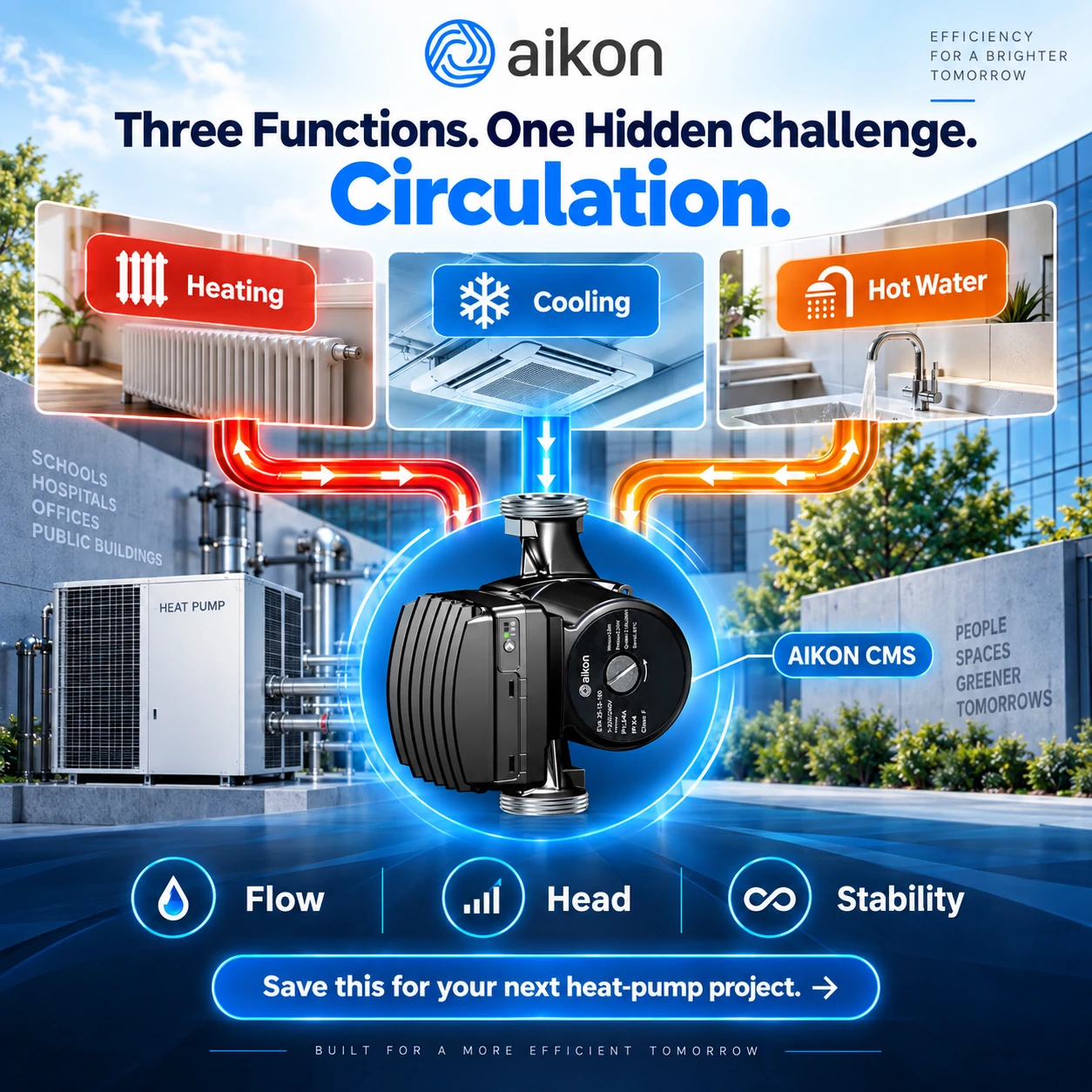
Poland’s latest public-building heat-pump initiative targets heating, cooling and hot water in one modular system. This article explains why stable circulation remains essential—and how pump selection affects integrated HVAC performance.

On September 23, Poland’s National Centre for Research and Development (NCBR) launched a new challenge for public buildings that are not connected to district heating networks.
The goal is ambitious:
One prefabricated heat-pump system should provide:
Heating.
Cooling.
Domestic hot water.
And it should be energy-efficient, scalable and quick to deploy. NCBR also wants the solution to work with renewable energy, energy storage and smart energy-management systems. The concept includes a modular, containerized plant room that can be prepared in factory conditions and deployed quickly on site.
That is a strong signal about where building systems are heading.
But it also raises a practical question:
Three functions. One system. What keeps everything circulating?
Quick Answer
A heat pump may generate heating or cooling, but it still needs a circulation system to move that energy through the building.
Heating, cooling and domestic hot water can all involve different:
flow requirements
temperature conditions
system resistance
operating hours
So an integrated system is not only a heat-pump challenge.
It is also a circulation challenge.
More Functions Mean More Demands on Circulation

A modular system sounds simple from the outside.
But inside, the hydraulic side still has to work.
For heating, the pump must move enough water to deliver heat.
For cooling, the circulation loop must maintain stable flow under a different temperature condition.
For domestic hot water, circulation affects response time and system comfort.
That means the pump should not simply be selected by pipe size.
It should be checked against:

NCBR’s project is specifically aimed at a prefabricated, modular and quickly deployable system.
That makes component selection even more important.
In a compact plant room, every component has to fit the system—not just physically, but hydraulically.
A modular heating system is only as good as the circulation inside it.
Where AIKON CMS Fits

This is where AIKON CMS canned motor pumps become relevant.
CMS can be applied in heating, cooling, hot water, HVAC and other circulation systems where stable operation matters.
For integrated or modular projects, the practical value is clear:
stable circulation
flow and head matching
low-noise operation
compact installation
reduced leakage concern
support for long-hour operation
The goal is not simply to install a pump.
The goal is to make sure the pump matches the real operating condition of each circulation loop.
Because a highly efficient heat pump cannot compensate for a badly matched circulation system.
Designing an Integrated Heat-Pump System?
You do not need to send a complete project package first.
Start with:
Application: heating / cooling / hot water
Required flow
Required head
Water or coolant temperature
Pipe length or system layout
Operating hours
Installation space
AIKON can help check whether the pump is:
too small
too large
or
well matched to the actual duty point
DM “loop” + your application, flow and head. We’ll help check the circulation duty point.
FAQ
1.Why does one integrated heat-pump system need different circulation conditions?
Because heating, cooling and hot-water circuits may operate at different temperatures, flow rates, resistance levels and operating schedules.
2.Does Poland’s NCBR project require canned motor pumps?
No. The project focuses on the overall heat-pump-based heating and cooling solution. Canned motor pumps are one possible circulation technology where their characteristics fit the system requirements.
3.Why are compact pumps useful in modular plant rooms?
Because prefabricated systems have limited installation space, and compact equipment can simplify integration when flow, head and installation dimensions are correctly matched.
Poland is asking for one system to deliver:
Heating. Cooling. Hot water.
That makes circulation more—not less—important.
If you are designing a heat-pump or modular HVAC system, DM “loop” + your flow and head. AIKON can help check whether the circulation pump matches the real duty point before installation.