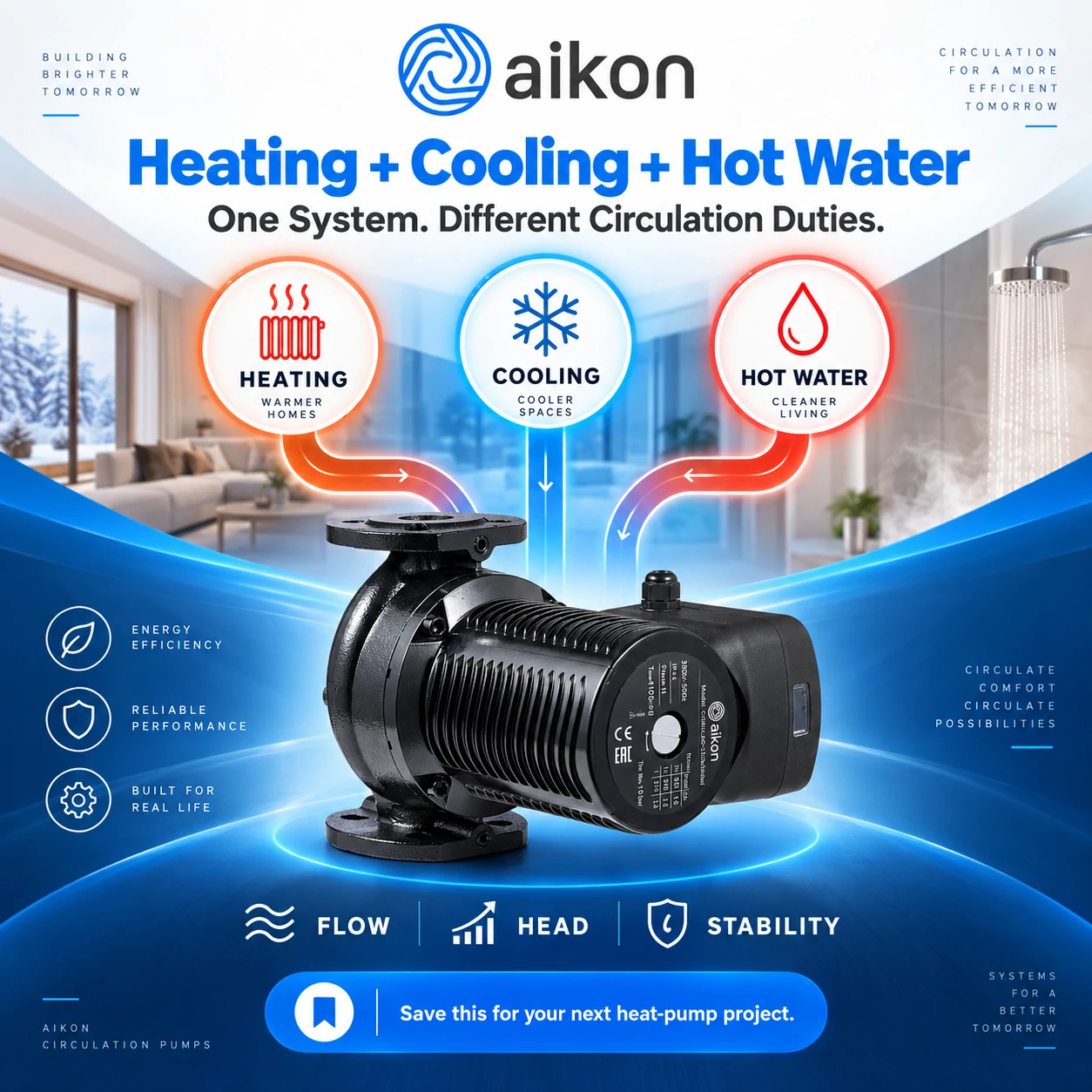
Poland is developing a modular heat-pump concept combining heating, cooling and domestic hot water. This article explains why integrated systems still need correctly matched circulation—and where AIKON CMS can support different loop requirements.
Heating. Cooling. Domestic hot water. One system.
On September 23, Poland’s National Centre for Research and Development, NCBR, announced a project to develop a prefabricated heat-pump-based system for public buildings that are not connected to district heating.
The system is expected to combine all three functions while being energy-efficient, scalable and quick to deploy. NCBR also wants a modular, containerized plant room prepared under factory conditions, with energy storage, intelligent controls and integration with local renewable energy.
The procurement is still active, with the current NCBR page listing October 13, 2026 at 12:00 as the closing time.
This is a good example of where building systems are heading:
more integrated, more modular, more intelligent.
But there is a less visible question behind all of it:
What keeps the energy moving?
Quick Answer
A heat pump can produce heating or cooling.
But it cannot deliver that energy through the building by itself.
That job depends on circulation.
And one integrated system does not mean one simple circulation duty.
Heating, cooling and domestic hot water may require different:
flow rates
heads
temperatures
operating hours
system resistance
So the circulation pump should not simply be “large enough.”
It has to match the actual loop.
One System Can Mean Several Different Duty Points

Think about what happens inside an integrated plant.
A heating loop needs enough water flow to carry heat to the building.
A cooling loop works at different temperatures and hydraulic conditions.
Domestic hot-water circulation has its own flow and response requirements.
That means:
One system. Three jobs. Different circulation duties.
Before selecting a pump, engineers still need to answer:

The main heat-pump equipment may be efficient.
But if circulation is badly matched, the system can still suffer from weak delivery, noise, unnecessary pumping energy or unstable operation.
A modular system is only as good as the circulation inside it.
Why CMS Makes Sense in a Modular System

This is where AIKON CMS canned motor pumps become relevant.
CMS can be applied in heating, cooling, domestic hot water, heat-pump and HVAC circulation systems when the operating conditions match the pump.
For an integrated or prefabricated system, five advantages matter most.
1. Flow & Head Matching
Heating, cooling and hot-water loops should not be treated as one identical duty point.
AIKON can match CMS models according to the real flow, head and system resistance of each loop.
The goal is not “a bigger pump.”
It is the right pump for the right duty point.
2. Stable Long-Hour Circulation
Public buildings may require circulation for long periods.
CMS is designed to support stable circulation where continuous or extended operation matters.
3. Compact Installation
NCBR specifically highlights prefabricated, modular and containerized plant-room concepts.
In this type of system, equipment space matters.
A compact circulation pump can make system integration easier without turning the pump into another space-planning problem.
4. Low-Noise Operation
A public building is not just a mechanical room.
It may be a school, office, educational facility or other occupied space.
Circulation performance should not create unnecessary noise for the people using the building.
5. Reduced Leakage Concern
In a compact technical room, one leak can affect surrounding equipment.
The canned motor structure helps reduce leakage concerns associated with traditional dynamic shaft seals, which can be valuable in integrated circulation systems.
The Pump Is Small. The System Impact Is Not.

A circulation pump may occupy only a small part of a modular plant room.
But it influences whether heating, cooling or hot water is actually delivered as intended.
That is why pump selection should follow the system—not the pipe size alone.
For AIKON, the useful question is:
What does this loop actually need?
Not:
“Which pump looks big enough?”
Designing a Heating, Cooling or Hot-Water Loop?
You do not need a complete project package to start.
Send AIKON:
Application: heating / cooling / domestic hot water
Required flow
Required head
Water or coolant temperature
Pipe length or system layout
Operating hours
Available installation space
We can help check whether the CMS selection fits the real duty point.
Send us the application + flow + head—we’ll help check the circulation loop before the system is built.
FAQ
1.Does one integrated heat-pump system use the same circulation conditions for heating, cooling and hot water?
Not necessarily. Different circuits can require different flow, head, temperature and operating conditions, so each duty point should be checked.
2.Does Poland’s NCBR project require canned motor pumps?
No. NCBR is seeking an integrated heat-pump-based heating and cooling solution. Canned motor pumps are one circulation option where their characteristics match the project conditions.
3.Why is compact pump design important in modular systems?
Because prefabricated plant rooms have limited installation space. Components must meet both hydraulic requirements and physical integration needs.