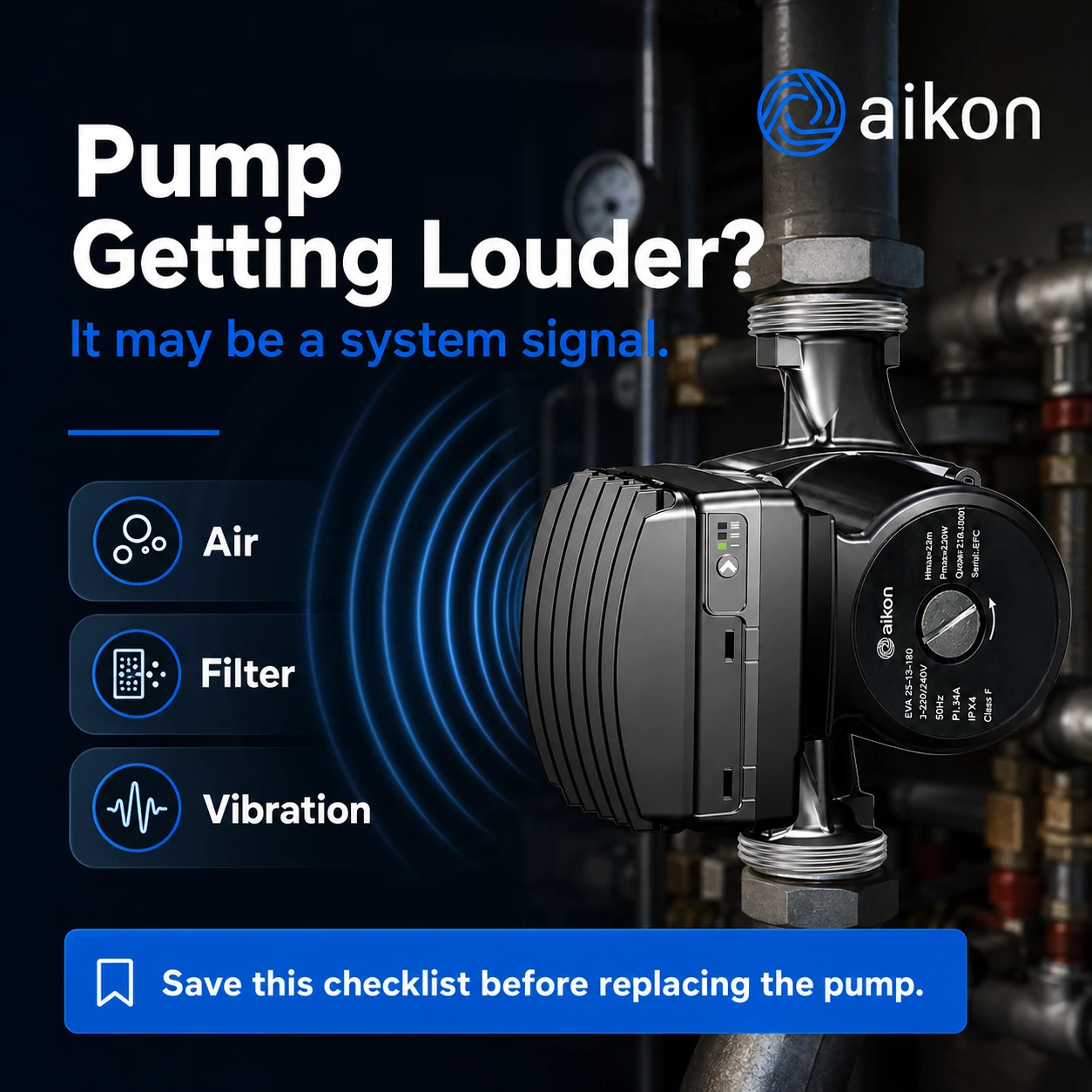
Learn why a circulation pump may become louder after years of use, what the noise may indicate, and what to check before replacing the pump.
The pump was quiet when it was new.
After a few years, the sound starts to change.
At first, it is only a light hum.
Then it becomes louder at night.
Later, the customer starts asking:
“Is the pump going bad?”
The honest answer is:
Maybe. But not always.
A pump getting louder after years of use is common, but it should not be treated as “normal” without checking. Noise is often a signal that something in the pump or the system has changed.
It may be the pump.
It may be the water circuit.
It may be air, dirt, pressure loss, vibration, or wrong operating conditions.
So before replacing the pump, listen carefully and check the system first.
Quick Answer
If a circulation pump becomes louder after years of use, it may be caused by air in the system, dirty water, blocked filters, pipe vibration, bearing wear, high resistance, wrong speed setting, or long-term overload.
A small increase in sound may happen over time. But if the noise keeps increasing, changes suddenly, or comes with weak circulation, heat, vibration, or leakage, it should be inspected.
What the Noise May Be Telling You

Different sounds often point to different problems.
The pump may not be broken immediately.
But the sound is telling you:
Something is no longer working the same way as before.
Check the System Before Replacing the Pump

Many noisy pump complaints are not caused by the pump alone.
Before replacing it, check:
Is there air in the system?
Air can create noise, weak circulation, and unstable flow.
Is the filter clean?
A dirty filter increases resistance and makes the pump work harder.
Are valves fully open?
Partially closed valves can create noise and pressure loss.
Is the pump oversized?
Too much flow can create pipe noise, valve noise, and vibration.
Has the pump been running for many hours every day?
Long-hour operation increases wear over time, especially if the system water is not clean.
If the pump is hot, leaking, vibrating strongly, or making a sharp mechanical sound, stop the system safely and arrange inspection.
How AIKON CMS Helps Reduce Long-Term Noise Complaints

For AIKON, a good circulation pump should not only be quiet on day one.
It should stay quiet and stable after real project operation.
AIKON CMS canned motor pumps are used in heating, hot water, HVAC, floor heating, and commercial circulation systems. They are designed to support:
low-noise operation
stable circulation
compact installation
reduced leakage concern
flow and head matching
But noise control is not only about the pump.
A quiet system also needs the right model, clean water, correct installation, proper flow, and reasonable pipe design.
That is why AIKON recommends checking the duty point before ordering, especially for systems that run for long hours.
Not Sure Where the Noise Comes From?
Before replacing the pump, send AIKON:
Application: heating / HVAC / hot water / floor heating
Noise type: humming / grinding / water rushing / vibration
When it happens: startup / night / continuous operation
Required flow and head
Pipe length or system layout
Water temperature
Current pump model or connection size
AIKON can help check whether the issue looks more like pump aging, air, system resistance, oversizing, or wrong pump selection.
Suggested CTA:
DM us a short video of the pump noise—we’ll help check what to look at first.
FAQ
Is it normal for a pump to get louder after years of use?
It can happen, but it should not be ignored. Increasing noise usually means the pump or the system condition has changed.
Does pump noise always mean the pump is broken?
No. Noise may come from air, dirty filters, valves, pipe vibration, high flow speed, or system resistance.
When should I stop the pump?
Stop it safely if there is sharp grinding noise, strong vibration, overheating, leakage, or water near electrical parts.
A louder pump is not just a sound problem.
It may be an early warning from the system.
Before replacing the pump, check the water circuit, air, filters, valves, flow, and head.
Save this checklist before your next pump noise inspection.