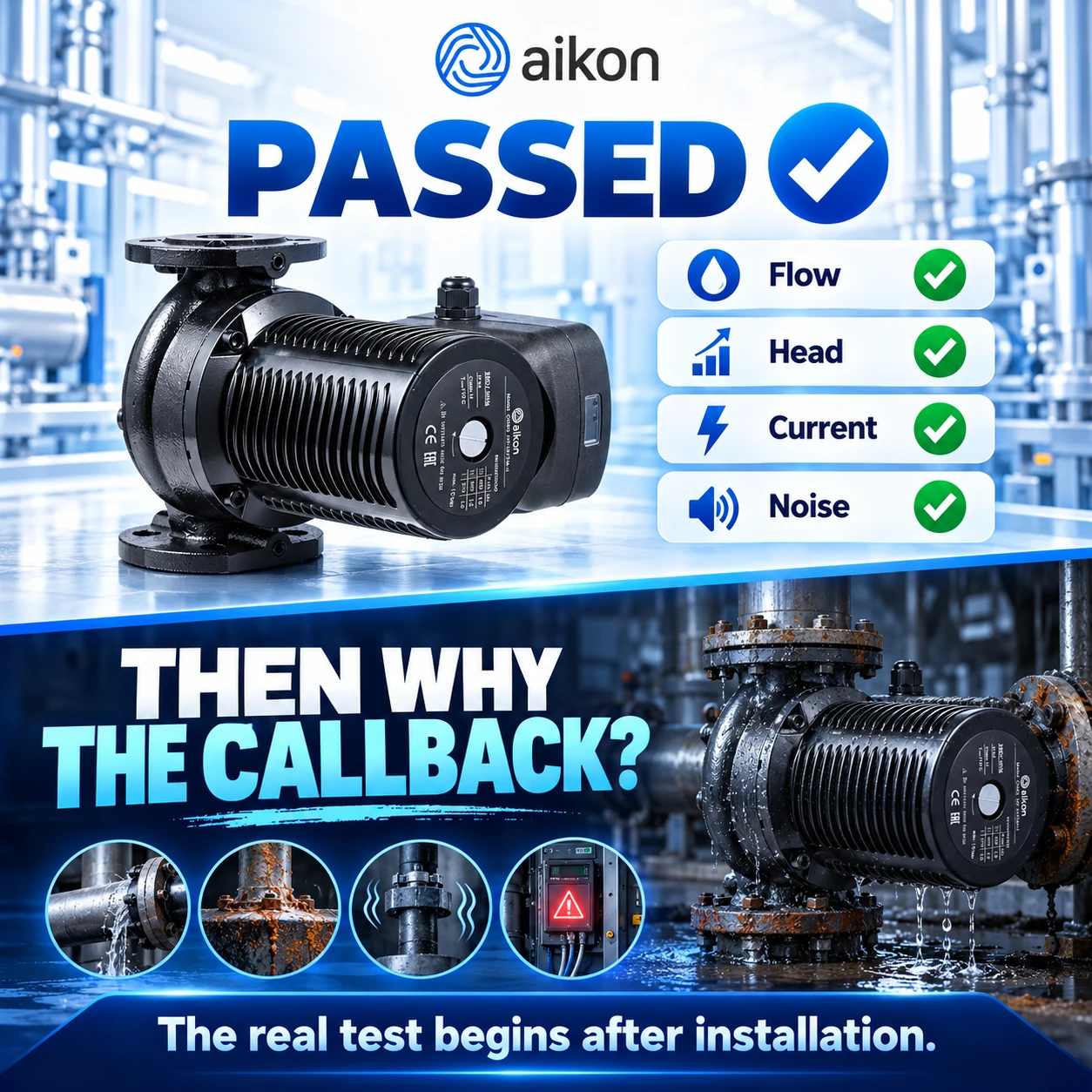
Learn why a circulation pump can pass every factory test yet develop noise, vibration or performance loss after installation—and how long-term internal design affects real project reliability.
The pump leaves the factory with everything checked:
Flow ✓
Head ✓
Current ✓
Noise ✓
Then, a few months after installation:
Noise increases.
Vibration appears.
Flow starts dropping.
Temperature becomes abnormal.
The customer calls again.
So what happened?
If the pump passed every factory test, why did the problems start after installation?
Because the factory and the project are not testing the same thing.
Factory testing is a snapshot. Field operation is the endurance test.
Quick Answer
Factory testing confirms that a pump meets defined performance and safety requirements under controlled conditions.
But real projects add something the test bench cannot fully reproduce:
time.
Thousands of operating hours, water quality, temperature cycles, air, system resistance, installation stress, voltage variation and wear can gradually change how the pump behaves.
The test bench checks the pump.
The project checks the pump, the system and time.
Why Problems Appear Later

Most long-term problems can be traced back to a few areas.
Bearing wear
As bearing surfaces wear, clearances can increase.
That may reduce rotor stability and gradually lead to:
vibration → noise → less stable operation
Lubrication and heat
Continuous operation creates friction heat, while motor heat also affects the internal environment.
If bearing circulation is insufficient, lubrication and cooling conditions become more difficult to maintain.
Internal recirculation
The impeller creates a pressure difference inside the pump.
If critical hydraulic clearances increase, part of the higher-pressure liquid can return toward the low-pressure side instead of entering the system.
That means:
less useful flow
more hydraulic loss
less stable internal flow
Motor thermal stress
A motor can pass its first test and still face years of thermal loading afterward.
Long-term heat affects insulation, materials and overall operating stability.
This is why Day-One performance and long-term field performance are not the same question.
How CMS-Ⅱ Was Designed for What Happens After the Test

The real question is not only whether a pump can pass the factory test.
It is:
What was the pump designed to withstand after the test?
AIKON CMS-Ⅱ focuses on several areas that become more important after long-hour operation.

CMS-Ⅱ also uses wear-resistant treatment at key shaft-bearing positions to help control long-term wear.
These details do not mean the pump will never fail.
They mean the design is focused on problems that often become visible only after the pump has been running for months or years.
What Does This Mean for a Project Buyer?

Better internal engineering is not valuable because the component sounds impressive.
Its value is the problems the customer may not have to deal with later.
Fewer callbacks
Less time returning to the same project for repeated pump complaints.
Lower replacement cost
Fewer emergency replacements, shipping costs and technician visits.
More stable customer experience
Lower risk of growing noise, vibration or declining circulation becoming visible to the end user.
Better brand protection
For distributors and OEM customers, the end customer sees your brand on the pump.
The pump may be a small part of the project. The cost of failure is not.
A Better Pump Still Needs the Right System
Not every on-site problem is caused by the pump.
Problems can also come from:
wrong pump sizing
poor water quality
air in the system
blocked filters or valves
pipe resistance
installation stress
abnormal voltage
A better pump cannot fix a badly designed system.
But:
Better pump engineering can reduce the risk of the pump becoming the weak point.
That is why reliable projects need both:
good product design + correct system matching
Experiencing Repeated Problems After Installation?
You do not need to prepare a complete engineering report.
Send AIKON:
pump nameplate photo
application
flow and head
a short description of the problem
We can help review whether the issue is more likely related to:
pump selection
system conditions
or
long-term operating requirements
DM us the pump nameplate + flow/head + problem description. We’ll help you check where the issue may really start.
FAQ
1.Does passing a factory test guarantee trouble-free field operation?
No. Factory testing confirms performance under defined conditions. Long-term field performance also depends on system design, installation, water quality, operating conditions and wear.
2.Why can pump noise increase after months of operation?
Possible causes include bearing wear, air, hydraulic imbalance, internal clearance changes, vibration or system resistance.
3.Can CMS-Ⅱ eliminate all long-term pump problems?
No. CMS-Ⅱ is designed to address several long-term mechanical and hydraulic risks, but correct sizing, installation and system conditions remain essential.