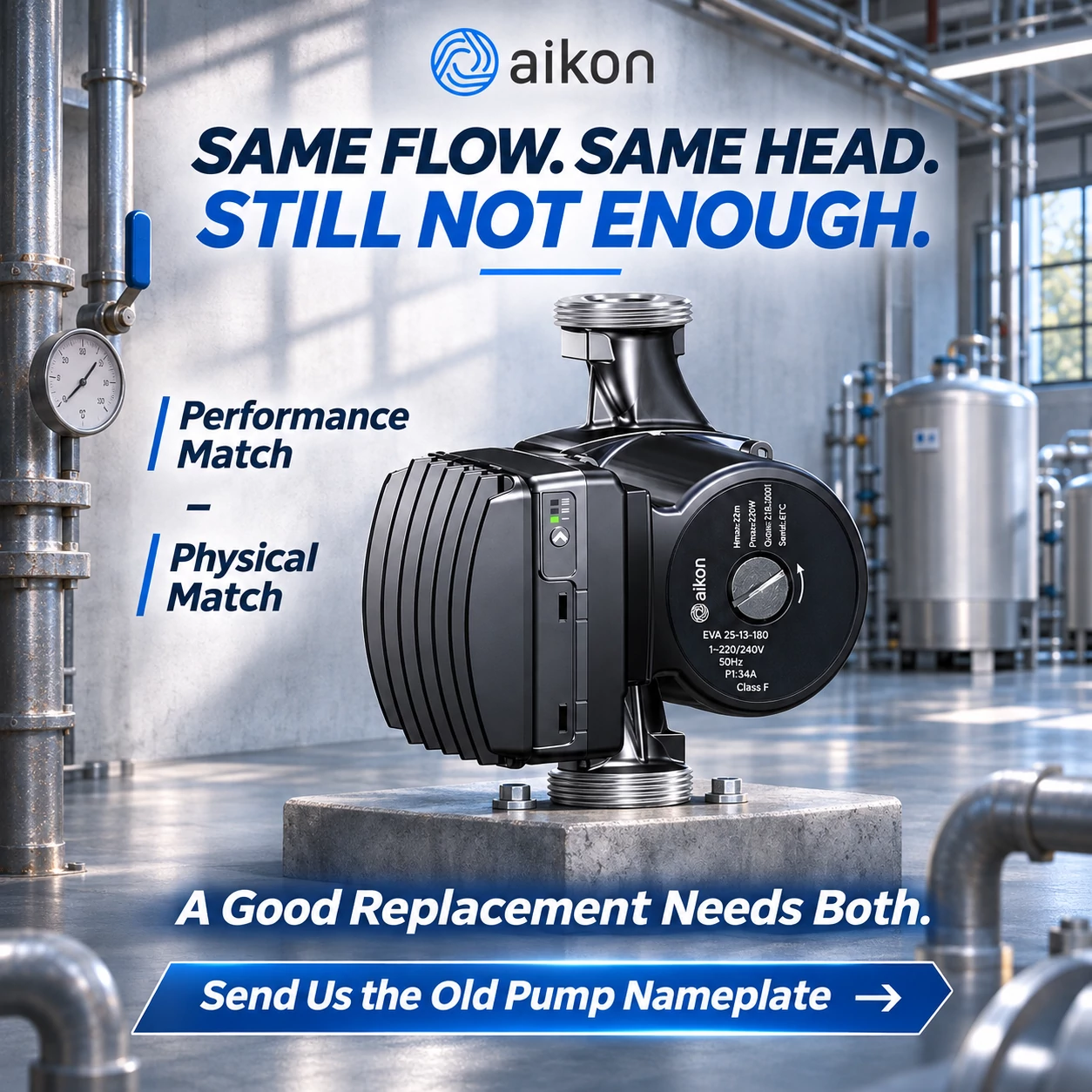
Replacing a circulation pump is about more than finding the same flow and head. Installation length, connections and operating conditions determine whether a simple pump change becomes a larger pipework project. AIKON CMS combines replacement flexibility with engineering designed for long-term circulation.
A circulation pump fails in an existing heating system.
The first question is usually:
“What pump has the same flow and head?”
But in a real replacement project, that is only the beginning.
You also need to ask:
Will it fit the existing pipework?
Is the installation length compatible?
Threaded or flanged?
Does the connection size match?
Does the voltage match?
Because:
A pump can match the hydraulic performance and still be a difficult replacement.
A Good Replacement Needs Two Matches

A suitable replacement needs both:
Performance Match
Flow / Head / Voltage / Operating Conditions
Physical Match
Installation Length / Connection Size / Thread or Flange
Put simply:
Performance Match tells you whether the pump can do the job.
Physical Match tells you whether it can fit the job.
If physical compatibility is ignored, a simple pump replacement can quickly become a pipework project.
Pipe cutting, adapters, new flanges, extra labor, draining and refilling the system—all of these add cost and downtime.
That is why:
Pump Price ≠ Replacement Cost

The lowest-priced pump may not be the lowest-cost replacement.
Where CMS Makes Replacement Easier

The AIKON CMS range includes different flow and head ranges, connection sizes, threaded and flanged options, and installation configurations.
That gives installers and distributors more opportunities to find a pump that matches both the required duty point and the existing installation.
Where a suitable CMS configuration is available, this may help reduce:
pipe modification
additional fittings
installation labor
downtime
rework risk
But replacement compatibility is only part of the value.
A good replacement should not simply fit today.
It should still be a good pump after installation.
CMS-Ⅱ uses a canned motor structure without a traditional dynamic mechanical shaft seal, helping reduce one common shaft-seal leakage concern.
Its internal design also includes:
4 × 1 mm circulation holes
→ support bearing lubrication and cooling
Enlarged bearing support
→ supports rotor stability during long-hour operation
Stainless-steel sealing ring seat and wear ring
→ help control hydraulic clearances and unwanted internal recirculation
So the CMS advantage is not simply:
“It fits.”
It is:
“It fits—and it is engineered for what happens after installation.”
Less Work Around the Pump
Consider an existing circulation pump with:
DN25 connection
180 mm installation length
230 V / 50 Hz
a defined flow and head requirement
A poor physical match may turn the job into:
Remove → Cut Pipe → Add Adapter → Reconnect → Refill → Commission
A compatible replacement may be closer to:
Verify → Remove → Install → Commission
The difference is more than convenience.
It can mean:
less modification
less labor
shorter downtime
lower project risk
For distributors, a broader CMS range can also make cross-reference enquiries, stock planning and replacement support easier to manage.
Before You Replace the Pump
Check at least:
Flow + Head
Installation Length
Connection Size
Thread / Flange
Voltage / Frequency
Application and operating conditions
Or simply send AIKON:
the existing pump model or nameplate photo + installation length + connection size.
We can help check whether a suitable CMS replacement is available.
A good replacement should fit the system—and still be a good pump.
FAQ
Is matching flow and head enough for a circulation-pump replacement?
No. Flow and head confirm hydraulic requirements, but installation length, connection type, connection size, voltage and operating conditions should also be checked.
Can a circulation pump be replaced without changing the pipework?
In some cases, yes. If both hydraulic performance and physical installation conditions match, unnecessary pipework modification may often be avoided.
What is the advantage of AIKON CMS for replacement projects?
CMS offers multiple hydraulic and installation configurations, while CMS-Ⅱ also includes canned-motor, bearing-support and hydraulic-clearance designs intended to support long-term circulation.
Can CMS directly replace every existing pump?
No. Replacement compatibility needs to be verified according to the actual model, duty point, dimensions and operating conditions.