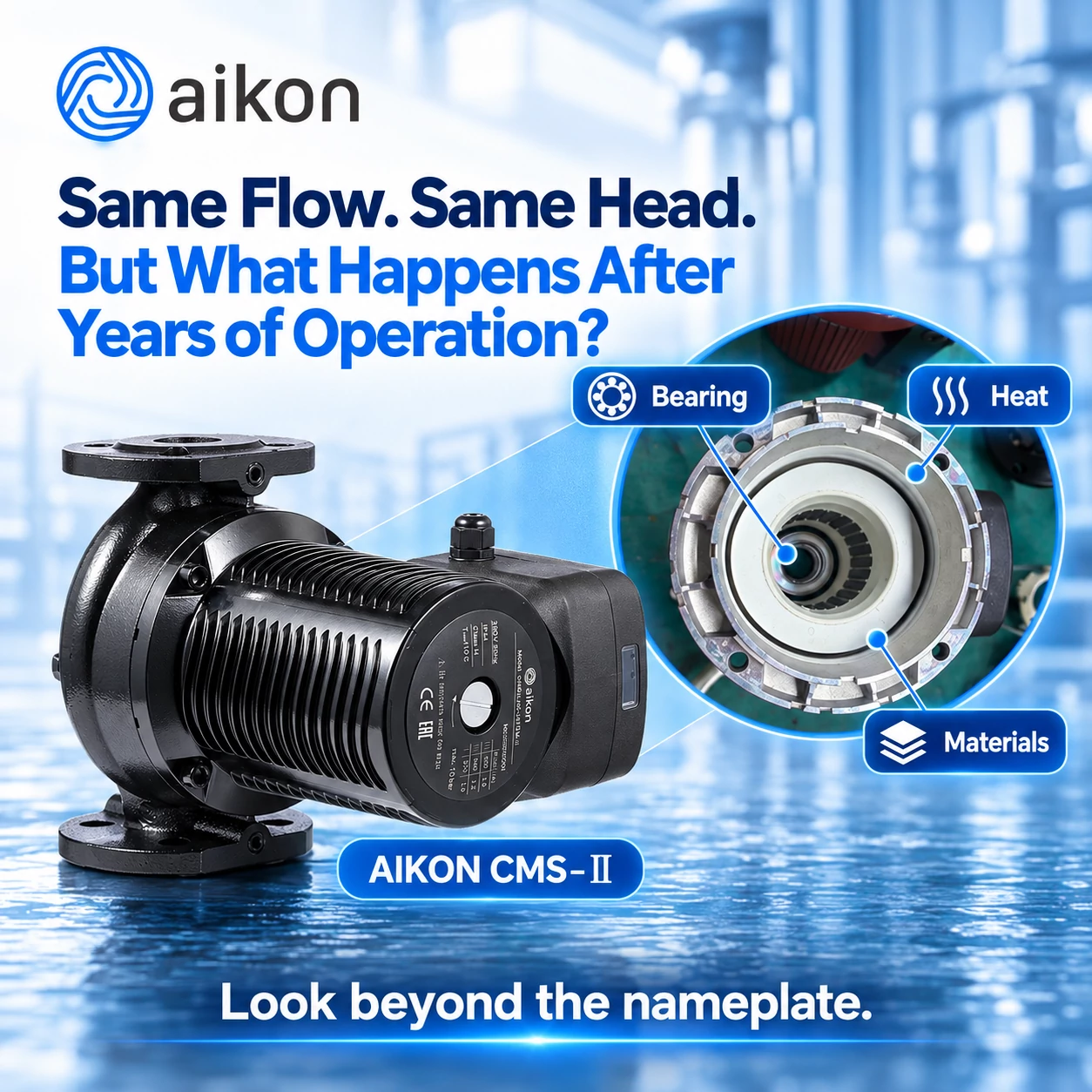
Learn why circulation pumps with similar flow and head can perform differently after years of use, and how bearings, heat, materials, internal leakage and operating conditions affect long-term performance.
Two pumps can look almost identical on a quotation.
Same flow.
Same head.
Similar power.
Install them today, and both may work normally.
The real difference may not appear until much later.
One pump is still running quietly.
Another starts getting louder, hotter, or less stable.
Why?
Because flow and head tell you what a pump can deliver at a certain operating point.
They do not tell you everything about what happens inside the pump after thousands of operating hours.
The nameplate tells you the duty point. The internal design tells you much more about what happens over time.
Quick Answer
Long-term pump performance depends on more than flow and head.
What matters over time includes:
bearing support and lubrication
motor temperature
impeller stability
internal leakage control
materials and wear resistance
the actual operating condition
That is why two pumps with similar specifications can age very differently.
The Differences You Cannot See on the Quotation

A circulation pump in a heating, hot-water, HVAC, or cooling system may run for thousands of hours every year.
Small design differences eventually become real operating differences.
Take the bearing area.
If lubrication and cooling are not stable, wear can gradually become vibration and noise.
The same is true for the motor. A pump that operates under greater thermal stress may still work today, but long-term heat affects the conditions under which the motor and insulation operate.
Then there is the hydraulic side.
The impeller needs to maintain its shape and balance. Internal clearances need to remain stable. Internal leakage needs to be controlled.
None of these details is obvious when buyers only compare:
Flow: ✓
Head: ✓
Power: ✓
Price: ✓
But they matter after installation.
How AIKON CMS Looks at Long-Term Operation

AIKON CMS is designed around several areas that become increasingly important during long-hour circulation.
For example, the CMS-Ⅱ design uses circulation passages around the bearing area to support lubrication, cooling, air removal and axial-force balance, together with enlarged bearing support.
For smaller sizes, PES + GF30% impellers are used to support rigidity and dimensional stability, while larger sizes use stainless-steel impellers.
CMS-Ⅱ also uses a stainless-steel sealing ring seat and wear ring to help control internal leakage and protect the hydraulic components.
On the motor side, the design provides more thermal margin to help reduce long-term heat stress.
These details do not mean that a pump will “never fail.”
They mean the product is engineered around the things that often become important after long periods of real operation:
wear, heat, vibration, lubrication and hydraulic stability.
A Good Pump Can Still Fail in the Wrong System

Internal design is only half the story.
Even a well-designed pump can have a short life if the operating conditions are wrong.
Before blaming the pump, check:
So a longer-lasting circulation system is usually the result of two things:
good pump engineering + correct system matching.
Before Comparing Two Pumps, Look One Level Deeper
When two pumps show similar flow and head, ask a few more questions:
How are the bearings lubricated and supported?
How is motor heat managed?
What material is used for the impeller?
How is internal leakage controlled?
Is the pump really matched to the system duty point?
Those questions often tell you more about long-term value than the first page of the datasheet.
If you already have the system flow, head and application conditions, AIKON can help check whether the CMS model fits the real duty point.
DM us your flow and head—we’ll help check the duty point before you order.
FAQ
Do pumps with the same flow and head have the same service life?
No. Flow and head describe hydraulic performance. Long-term performance also depends on internal design, materials, thermal conditions, water quality, installation and operating conditions.
Does a louder pump always mean it is worn out?
Not necessarily. Noise may also come from air, cavitation, pipe vibration, excessive flow or system resistance.
Is a larger pump more durable?
No. Oversizing can create unnecessary flow, noise and operating stress. The correct pump should match the actual duty point.
Same flow. Same head. Look beyond the nameplate.
The differences that show up years later often begin with things you cannot see from the outside.
Save this checklist for your next pump comparison.