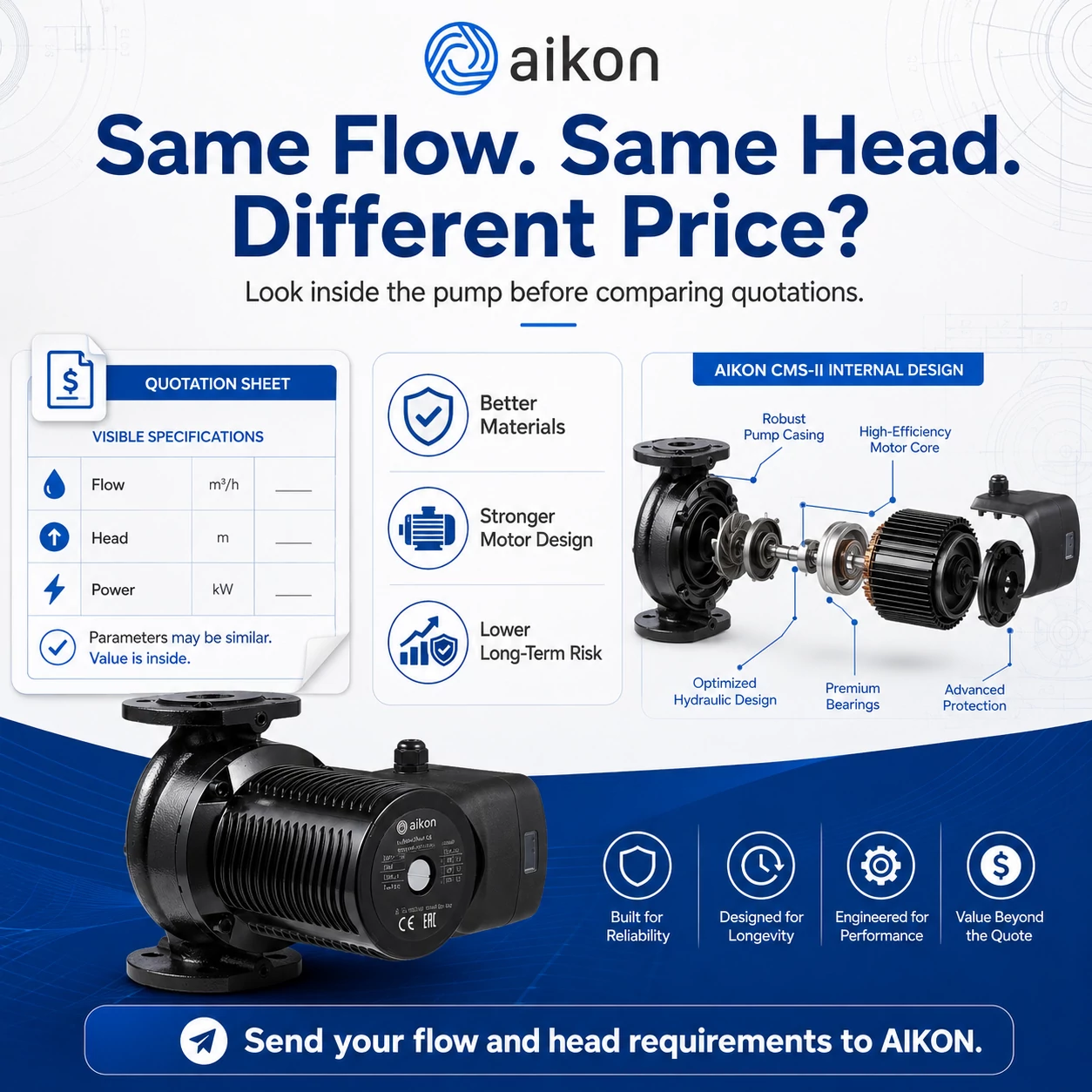
Learn why circulation pumps with similar flow and head can have different prices. This article explains how materials, motor design, bearings, sealing, testing, and supplier support affect long-term pump value.
When procurement or engineering buyers compare circulation pumps, the first comparison is usually simple:
flow, head, power, connection size, and price.
If two pumps show similar flow and head, a lower price naturally looks more attractive.
But for heating, hot water, HVAC, floor heating, and commercial circulation systems, the purchase price is only the first cost. The real cost appears after the pump has been running for months or years.
A cheaper pump may meet the basic duty point at the beginning. But if it later brings noise, vibration, leakage risk, overheating, unstable operation, replacement work, or customer complaints, the total project cost may become much higher.
That is why the better question is not:
“Why is this pump more expensive?”
The better question is:
“What does the price include that protects long-term operation?”
Quick Answer
Two circulation pumps with similar flow and head can have different prices because their materials, bearing structure, motor margin, sealing design, moisture protection, noise control, testing standards, and supplier support may be different. These hidden design factors affect long-term reliability, maintenance cost, and project risk.
Who This Article Is For
This article is useful for procurement teams, engineers, distributors, contractors, OEM customers, and project buyers who need to compare pump value beyond the quotation.
It is especially useful when customers say:
“The flow and head are almost the same. Why should we pay more?”
The Real Problem: Same Parameters Do Not Mean Same Value

Two pumps may look similar on paper:
same flow
same head
similar power
same connection size
But long-term use may be completely different.
One pump may remain quiet and stable. Another may gradually develop noise, wear, heat, or leakage-related problems. The buyer may save money at purchase, but later pay through service visits, replacement cost, project delays, or brand trust loss.
So price should not be judged only by the first quotation. It should be judged by long-term value per project.
What Is Hidden Behind Pump Price?

Pump price is often affected by design decisions that are not visible from outside.

A lower price is not always wrong. It may be suitable for low-risk or short-time applications. But for long-hour systems, commercial projects, OEM equipment, or private-label business, buyers should understand what has been included—or removed—to reach that price.
How CMS-Ⅱ Creates Engineering Value

AIKON CMS-Ⅱ is designed for customers who care about long-term circulation performance, not only first-day parameters.
Its structure focuses on several real project risks.
Internal leakage and efficiency risk
CMS-Ⅱ uses a stainless-steel sealing ring seat and sealing wear ring to help control internal leakage, protect the pump body and impeller, reduce vibration, and improve hydraulic stability.
Impeller stability risk
For sizes below DN65, CMS-Ⅱ uses PES + GF30% impellers, supporting heat resistance, rigidity, dimensional stability, hydrolysis resistance, and lightweight hydraulic performance. Larger sizes use stainless-steel impellers to match higher mechanical load.
Bearing wear and noise risk
CMS-Ⅱ uses four 1 mm circulation holes on the pump cover to help the medium enter the bearing cavity for lubrication, cooling, air removal, and axial force balance. Enlarged radial bearings also improve rotating stability.
Motor aging risk
CMS-Ⅱ increases the stator diameter to about 130 mm, rotor outer diameter to about 75 mm, and power margin up to 2.2 kW. The temperature rise is controlled around 45–52 K under applicable conditions, helping reduce motor thermal stress.
Moisture and condensation risk
CMS-Ⅱ motor housing includes multiple condensation drainage holes to help release moisture, drain condensed water, balance pressure, and protect motor windings in humid or cold-hot environments.
These are not decorative design points. They are the reasons why two pumps with similar flow and head may perform differently after long-term operation.
What Buyers Should Compare Besides Price
Before choosing the cheaper quotation, buyers should ask:
Will the impeller stay stable under hot-water operation?
How is bearing lubrication handled?
How is motor temperature rise controlled?
How is moisture released from the motor housing?
How is internal leakage reduced?
Can the supplier support model selection and batch supply?
If these questions cannot be answered clearly, the low price may only be the beginning of higher future cost.
What to Send AIKON
Need Help Comparing Pump Value, Not Just Price?
Send AIKON your project information:
Application: heating / HVAC / hot water / floor heating / solar hot water
System data: required flow, required head, liquid temperature, pipe length, voltage and frequency
Project needs: quantity, target market, OEM or private label requirements, connection type, operating hours
AIKON can help evaluate:
✓ suitable CMS model
✓ flow and head matching
✓ long-term application suitability
✓ OEM and bulk supply support
✓ sample or model confirmation
FAQ
1.Why are two pumps with the same flow and head priced differently?
Because flow and head do not show internal materials, motor design, bearing structure, sealing, moisture protection, testing, or supplier support.
2.Is a cheaper circulation pump always worse?
No. A cheaper pump may fit low-risk applications. But for long-hour heating, hot water, HVAC, or commercial systems, long-term reliability should be considered.
3.What should procurement buyers compare besides price?
They should compare structure, materials, temperature rise, bearing support, internal leakage control, batch consistency, and after-sales risk.
4.How can AIKON help buyers compare pump value?
AIKON can review application conditions, flow, head, temperature, voltage, quantity, and OEM requirements to recommend suitable CMS pump solutions.
Strong CTA
Do not compare circulation pumps only by flow, head, and quotation price.
A pump price may include—or exclude—materials, motor margin, bearing support, sealing design, testing, and supplier service.
Send your flow, head, temperature, voltage, quantity, and application conditions to AIKON. AIKON helps procurement and engineering buyers select CMS circulation pump solutions based on real project value, not only purchase price.