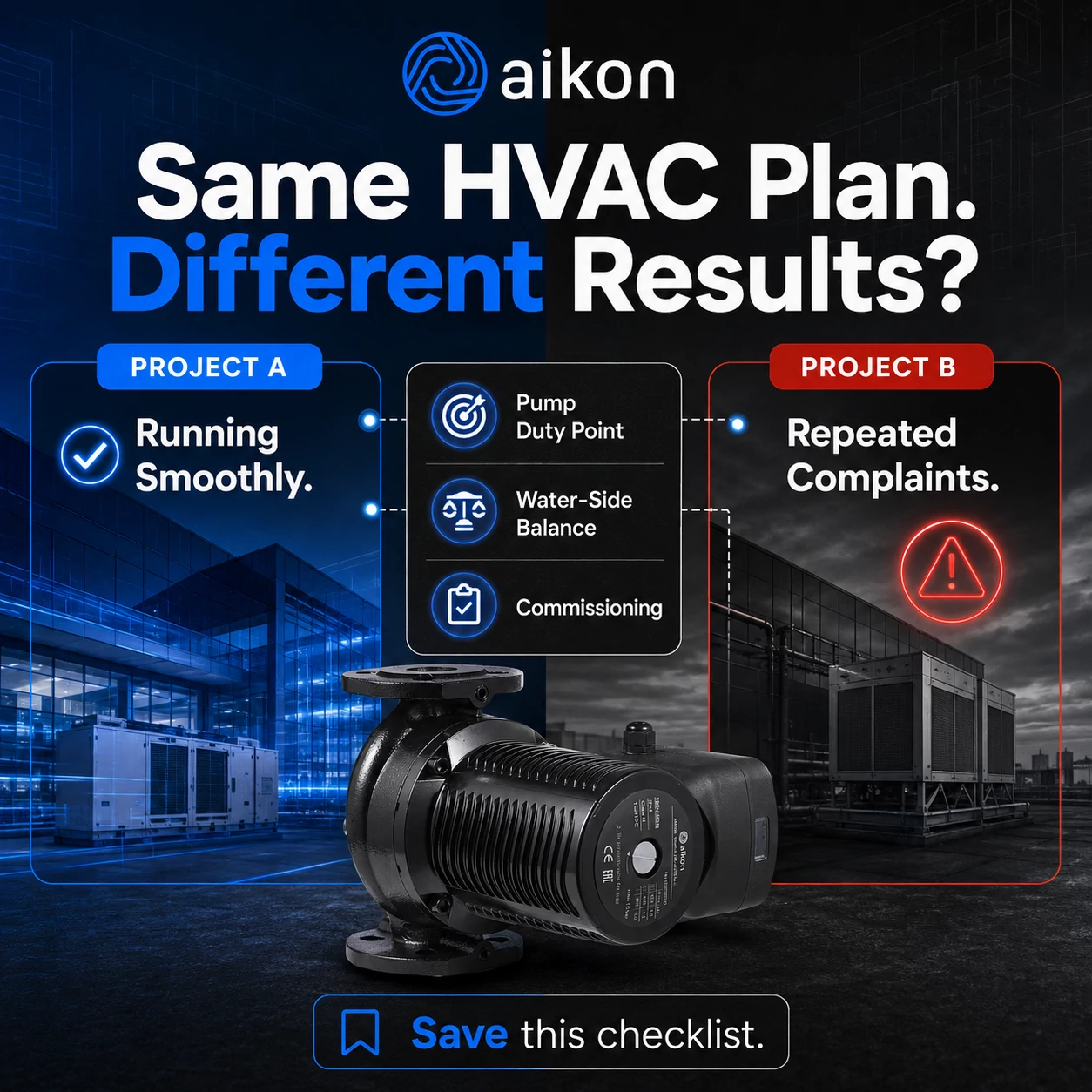
Learn why similar HVAC projects may deliver different results, and how pump selection, water-side balance, pipe resistance, installation, and commissioning affect project complaints.
Two HVAC projects may look almost the same on paper.
Same building type.
Similar equipment.
Similar heating or cooling demand.
Similar system design.
But after installation, the results can be very different.
One project runs smoothly.
The other gets complaints every week:
“This area is still too cold.”
“The system takes too long to respond.”
“The pump is noisy.”
“Why are we still adjusting the system?”
For contractors and HVAC companies, this is not just a technical issue.
It becomes a delivery issue, a service issue, and sometimes a reputation issue.
The problem is often not that the whole design is wrong.
More often, the system has not been matched, installed, balanced, or commissioned well enough for the real site conditions.
Quick Answer
Similar HVAC projects can deliver different results because the real site conditions are never exactly the same. Pump selection, pipe resistance, valve settings, water-side balance, filters, air removal, installation quality, and commissioning all affect final performance.
A good HVAC plan still needs correct circulation on site.
Why Some Projects Start Getting Complaints

In water-based HVAC systems, heating or cooling must be delivered through the water circuit.
If circulation is weak, unstable, noisy, or unbalanced, the main equipment may still run, but comfort problems continue.
Before blaming the chiller, boiler, heat pump, or control system, check the water side:

This is why two “similar” projects can behave differently.
The drawing may look the same.
The real system is not.
The Overlooked Variable: Circulation

Many project complaints are described as comfort problems.
But behind them, the real issue may be circulation.
If the pump is undersized, far-end zones may not receive enough flow.
If the pump is oversized, the system may become noisy and hard to balance.
If the system is not vented or cleaned properly, even the right pump may perform poorly.
A successful HVAC project is not only about selecting major equipment.
It is also about making sure the water circuit can deliver heating or cooling steadily to each zone.
That is why pump selection should not be based only on pipe size or habit.
It should be checked by:
flow, head, pipe length, system resistance, water temperature, operating time, and noise requirement.
Where AIKON CMS Fits

AIKON CMS canned motor pumps are used in HVAC, heating, hot water, floor heating, and commercial building circulation systems.
For project customers, the value is not just “a pump that runs.”
The value is helping reduce problems that often appear after installation:
weak circulation
pump noise complaints
leakage concerns
wrong model selection
unstable long-hour operation
AIKON helps buyers and contractors check the pump against real working conditions before ordering.
The goal is simple:
reduce project uncertainty before the complaint starts.
Before Your Next HVAC Project, Check These Details
You do not need a perfect technical file to start.
Send AIKON the basic project information:
Application: HVAC / heating / cooling / hot water
Required flow and head
Pipe length or system layout
Number of floors, branches, or zones
Water temperature
Voltage and frequency
Noise requirement
Current pump model or planned connection size
AIKON can help check whether the pump may be too small, too large, or not well matched to the duty point.
Suggested CTA:
DM us your flow and head—we’ll help check the duty point before installation.
FAQ
Why do similar HVAC projects have different results?
Because real site conditions differ. Pipe length, resistance, valve settings, balancing, air removal, pump selection, and commissioning all affect performance.
Is HVAC project failure always caused by the main unit?
No. The chiller, boiler, or heat pump may work normally, but poor circulation or balancing can still create comfort complaints.
How can contractors reduce HVAC project complaints?
Check the pump duty point, pipe resistance, water-side balance, valves, filters, air removal, and commissioning before handover.
A good HVAC plan still needs good circulation on site.
Before the next project becomes another complaint case, check the water side first.
Save this checklist for your next HVAC project handover.