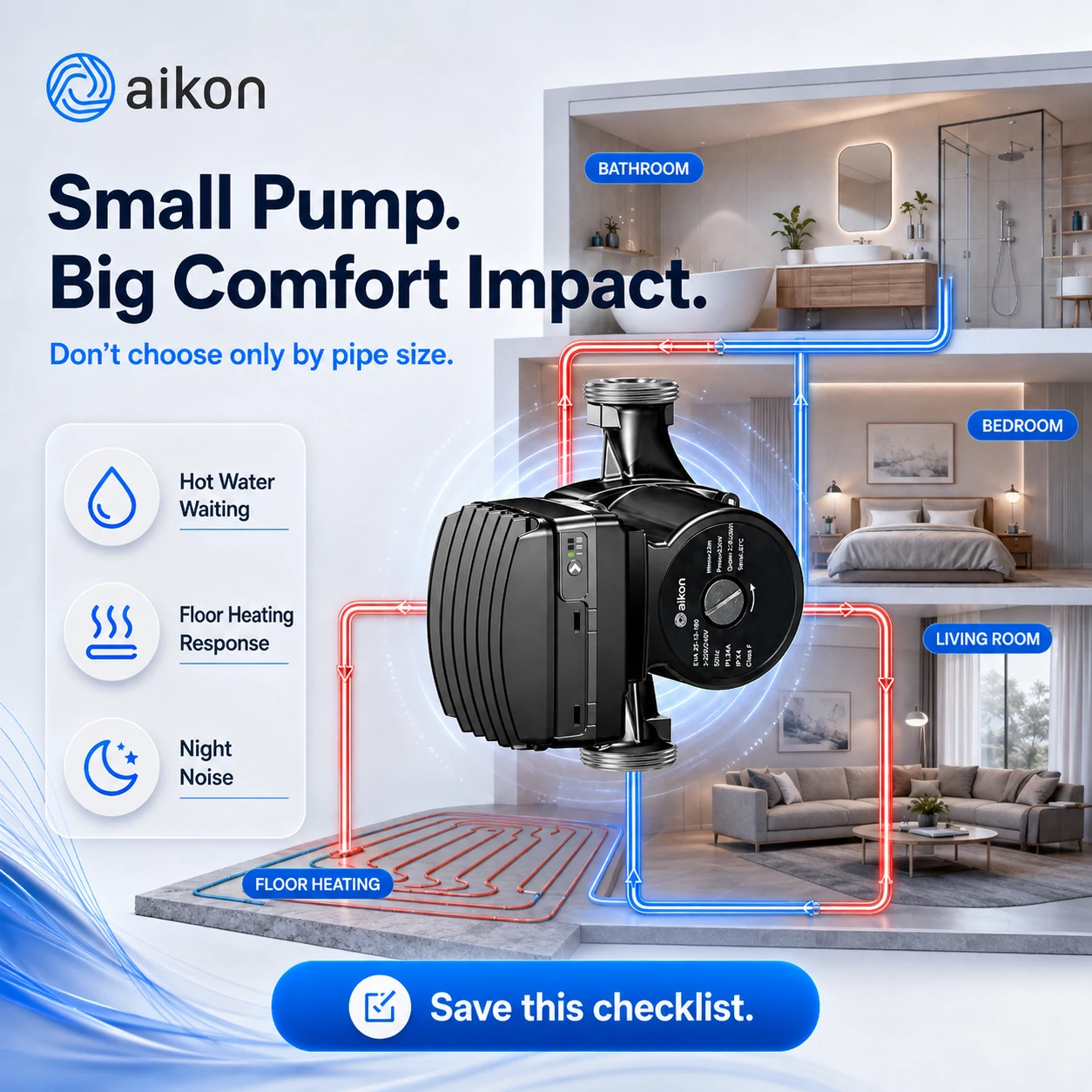
Learn how a small circulation pump can affect home comfort through hot water waiting time, floor heating response, room temperature balance, noise, and system stability.
A circulation pump is easy to ignore.
It is small.
It is usually hidden in a pump room, cabinet, or equipment corner.
Most homeowners never look at it.
But they notice the problems when circulation is poor.
The shower takes too long to get hot.
The floor heating warms up slowly.
Some rooms feel comfortable, while others stay cold.
A pump noise becomes obvious at night.
The customer does not complain about pump specifications.
They complain about comfort.
So, can one small pump decide the comfort of an entire home?
Not by itself. Home comfort also depends on the heat source, pipe design, insulation, controls, and installation quality.
But the circulation pump can strongly affect whether hot water and heat are delivered smoothly to the right place.
Quick Answer
A small circulation pump does not control the whole home by itself, but it can affect home comfort through flow, pressure, noise, hot water return, floor heating response, and long-term stability.
If the pump is too small, circulation may be weak.
If it is too large, the system may become noisy or inefficient.
The right pump should match the home’s real water circuit.
The Pump Is Small, But the Comfort Problems Are Not

In many homes, the heat source may be working normally.
The boiler can heat water.
The heat pump can produce hot water.
The floor heating system may be installed correctly.
But if circulation is not right, comfort still suffers.
Here are common examples:

This is why the pump should not be selected only by pipe size or price.
A pump that “can run” is not always the same as a pump that “fits the home.”
What to Check Before Choosing a Home Circulation Pump

Before selecting a pump for a villa, apartment, hotel room system, or home heating project, check the basic working conditions:
What is the application?
Hot water return, floor heating, radiator heating, or HVAC circulation?
How much flow is needed?
Too little flow means slow response. Too much flow may bring noise and energy waste.
How much head is needed?
The pump must overcome pipe length, fittings, valves, and loop resistance.
Where is the pump installed?
A pump near living spaces should be quiet. A compact cabinet also needs enough installation space.
How long will it run each day?
A pump used for long-hour circulation needs stable operation, not just first-day performance.
These checks are simple, but they prevent many comfort complaints later.
Where AIKON CMS Fits

AIKON CMS canned motor pumps are used in hot water circulation, floor heating, heating, HVAC, and home comfort systems.
For home and villa projects, AIKON focuses on practical comfort-related needs:
stable circulation
low-noise operation
compact installation
reduced leakage concern
flow and head matching
The goal is not to choose the biggest pump.
The goal is to choose a pump that fits the water circuit, runs quietly, and supports stable comfort after installation.
For installers, distributors, and project buyers, this matters because a comfort problem rarely stays technical.
It becomes a customer call:
“Why does hot water take so long?”
“Why is this room still cold?”
“Why can I hear the pump at night?”
Not Sure Which Pump Fits the Home?
Send AIKON the basic project details:
Application: hot water / floor heating / heating / HVAC
Required flow and head
Pipe length or loop layout
Number of floors or branches
Water temperature
Voltage and frequency
Noise requirement
Current pump model or connection size
AIKON can help check whether the pump may be too small, too large, too noisy, or not well matched to the system.
Suggested CTA:
DM us your flow and head—we’ll help check the duty point.
FAQ
Can a small pump affect home comfort?
Yes. It can affect hot water waiting time, floor heating response, room temperature balance, noise, and circulation stability.
Is a bigger pump always better for a home?
No. An oversized pump may create noise, energy waste, and unstable flow. The right pump should match flow, head, and pipe resistance.
What should I check before choosing a home circulation pump?
Check application, flow, head, pipe length, number of loops or branches, water temperature, voltage, and noise requirement.
Strong CTA
A small pump may not control the whole home.
But it can affect how comfort feels every day.
Before choosing a home circulation pump, check whether it truly fits the water circuit.
Save this checklist for your next home heating or hot water circulation project.