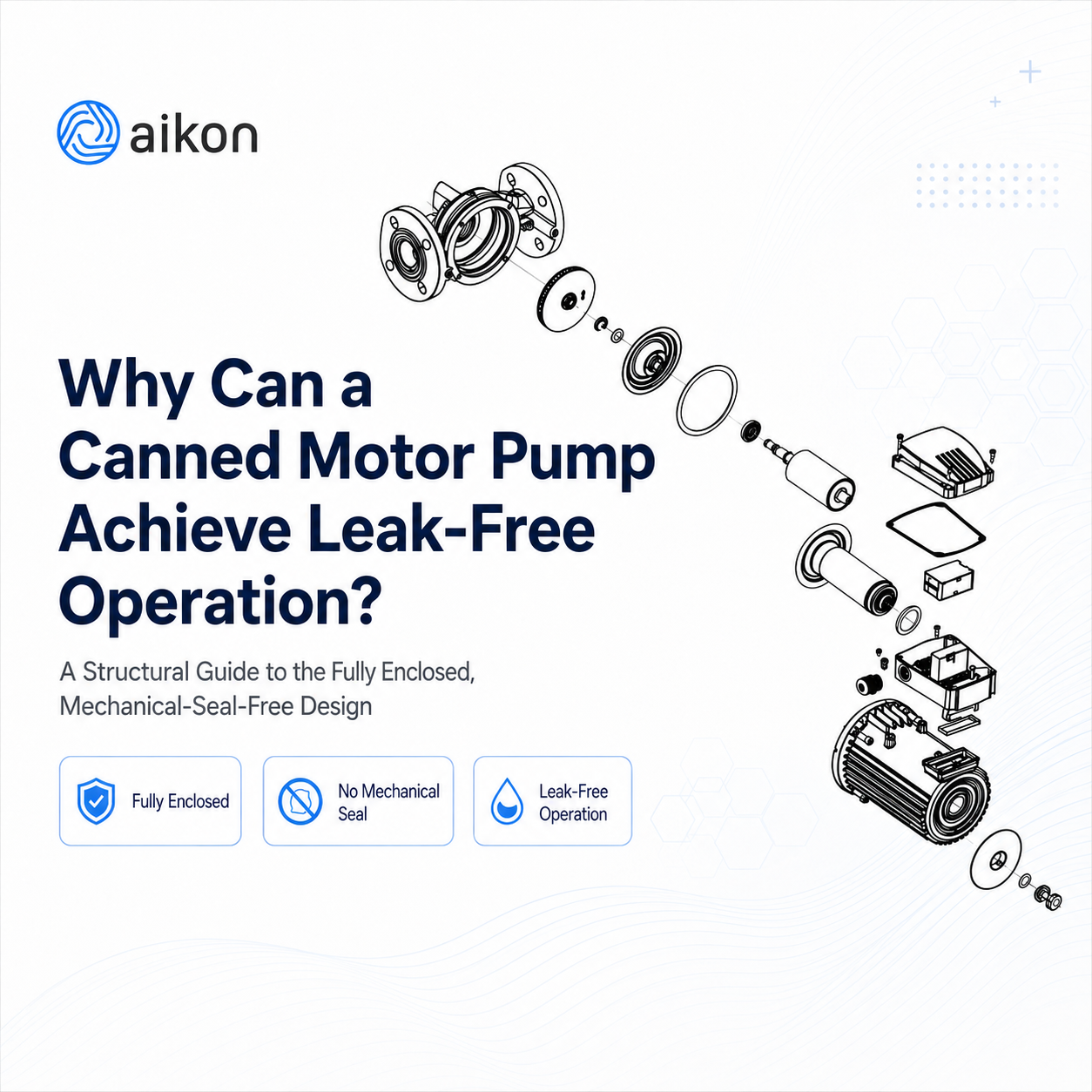
This article explains why canned motor pumps can achieve leak-free operation in HVAC systems. It covers the integrated pump-and-motor structure, the elimination of conventional mechanical seals and external shaft penetration, the role of the canned sleeve, and how the circulating medium lubricates and cools internal bearings. It also highlights the benefits for hydronic heating, underfloor heating, heat pump circulation, and other HVAC applications.
In HVAC systems, whether for villa underfloor heating, commercial central air-conditioning, or heat pump circulation, leakage has always been a persistent problem—and often an expensive one.
Water leakage can damage equipment in mechanical rooms, increase routine maintenance workload, and even lead to unplanned system shutdowns. In many conventional pump systems, the weak point behind these problems is the mechanical seal.
A canned motor pump solves this issue at the structural level. This is one of the main reasons why canned motor pumps are increasingly used in HVAC circulation applications where reliability and low maintenance are important.
The key lies in the design: a canned motor pump does not depend on a traditional mechanical seal between the pump and motor. Instead, it uses an integrated canned motor structure that eliminates the conventional shaft-seal leakage path.
The AIKON CMS canned motor pump is developed based on this principle for heating and HVAC circulation applications.
Why Do Conventional Mechanical Pumps Have Leakage Risk?
Traditional centrifugal pumps have an inherent structural requirement: the pump shaft must pass through the pump casing to connect with the external motor.
The shaft rotates while the pump casing contains pressurized liquid, so the shaft penetration point must be sealed. In most cases, this is achieved with a mechanical seal.
A mechanical seal typically consists of two precision-ground sealing faces that rotate against each other under pressure. Over long-term operation, these sealing surfaces can wear, friction can increase, and leakage may gradually develop—from slight seepage to dripping and eventually seal failure.
Mechanical seals are wear components. Their operating condition can be affected by:
· Operating temperature
· Water quality
· System pressure
· Alignment accuracy
· Long-term running conditions
As a result, mechanical seals may require periodic inspection or replacement, creating ongoing maintenance and after-sales costs for HVAC projects.Throughout the service life of a conventional pump, the mechanical seal remains a potential maintenance and leakage point.
For building owners and HVAC contractors, every seal failure may also bring additional consequences, including equipment exposure to water, system interruption, and emergency service costs.
How Does a Canned Motor Pump Eliminate the Traditional Leakage Path?
A canned motor pump follows a completely different design concept.
Instead of trying to seal a rotating shaft that passes through the pump casing, it removes the external shaft penetration structure altogether.
In the AIKON CMS Series, the motor is enclosed within the canned structure, eliminating the sealing point created by an externally penetrating shaft.
This is the fundamental reason behind its leak-free design.
Structural Comparison
Conventional Mechanical Pump:

Canned Motor Pump:

The key difference is simple:
A canned motor pump eliminates the traditional mechanical seal between the motor and the pumped medium.
What Does the Canned Sleeve Do?
The term “canned” comes from the idea of enclosing the motor section inside a sealed metallic barrier. The canned sleeve is one of the most important components inside a canned motor pump.
Its main function is to isolate the electrical stator section from the circulating medium while allowing the rotor to operate within the internal hydraulic environment. In the AIKON CMS-II Series, the canned sleeve adopts an integrated spinning and extrusion forming process. Compared with a welded structure, this design improves mechanical strength and pressure resistance.
For HVAC procurement professionals, the canned sleeve should not be viewed simply as a protective cover. It is a key structural barrier that keeps the electrical section separated from the circulating liquid.
How Are the Internal Bearings Lubricated?
Once the traditional mechanical seal is removed, the operating method of the internal rotating components also changes. A canned motor pump uses the circulating medium itself to lubricate and cool the internal bearings.
The pump cover includes lubrication passages that allow the medium to flow around the bearing surfaces and form a lubricating film.
This helps:
· Reduce dry friction
· Improve heat dissipation
· Control wear during operation
This structure also means:
· No external lubrication system is required
· No lubricating oil enters the circulating medium
· No grease filling point needs routine maintenance
For HVAC systems, this contributes to a simpler maintenance structure.
What Does Leak-Free Design Mean for HVAC Projects?
The value of a leak-free canned motor structure becomes especially clear in systems that operate for long periods or where maintenance access is limited.
Typical applications include:
· Hydronic heating systems
· Underfloor heating
· Air-conditioning water circulation
· Heat pump circulation
· Hot water circulation
· Residential HVAC systems
· Commercial HVAC systems
The AIKON CMS Series canned motor pumps are designed for these types of heating and HVAC circulation applications.
For HVAC contractors, removing the traditional mechanical seal means fewer seal-related maintenance tasks and a lower risk of leakage around the pump shaft.
For procurement teams, it also supports a lower-maintenance equipment strategy over the pump’s lifecycle.
Conclusion
A canned motor pump can achieve leak-free operation not because it uses a better mechanical seal, but because it eliminates the traditional mechanical seal altogether.
By integrating the pump and motor, removing the external shaft penetration, and using a canned sleeve to isolate the stator from the circulating medium, the canned motor pump removes one of the most common structural leakage points found in conventional mechanical pumps.
For HVAC systems that require reliable circulation, reduced maintenance, and lower leakage risk, this structural difference is one of the core advantages of canned motor pump technology.
Q1: Why are canned motor pumps considered leak-free?
A: They eliminate the traditional mechanical seal and external shaft penetration, removing a common leakage path.
Q2: What is the role of the canned sleeve?
A: It isolates the motor stator from the circulating medium while allowing the rotor to operate inside the pump.
Q3: Where are canned motor pumps commonly used in HVAC systems?
A: They are commonly used in hydronic heating, underfloor heating, heat pump circulation, hot water circulation, and commercial HVAC systems.