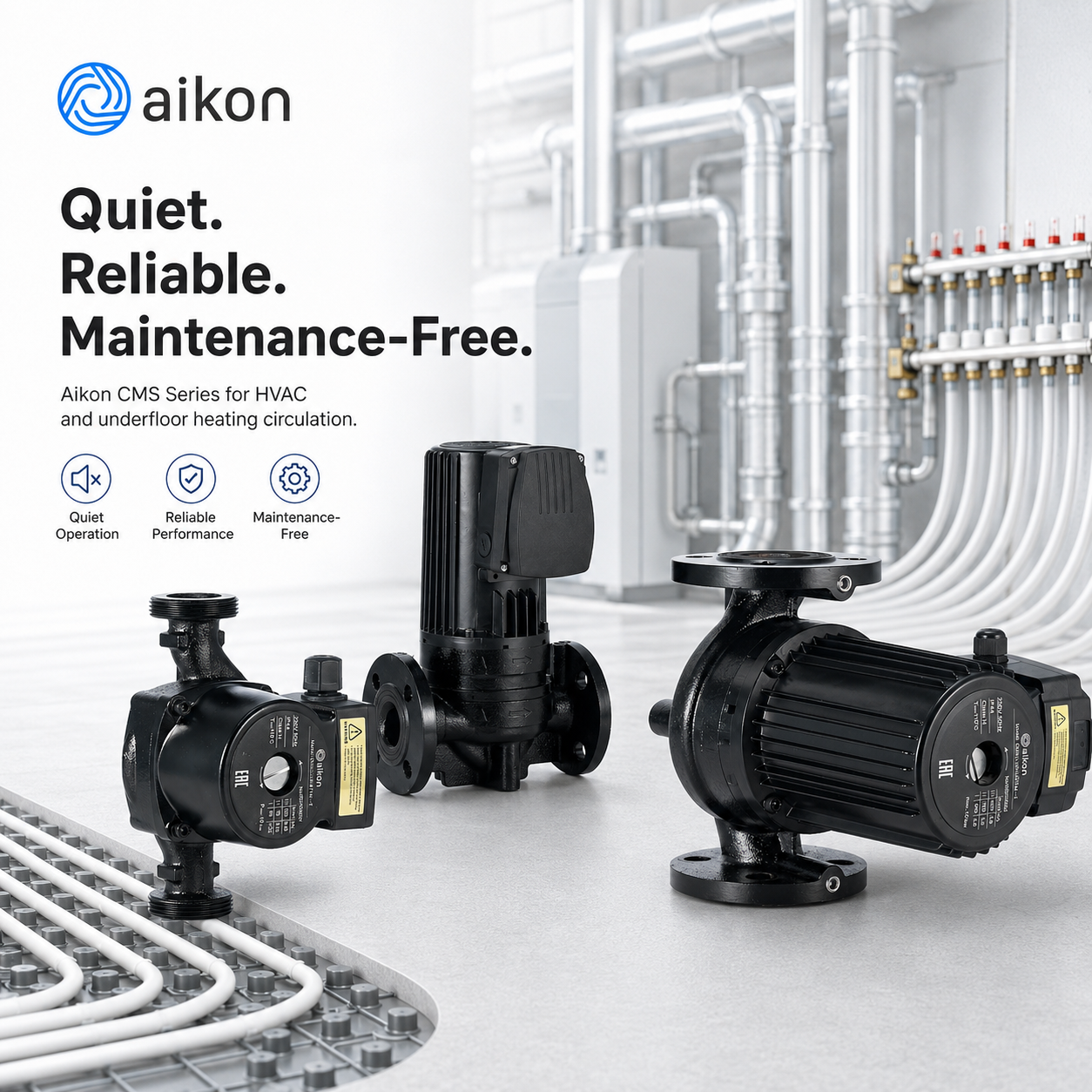
Learn why canned motor pumps are the ideal low-noise circulation solution for underfloor heating and HVAC systems. Explore how their enclosed design delivers quiet, reliable, and maintenance-free operation.
If you have ever stood next to a boiler room in a villa or commercial building and heard a constant humming, vibrating, or whining noise, chances are the circulator pump was the culprit. In underfloor heating systems — especially those running year-round in large buildings — pump noise is more than an annoyance. It is a sign of mechanical wear, a source of occupant complaints, and often a reason for costly call-backs.
For HVAC contractors and building owners, choosing the right pump makes the difference between a quiet, reliable system and a noisy, maintenance-prone one. Canned motor pumps are consistently quieter than standard centrifugal pumps — and the reason comes down to fundamental differences in how they are built.
Where Does Pump Noise Come From?
In a standard centrifugal circulator, noise comes from three main sources:
Cooling fan noise – Most conventional pumps use an external fan to cool the motor. The fan creates airflow noise that adds to the overall sound level.
Mechanical seal friction – Standard pumps have a rotating shaft seal that rubs against the pump housing. As the seal wears over time, friction increases — and so does noise.
Rolling bearing vibration – Ball bearings in conventional motors generate vibration and transmit noise through the pump casing and into the pipework.
These are not minor issues. In residential and commercial heating systems, even low-level noise can travel through the building structure and become a persistent source of discomfort. European standards such as EN 16644 specifically address noise testing for glandless circulators used in heating installations, reflecting how seriously the industry takes this issue.
Why Canned Motor Pumps Are Quieter — Three Design Differences
Canned motor pumps eliminate all three noise sources through structural design.
① No cooling fan
Canned motor pumps use a water-cooled motor. The pumped liquid circulates through the motor cavity, carrying heat away. With no external cooling fan, there is no fan noise whatsoever. This is one of the most significant differences — and the quietest pumps on the market are almost always fanless designs.
② No mechanical seal
Standard pumps rely on a mechanical seal where the motor shaft passes through the pump casing. This seal rubs against the shaft with every rotation. Over time, wear creates friction, vibration, and noise. Canned motor pumps have no dynamic shaft seal. The motor and pump are fully enclosed in a single sealed chamber. Only static seals remain — and static seals do not move, so they generate no friction noise.
③ Plain bearings instead of rolling bearings
Instead of ball bearings, canned motor pumps use plain bearings (typically graphite or silicon carbide) lubricated by the pumped liquid itself. These bearings operate with extremely low friction, run smoothly, and produce far less vibration than rolling-element bearings. Many canned motor pumps operate at noise levels below 45 dB(A) — quieter than a whispered conversation.
The Long-Term Noise Advantage
This is where canned motor pumps truly separate themselves from standard circulators.
A new standard pump may seem quiet at first. But after years of operation, the mechanical seal wears down, ball bearings develop play, and the cooling fan accumulates dust. Noise levels creep up. By year five or six, what was once a quiet pump can become a source of complaints.
A canned motor pump, by contrast, stays quiet over time. With no mechanical seal to wear, no fan to degrade, and plain bearings that are continuously lubricated by the circulating water, the pump's acoustic performance remains stable for years. Studies have shown that canned motor pumps have among the best MTBF (Mean Time Between Failures) values of any pump technology. They deliver low-noise, maintenance-free operation throughout their service life.
Independent measurements indicate that shielded motor pumps typically operate 10–15dB quieter than conventional centrifugal pumps. In a building with multiple circulators, that difference is substantial.
What This Means for Contractors and Building Owners
For villa and commercial underfloor heating projects, the noise advantage of canned motor pumps translates into tangible benefits:
Fewer occupant complaints – Quiet operation means tenants and homeowners are not disturbed by pump noise, especially in buildings where the plant room is near living spaces.
Lower maintenance costs – With no mechanical seal to replace and no bearings to repack, canned motor pumps are effectively maintenance-free.
Longer service life – The pump stays quiet and reliable for years, reducing the risk of call-backs for contractors.
Compliance with noise standards – For projects subject to acoustic requirements, canned motor pumps help meet specifications more easily.
Aikon Canned Motor Pumps for HVAC and Underfloor Heating Systems
Aikon CMS Series canned motor pumps are designed for heating, air conditioning, and water circulation applications.
Key features include:
· Fully enclosed structure
· No mechanical seal design
· Low noise operation
· Leak-free performance
· Maintenance-free operation
· Reliable long service life
They are suitable for:
· Villa underfloor heating systems
· Commercial heating projects
· Heat pump systems
· HVAC circulation systems
For HVAC contractors, distributors, and system integrators, choosing the right circulation pump can improve system reliability, reduce maintenance costs, and enhance customer satisfaction.
Aikon Canned Motor Pumps — providing quieter, more reliable circulation solutions for modern heating and HVAC systems.
FAQ 1 Why are canned motor pumps quieter than traditional circulation pumps?
Canned motor pumps eliminate external cooling fans, mechanical seals, and reduce vibration through an integrated enclosed design, resulting in quieter operation.
FAQ 2 Are canned motor pumps suitable for underfloor heating systems?
Yes. Canned motor pumps are ideal for villa and commercial underfloor heating, HVAC circulation, and heat pump systems due to their low noise and reliable performance.
FAQ 3 What are the advantages of using canned motor pumps in HVAC systems?
They provide low-noise operation, leak-free performance, maintenance-free design, and long-term reliability for modern heating and cooling applications.