Learn why hot water may still take time to arrive even with a circulation pump. This article explains pipe layout, pump flow, pump head, control method, return pipe design, and pipe insulation.
Why Does Hot Water Still Take So Long to Arrive?
Many users think that once a hot water circulation pump is installed, hot water should arrive immediately after opening the tap.
But in real hot water systems, this is not always true.
The pump may be running, but users may still wait several seconds or even longer for hot water. This does not always mean the pump is broken. In many cases, the delay comes from pipe layout, pump flow, control method, or poor pipe insulation.
For hotels, apartments, villas, hospitals, and commercial buildings, hot water waiting time affects user comfort. To solve the problem, buyers should look at the whole system, not only the pump.
Quick Answer
Hot water can still take a long time to arrive because the system may have long pipe runs, low circulation flow, poor return pipe design, incorrect pump selection, timer control delay, or heat loss from uninsulated pipes. A circulation pump helps, but it must match the system design.
A Pump Cannot Fix a Poor Pipe Layout
A hot water circulation pump keeps water moving through the hot water loop. But if the pipe design is not suitable, the pump cannot fully solve the waiting problem.
For example, if the distance from the heater to the faucet is long, there may still be cold water sitting in the branch pipe. When the user opens the tap, that cold water must come out first before hot water arrives.
This is why hot water return pipe design is important. A good system should reduce long dead legs and keep hot water closer to the points of use.
Pump Flow Also Matters
If the pump flow is too low, hot water may move too slowly through the return loop.
If the pump head is too low, the pump may not overcome the resistance of pipes, valves, elbows, or heat exchangers. In this case, the pump may be running, but the circulation may still be weak.
That is why pump selection should be based on flow rate and head, not only pipe size.
For hot water systems, buyers should confirm:
Pipe length
Required flow rate
Required head
Water temperature
Number of water points
Power supply and installation space
Correct selection helps the system deliver hot water more consistently.
Control Method Can Create Waiting Time
Some hot water circulation systems do not run continuously. They may use a timer, temperature control, or manual control.
These control methods can save energy, but they may also create waiting time.
For example, if the pump only runs during certain hours, users may still wait for hot water outside that time. If the temperature sensor is placed too far from the actual faucet, the system may not respond quickly enough.
So when users complain about slow hot water, installers should also check the control logic, not only the pump.
Pipe Insulation Is Often Ignored
Even with a good pump, hot water can lose heat during circulation.
If the pipes are not insulated well, water temperature drops quickly. The pump may keep water moving, but the water reaching the tap may not feel hot enough.
Good pipe insulation helps reduce heat loss and improves hot water comfort. This is especially important in large buildings, long pipe runs, cold climates, and systems that operate for long hours.
AIKON CMS Reference Model for Hot Water Circulation
For small residential hot water return systems, villas, apartments, or light commercial hot water circulation, AIKON CMS(L)25-6T1M-I can be used as a reference model when the system requires a compact DN25 threaded circulation pump.
This model can be considered when the system needs stable circulation, compact installation, low-noise operation, and reduced leakage risk. However, it should not be selected only by pipe size. The final model should be confirmed by pipe length, required flow, head, water temperature, voltage, and installation conditions.
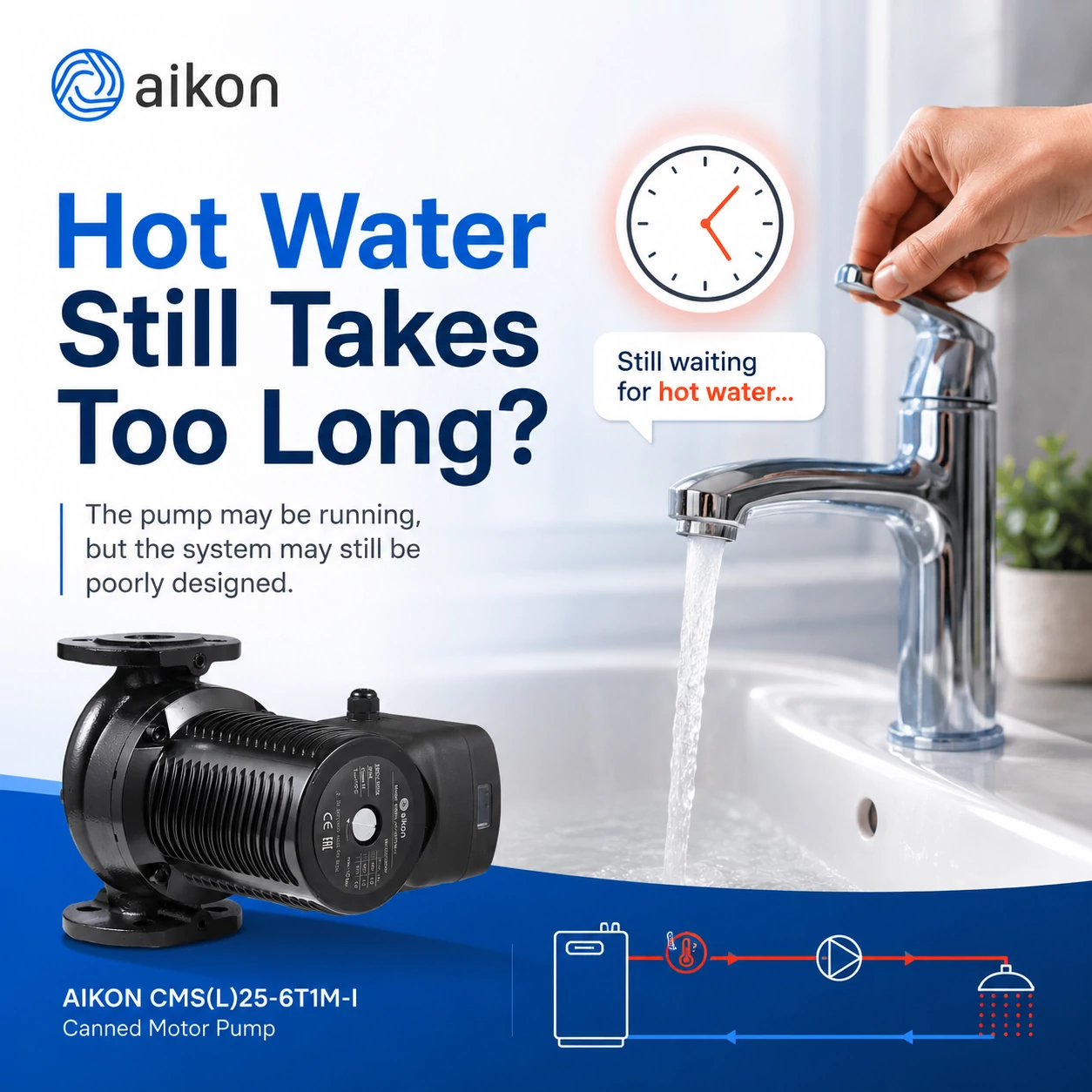
For larger buildings, longer pipe networks, or systems with higher resistance, buyers may need higher-head or larger-size CMS models, such as DN25-8, DN25-12, DN32, or larger options.
How AIKON CMS Pumps Support Hot Water Systems
AIKON CMS Canned Motor Pumps are designed for circulation systems where users need stable operation, low noise, compact structure, and reduced leakage risk.
For hot water circulation systems, these features matter because the pump may run for long hours and may be installed near living or working areas. A noisy pump, leaking pump, or wrongly selected pump can quickly affect user comfort.
AIKON can support distributors, installers, OEM customers, and project buyers with model selection, application matching, bulk supply, and OEM support. Customers can send project information such as flow rate, head, pipe length, liquid temperature, voltage, and installation space before ordering.
This helps reduce the risk of choosing a pump that runs, but still cannot deliver hot water quickly enough.
FAQ
Why does hot water still take long to arrive even with a pump?
Because the delay may come from long pipe runs, poor return pipe design, low pump flow, wrong pump selection, timer control, or poor pipe insulation.
Does a larger hot water circulation pump solve the problem?
Not always. A larger pump may create noise or energy waste. The pump should match the required flow and head of the system.
Which AIKON CMS pump can be considered for small hot water circulation?
For small residential or light commercial hot water circulation, AIKON CMS(L)25-6T1M-I can be used as a reference model. Final selection should still be based on actual system conditions.
Conclusion
If hot water still takes a long time to arrive, do not only ask whether the pump is running.
Check the full system: pipe layout, return loop design, pump flow, pump head, control method, and pipe insulation.
Visit the AIKON CMS Canned Motor Pump product page to explore hot water circulation pump solutions and send your flow, head, pipe length, and water temperature requirements for model selection support.
Product Page: